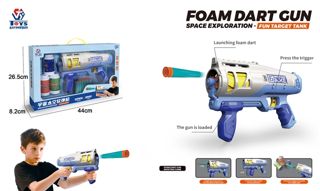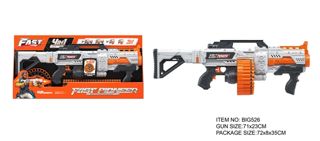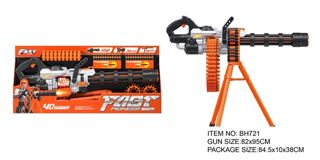

A sealed golden sample is the only physical proof that dart size, chamber fit, and feed consistency match your production specification. A buyer once approved a foam dart platform from a Canton Fair photo, and the second lot came back with darts that rattled in the chamber and jammed on the belt feed. The fix was not a better photo—it was a sealed golden sample on the QC shelf, compared against bulk for colour, fit, flash, and function. Generic style language never substitutes for dimensional compatibility testing. Approve the platform only after confirming dart size on the golden sample and the agreed production specification—not from a catalogue sentence or a Fair lighting shot. This article covers what to measure, what to test, and what to write into the PO so the second lot does not become a rework lot.
For importers and private-label buyers of foam dart blasters, the decision gate is not the price per unit or the hero unit on the booth table. It is whether the production darts seat, feed, and release consistently across the whole chamber, the belt, or the magazine.
Key Takeaways
- Seal a golden sample with approved material, colour, decoration, dimensions, and photos before production; it is the physical QC reference that ends disputes, but it does not replace required market testing (e.g., EN71 or ASTM F963).
- Measure dart length, shaft diameter, and tip geometry on the golden sample with a caliper, and compare bulk darts to that master—an email or a photo cannot confirm dimensional tolerance.
- Chamber fit must be tested across all dart positions, not just one: a Tactical 6-Dart Foam Blaster with a single tight slot will fail feed consistency in the field.
- Feed consistency is the highest-risk dimension for belt-feed and high-volume electric platforms; test a full belt or a full 48-dart magazine, not a single round.
- Write the dimensional spec, tooling ownership, and inspection plan into the PO; an AQL number or Incoterms version that is not on the paper does not exist.
What to Measure: Dart Dimensions on the Golden Sample
The first filter is dimensional. Standard elite-style dart platforms rely on a specific dart length, shaft diameter, and tip geometry. If the bulk darts are 0.5 mm longer or the shaft is 0.2 mm wider, the chamber will either bind or the dart will wobble on release. Neither shows in a catalogue photo.
Ask the factory to supply a golden sample with the actual production dart, not a display dart. Measure the dart's total length, the shaft diameter at three points, the tip's crush resistance, and the foam's density by feel and by gauge. Record these numbers on the golden-sample tag and in the PO. If the factory cannot provide a dart from the same batch as the sample, that is a red flag.
For refill matching, the same logic applies: a refill dart from a different supplier will have different dimensions. The golden sample is the reference for what your refill must match. If you plan to sell refills separately, specify the dart dimensions on the refill packaging and test the refill against the golden sample before approving it.
Chamber Fit and Feed Consistency: The Two Tests That Matter
Chamber fit is not a single-slot test. On a Tactical 6-Dart Foam Blaster, you must load all six positions and cycle the action repeatedly. A platform that feeds the first dart cleanly but jams on the fourth is a field failure, not a QC nuance. The same applies to a Belt-Feed Foam Dart Blaster: feed the entire belt, not a three-dart segment, and check for misfeeds, double-feeds, and tip deformation.
For electric platforms like the 48-Dart Electric Soft Bullet Blaster, feed consistency is the critical dimension. A full magazine test—48 darts, not 10—will reveal whether the spring tension, the follower, and the dart dimensions work together. Ask the factory to run this test in front of you or send a video of the full-magazine cycle. But a video is evidence, not a substitute for the golden sample; the physical piece is the standard.
Tip construction matters here. A soft EVA tip that deforms on the first feed will cause jams on the second. Check tip adhesion: pull on the tip of a production dart to see if it separates from the foam shaft. The golden sample should have the same tip construction as bulk, and the PO should specify the tip material and adhesion requirement.
Golden-Sample Retention: Your QC Shelf, Not the Factory's Hero Unit
The golden sample is only useful if you control it. At the Canton Fair, a booth sample is often a hero unit—labelled with a tool number and revision, but not necessarily the production standard. Fair lighting lies, and the revision card does not. Do not approve from a photo taken at the fair; approve from a sealed sample that you hold.
Retain the golden sample in your own QC area, sealed and labelled with the approval date, the tool number, the revision, and the measured dimensions. When the bulk arrives, compare against that physical piece: colour, fit, flash, and function. Buyers who approve only a photo pay for it on the second lot—this is the lesson from eleven years of Chenghai production floors.
If the factory asks for the golden sample back, that is a negotiation point. The sample is the production reference, and your retention of it is part of the QC agreement. Write the retention period and the release condition into the contract, the same way you would write tooling ownership and storage years.
Writing the Spec into the PO: What to Ask the Factory
A golden sample is the physical reference, but the PO is the legal one. The inspection plan, the AQL number, and the dimensional tolerance must be written on the PO, not inferred from a catalogue sentence. If a buyer wants an AQL number, they get it from the agreed inspection plan on the PO, not from a blog post or a handshake.
Ask the factory for the following in writing: the dart dimensions (length, shaft diameter, tip geometry), the chamber and feed test procedure, the golden-sample retention period, and the tooling ownership terms. If the factory cannot write these down, that is a risk signal. The same logic applies to Incoterms: FOB without a named place started a freight argument that lasted longer than production. Write the Incoterms version and the named place (e.g., Shantou or Shenzhen) as actually booked.
Certification is a separate gate. UKCA and a VOC file are different papers, and a buyer who tries to use one certificate for both will fail an audit. Map the market, the lot, and which file covers which test. For the US market, ASTM F963 and CPSIA are relevant; for the EU, EN71 and CE. Confirm the certificate covers the exact lot you are importing, not just the product line.
Picks at a Glance: Golden-Sample Verification Priorities
| Belt-Feed Foam Dart Blaster | Feed consistency across the full belt; MOQ 54; price 4.99 USD; EN71 |
|---|---|
| Tactical 6-Dart Foam Blaster | Chamber fit across all six positions; MOQ 216; price 2.28 USD; EN71 |
| Space-Theme Foam Dart Blaster | Dart-to-chamber dimension match; MOQ 72; price 3.35 USD; EN71, CE |
| 48-Dart Electric Soft Bullet Blaster | Full-magazine feed consistency; ABS/EVA; MOQ 50; price 9.65 USD; EN71 |
| 12-Dart Electric Soft Bullet Blaster | Magazine spring tension and tip adhesion; ABS/EVA; MOQ 50; price 7.28 USD; EN71 |
| Graffiti Mini Manual Soft Dart Blaster | Manual feed consistency; MOQ 432; price 1.61 USD; EN71, CE |
| Mechanical-Style Mini Foam Blaster with Targets | Dart-to-target compatibility; ABS; MOQ 96; price 2.05 USD; EN71 |
| Electronic Scoring Target and Foam Dart Blaster Set | Dart-to-target sensor compatibility; ABS/EVA; MOQ 72; price 4.20 USD; EN71, 10P, CE, ASTM F963, CPC, CPSIA |
| Pump-Action Foam Dart Shotgun Blaster | Pump action and chamber feed; ABS/EVA; MOQ 54; price 3.55 USD; EN71, 10P, CE, ASTM F963, CPC, CPSIA |
| Raging Shark Foam Dart Crossbow Blaster | Crossbow feed and tip construction; ABS/EVA; MOQ 63; price 4.65 USD; EN71, 10P, CE, ASTM F963, CPC, CPSIA |
How to Choose: The Verification Protocol for Importers
Choose a platform only after the golden sample passes four gates: dimensional measurement, chamber fit, feed consistency, and tip construction. If a factory cannot produce a golden sample with a measured dart and a full-cycle feed test, move to the next supplier.
For a supermarket or gift distributor, the Electronic Scoring Target and Foam Dart Blaster Set (3014) has the broadest certification set (EN71, 10P, CE, ASTM F963, CPC, CPSIA), which reduces the paperwork risk across US and EU markets. For a high-volume Amazon listing, the Graffiti Mini Manual Soft Dart Blaster (2990) has the lowest unit price at 1.61 USD but the highest MOQ at 432—confirm your cash flow before committing.
For a private-label buyer, the tooling ownership question is the gate. If you pay a tooling fee, the contract must freeze the storage years, the release conditions, and what happens if the tool sits idle. Tooling policy is a document, not a handshake. The golden sample is the physical proof that the tool produces the right dimensions; without the written tooling terms, the sample is just a piece of foam.
Where These Platforms Are Made: Production Geography and What It Means for Your RFQ
Foam dart platforms and their darts are typically injection-moulded ABS or ABS/EVA, and the production geography is concentrated in a few Chinese clusters. Injection-moulded plastic toys like these come largely from Chenghai (Shantou), which is also where the golden-sample discipline is most established. Wooden toys cluster in Yunhe, plush in Yangzhou, and general merchandise in Yiwu—but for foam dart blasters, Chenghai is the default starting point for an RFQ.
The geography matters for your RFQ in two ways. First, a Chenghai factory will expect the golden-sample protocol; if they resist sealing a sample, that is a deviation from regional norm. Second, shipping from Shantou or Shenzhen changes the Incoterms named place, so write the actual port into the PO. Ask the factory which port they book—Shantou or Shenzhen—and confirm the Incoterms version, not just the abbreviation.
Do not assume that a factory in a different cluster (e.g., a plush or wood cluster) can produce ABS/EVA dart platforms to the same tolerance. The injection-moulding tooling and the dart foam supply chain are specific to the Chenghai ecosystem. If you source from outside that cluster, increase the golden-sample verification frequency.
Use Case vs. Test Matrix: What to Ask and What to Test
The table below translates each use case into a specific material question and a test to request from the factory. This is the RFQ language that gets you a measurable answer, not a marketing sentence.
| High-volume electric feed (48-dart) | Material to ask: ABS for the shell, EVA for the dart tip; Test to request: full-magazine cycle (48 darts) three times, no misfeed |
|---|---|
| Belt-feed continuous play | Material to ask: belt material and link strength; Test to request: full-belt feed test, check for link separation and tip deformation |
| Multi-dart chamber (6-dart) | Material to ask: chamber wall thickness and dart shaft diameter; Test to request: load all six positions, cycle 20 times, check seating and release |
| Target scoring set | Material to ask: dart tip crush resistance and target sensor surface; Test to request: dart-to-target impact test, confirm scoring registers consistently |
| Outdoor / sunlight exposure | Material to ask: UV stabiliser in the colour masterbatch; Test to request: UV exposure sample check for fading and brittleness, confirm colour retention |
Outdoor Failure Modes: What the Golden Sample Does Not Show Until You Ask
A golden sample stored on a QC shelf does not face sunlight, chlorinated water, or a hard drop on concrete. Those are the failure modes that generate returns, and they need specific tests beyond the dimensional check.
Sunlight fading is a colour-masterbatch issue. Ask the factory whether the ABS colour contains a UV stabiliser, and request a UV-exposure sample to confirm colour retention. A sample that looks bright in a Chenghai warehouse may turn chalky after three months on a US retail shelf. Chlorine water (pool or beach play) attacks the surface finish and the dart foam; ask for a chlorine-exposure test if your market includes pool retail.
Drop and impact resistance is a wall-thickness and material-quality question. A thin ABS shell will crack on the first drop; a thick shell adds weight and cost. The golden sample is the reference for wall thickness, but the test is yours to request. Ask the factory for a drop-test video or a physical abuse test on the sample—do not rely on the catalogue's material listing.
FAQ
What exactly should I measure on the golden sample to confirm dart size?
Measure the dart's total length, the shaft diameter at three points, and the tip geometry with a caliper. Record these numbers on the sample tag and in the PO. The bulk darts must match these dimensions within the agreed tolerance; if they do not, reject the lot.
How do I test chamber fit on a multi-dart blaster before approving?
Load all dart positions—not just one—and cycle the action at least 20 times. Check for seating, release, and misfeeds on each position. A platform that feeds the first dart but jams on the fourth is a field failure and should be rejected.
What is the difference between a golden sample and a Canton Fair booth sample?
A booth sample is often a hero unit labelled with a tool number and revision, but it is not necessarily the production standard. Fair lighting lies. The golden sample is a sealed piece with approved material, colour, dimensions, and photos, retained by you as the QC reference. Approve only from the sealed sample, not from a Fair photo.
What should I write into the PO to protect against feed consistency problems?
Write the dimensional tolerance (dart length, shaft diameter), the full-cycle feed test procedure, the AQL number from the agreed inspection plan, and the golden-sample retention period. Also write the Incoterms version and named port (Shantou or Shenzhen). A number that is not on the PO does not exist.
How long should I retain the golden sample, and who owns the tooling?
Retain the golden sample for the full production and post-shipment claim period, sealed and labelled. Tooling ownership, storage years, and release conditions must be written into the contract; if you paid a tooling fee, the contract must freeze what happens if the tool sits idle. Tooling policy is a document, not a handshake.
Does a golden sample replace required market testing like EN71 or ASTM F963?
No. A sealed golden sample is a practical production-QC reference, but it does not replace required market testing. Map the market, the lot, and which certificate covers which test. For the EU, EN71 and CE; for the US, ASTM F963, CPSIA, and CPC. A certificate that does not match the lot is not paperwork.
Sources
Request a Quote
Ready to spec a foam dart platform with a golden-sample gate in your PO? Send us your target market, your MOQ range, and your dart-dimension requirements, and we will confirm the verification protocol before any production starts.