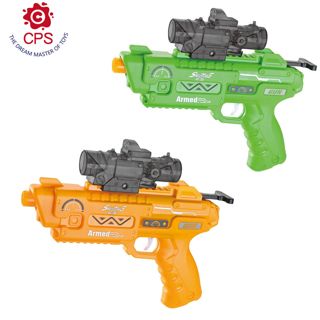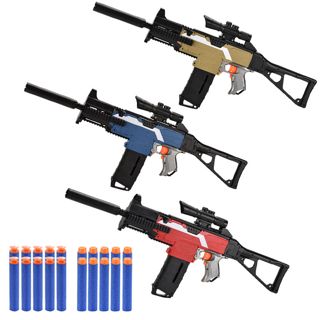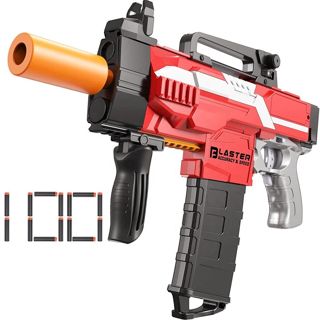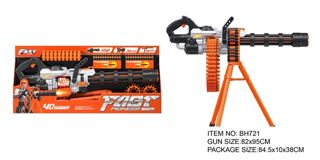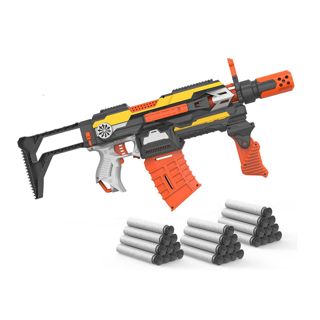

If you are sourcing a scoped automatic foam blaster wholesale, the scope is not automatically the reason to pay more. Buy the scope only when it changes how the blaster is used, how it is displayed, or what the listing can honestly claim. A moulded tube that never aligns, never holds zero, and never appears in your marketing is decoration you are paying for.
This page walks importers, Amazon sellers, supermarket buyers and private-label buyers through the checks that separate a functional scope from a cosmetic one: scope function, attachment tolerance, automatic cycle, feed tests, package wording, accessory protection and price-break logic. Every checkpoint maps back to a physical golden sample or catalog SKU — not a photo, not a trade-show hero unit.
Key Takeaways
- Pay a feature premium only when the scope's verified role supports the sales proposition. If removing the scope does not change the product's use, display or listing claim, the scope is decoration and should not carry a price break.
- Compare bulk against the sealed physical golden sample on colour, fit, flash and function. Photos and trade-show hero units are not production standards; the revision card and sealed sample are.
- Run a feed test and an automatic-cycle observation before approving the lot. Record what you see as an observation, not as an invented rate, FPS number or dart count.
- Match the test report to the actual SKU, model, material, colour, age grade and sample construction. A report that does not match the shipped identity is not usable evidence.
- Confirm manufacturer, date and lot content on the product or pack, and keep any children's-product certification matched to the SKU, not to the factory door.
What does the scope actually do on an automatic foam blaster?
A functional scope changes how the blaster is aimed or how the product is displayed; a decorative scope changes only the silhouette. On an automatic foam blaster, the scope's verified role is the first thing to test. Ask the supplier to demonstrate the scope on the actual production unit, not on a separate display piece.
If the scope is moulded into the shell and cannot be removed, its role is mostly visual. That is not automatically bad — a scoped silhouette may sell on a shelf — but it should not be priced as a performance accessory. If the scope is a separate part with an attachment interface, attachment tolerance becomes the critical check.
The buyer decision is straightforward: pay the premium only when the scope's verified role supports the sales proposition. If the scope is decorative and the sales proposition is price-led, the decoration is cost without value.
How tight does the scope attachment tolerance need to be?
Attachment tolerance is the fit between the scope and the mounting point, and it is the difference between a usable accessory and a loose part. A scope that wobbles, rotates or falls off in the box will generate returns and complaints regardless of how it looks in a listing photo.
A measurement system should be capable of resolving the tolerance being controlled; a ruler may not support a tight moulded-part tolerance. Ask the supplier what tolerance is specified and how it is checked on the line. If the answer is 'it fits', the tolerance is not controlled.
For private-label buyers, the attachment interface also affects packaging. A scope that ships pre-mounted needs a different pack cavity than a scope that ships in a separate bag. Confirm which configuration is quoted before comparing prices.
How do you test the automatic cycle and feed on a scoped blaster?
The automatic cycle and the feed path are the two functions that decide whether the blaster works at all. Test them on the golden sample and on bulk, not on a catalogue description. Watch the cycle run, then watch the feed engage, and note whether the scope interferes with either action.
Record feed-test results as observations: does the feed advance, does it jam, does the scope block access to the feed cover. Do not convert those observations into invented rates, FPS figures or dart counts beyond the catalog name. The catalog name is the limit of what you can state without verified test data.
A scope mounted over the feed cover can turn a functional accessory into a handling problem. If the buyer's channel is a supermarket or gift distributor where the package is handled before purchase, feed-cover clearance matters more than the scope's optical quality.
What package wording and tracking-label content must be on a scoped automatic SKU?
Package wording is not decoration. A lot or batch code on the package supports recall, complaint investigation and stock segregation when the product or material changes. If the scope is a separate part, the lot code must cover the assembled unit, not only the blaster body.
For US children's lots, manufacturer, date and lot content belong on the product or pack as required, and the children's-product certification must be matched to the SKU, not to the factory door. A barcode alone is not tracking-label content.
According to the US Consumer Product Safety Commission (CPSC), component-part test evidence can support a children's-product certification only when the component and the applicable CPSC conditions are correctly matched. If the scope is sourced from a different supplier than the blaster body, that component evidence has to be mapped deliberately.
How should the scope be protected in the pack and in transit?
Accessory protection is a functional question, not a decoration question. A scope that arrives scratched, cracked or detached creates a return even if the blaster body is perfect. Check the pack cavity, the scope's retention method and the transit test that was actually run.
For Amazon sellers, the pack must survive the inbound journey and the customer's first handling. For supermarket and gift distributors, the pack must survive shelf stocking and repeated handling. Ask whether the scope ships pre-mounted, bagged or in a moulded cavity, and whether the retention method has been tested in transit.
If the scope is decorative and the pack cost rises because of it, the decoration is carrying cost without adding usable or marketable value. That is the point to challenge the price break.
How does price-break logic apply to a scoped automatic SKU?
Price-break logic starts with the verified role of the accessory. If the scope is functional and the listing or shelf presence depends on it, a higher unit price can be justified. If the scope is decorative, the premium has to be justified by the silhouette alone — a weaker position in a price-led channel.
Compare the scoped SKU against the equivalent unscoped SKU in your own range. If the only difference is the scope and the scope's role is decorative, the buyer is paying for decoration. If the scope changes the product's use, display or listing claim, the premium has a basis.
Do not accept a catalogue sentence as the inspection plan. If a numeric inspection requirement is needed, it comes from the agreed inspection plan on the PO. That is where the sampling level and defect classes are defined, not in a marketing sheet.
Worked example (illustrative, not a real shipment)
A private-label buyer orders a scoped automatic foam blaster SKU in one lot of roughly 1,200 units, split across two destinations: a US Amazon fulfilment centre and a UK gift distributor. The US pack needs a tracking-label content block and a lot code; the UK pack needs its own market paperwork mapping. The scope ships pre-mounted in a moulded cavity for the US pack and bagged separately for the UK pack.
The lot is held at the golden-sample check because the bulk scope colour is two shades off the sealed sample, and the attachment tolerance allows visible rotation. The supplier argues the rotation is cosmetic. The buyer's position is that a rotating scope on a pre-mounted pack is a return driver, so the lot is isolated, the defect class is recorded, and the lot is released only after rework.
The price-break question is resolved by the same evidence: because the scope is functional in the listing and is pre-mounted for the US pack, the premium is accepted for that destination. For the UK pack, where the scope is bagged separately and the sales proposition is price-led, the premium is not accepted. The decision is recorded per SKU with the evidence used.
Scoped automatic SKU checkpoints and red flags
| Scope function | Verify the scope changes aiming, display or listing claim. Red flag: scope is moulded in and never referenced in the sales proposition. |
|---|---|
| Attachment tolerance | Confirm the specified tolerance and how it is checked on the line. Red flag: supplier says 'it fits' with no measurement method. |
| Automatic cycle | Observe the cycle on golden sample and bulk. Red flag: cycle is demonstrated only on a trade-show hero unit. |
| Feed test | Watch the feed advance and check scope clearance. Red flag: scope blocks the feed cover or jam access. |
| Package wording | Confirm manufacturer, date and lot content on product or pack. Red flag: barcode only, no tracking-label content. |
| Accessory protection | Check pack cavity, retention method and transit test. Red flag: scope ships loose in a bag with no retention. |
| Test report identity | Match report to SKU, model, material, colour, age grade and sample construction. Red flag: report references a different model or factory door. |
| Price-break logic | Tie premium to the verified accessory role. Red flag: premium justified only by catalogue wording. |
| Line clearance | Confirm last SKU's labels, colours and work instructions are cleared before the run. Red flag: mixed labels from a previous SKU reach the pack line. |
What to ask suppliers before you pay the scope premium
Can you show the sealed golden sample for this SKU, and will bulk be compared to it on colour, fit, flash and function?
What is the scope's verified role in this SKU's sales proposition, and what changes if the scope is removed?
What attachment tolerance is specified, and how is it checked on the line?
How is the automatic cycle and feed tested, and what do you record from that test?
What manufacturer, date and lot content appears on the product or pack, and how is the children's-product certification matched to the SKU?
Which file covers which market and lot for this item, and can you show the mapping?
What is your line-clearance procedure for labels, colours and work instructions between SKUs?
Which features on this SKU are decorative only, and what cost do they add?
How is the scope protected in pack and transit, and has the retention method been transit tested?
What is the agreed inspection plan on the PO if a numeric sampling requirement is needed?
FAQ
Is a scoped automatic foam blaster always more expensive than an unscoped one?
No — the premium only exists when the scope's verified role justifies it. If the scope is decorative and does not change aiming, display or the listing claim, the buyer is paying for decoration. Confirm the scope configuration and the pack before comparing prices.
What MOQ should I expect for a scoped automatic SKU?
MOQ varies by SKU and configuration, so confirm it per model rather than assuming one number for the category. In the supplied catalog, electric automatic blaster MOQs range from 8 to 500 units depending on the model. Ask for the MOQ of the exact scoped configuration, because a separate scope part can change the order quantity.
How do I check attachment tolerance without a lab?
Ask the supplier what tolerance is specified and how it is checked on the line, then verify it on the sealed golden sample and on bulk. A measurement system should be capable of resolving the tolerance being controlled; a ruler may not support a tight moulded-part tolerance. If the scope rotates or detaches during handling, the tolerance is not controlled.
Can I use one test report for the scoped SKU and the unscoped version?
Only if the report identity matches the actual SKU, model, material, colour, age grade and sample construction. A report that references a different model or the factory door is not usable evidence for the shipped unit. According to the CPSC, component-part test evidence can support a children's-product certification only when the component and the applicable CPSC conditions are correctly matched.
What package wording should be on a scoped automatic SKU for the US market?
Manufacturer, date and lot content belong on the product or pack as required, and the lot or batch code supports recall, complaint investigation and stock segregation. A barcode alone is not tracking-label content. Confirm the certification is matched to the SKU, not to the factory door.
How do I decide whether the scope premium is worth paying?
Compare the scoped SKU against the equivalent unscoped SKU in your own range and ask what changes if the scope is removed. If the scope changes how the blaster is aimed, displayed or described in the listing, the premium has a basis. If the only change is the silhouette, treat the scope as decoration and do not pay the premium.
Sources
Request a golden-sample check before you approve the scope premium
If you are sourcing a scoped automatic foam blaster and want the scope, feed cycle and pack checked against a sealed physical sample before the PO is confirmed, send the SKU and target market. The scope's role, the attachment tolerance and the pack configuration can then be mapped so the price-break decision rests on evidence, not on a catalogue sentence.