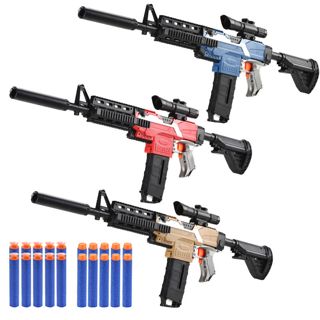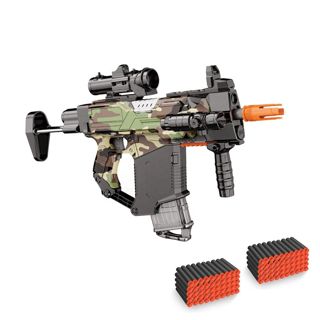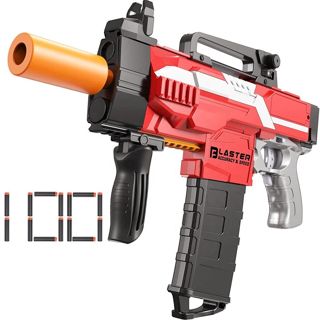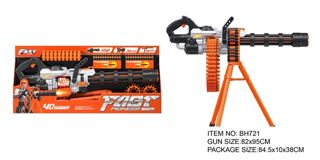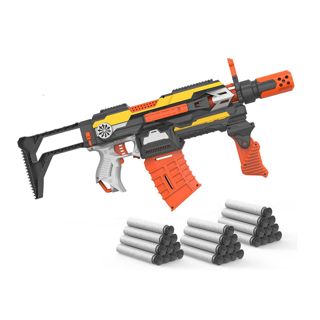

If your listing copy implies the scope helps a buyer aim, you have just sold a functional aiming aid — whether or not the part is one. Classify every scope SKU by verified function before you approve artwork or write a bullet point, because the wording you publish, not the moulding, is what a returns desk and a marketplace complaint will be judged against.
This page compares the two ways a scope can be specified on a foam-dart blaster — decorative ornament versus functional aiming aid — and gives the decision path: scenario, material, reason, then the three questions to put to the factory before a PO. It is written for importers, Amazon sellers, supermarket buyers, gift distributors and private-label buyers who have to sign off on both the sample and the sentence.
Key Takeaways
- A scope is functional only if the supplier can describe what the user looks through and align it to; if that description is vague, spec it as decorative and write the listing accordingly.
- Attachment fit is a separate approval from appearance: a moulded-in scope, a screw-fixed scope and a clip-on scope carry different handling and returns risk, and none of them can be cleared from a photo.
- Approve bulk against a sealed golden sample compared for colour, fit, flash and function — photo-only approval is the classic second-lot cost.
- Never publish FPS, range or dart-count figures that are not in the supplier's measured data; a number without a stated test method is marketing, not a specification.
- The scope description belongs on a document that travels with the lot — the PO inspection plan or the golden-sample card — not in a catalogue sentence or a trade-fair photo.
Decorative Scope vs Functional Aiming Aid at a Glance
| Rank | 1 — Decorative scope (ornament spec) |
|---|---|
| Company | Applies to any blaster SKU whose scope is a styling feature; e.g. the Electric Automatic Soft-Shot Gun with Scope (ABS/EVA, MOQ 40) unless the sample proves otherwise |
| HQ/Origin | Chenghai, China (blaster supply base) |
| Specialty | Visual styling and shelf appeal; no sighting function claimed |
| MOQ/OEM | MOQ 40 on the scope-named SKU; varies by spec for others |
| Notable products | Scope-named electric blaster; light-up and space-theme blasters where add-ons are cosmetic |
| Rank | 2 — Functional aiming aid (performance spec) |
| Company | Same SKU family, but only where the supplier states a sighting function and supports it with a sample check |
| HQ/Origin | Chenghai, China (blaster supply base) |
| Specialty | Alignment to the dart path; requires a defined check and a claim the supplier will sign |
| MOQ/OEM | MOQ 10–500 across the blaster range; ask TDS for the specific model |
| Notable products | Motorized rifle and SMG platforms where a mounted optic is plausible; ask TDS per model |
| Rank | 3 — Hybrid: decorative body, functional interface |
| Company | Scope shell is cosmetic but mounts on a rail or screw boss intended for accessories |
| HQ/Origin | Chenghai, China (blaster supply base) |
| Specialty | Upgrade path for gift and hobby-adjacent channels without an accuracy claim |
| MOQ/OEM | Ask TDS; attachment method not stated in the catalogue record |
| Notable products | Ask TDS — no supplied record confirms a rail interface on any listed SKU |
Why the Function/Ornament Split Is a Commercial Decision, Not a Legal Footnote
The functional-versus-decorative distinction is usually discussed as an intellectual-property question, and that is where most of the searchable material sits. According to IP Nimble's explainer on functional and decorative elements, a feature dictated by utility is treated differently from one that exists for ornamentation. You do not need the legal layer to make the buying call, but the same test is useful commercially: what does the part do, and would a buyer notice if it did nothing?
A decorative element is there for visual appeal and aesthetic distinction. A functional add-on is there to improve usability or performance. Market commentary on accessories draws that line plainly — productdif.com groups adjustable straps and water-resistant coatings as functional, and charms, stickers and colour skins as aesthetic. Apply that lens to a scope and the question becomes answerable: if the part has no sighting function, it is ornament, and your copy should say so.
The reason this matters more in blasters than in most toy categories is expectation. A parent who reads "scope" on a box and finds a hollow cosmetic tube does not file a legal complaint; they file a return and a one-star review. Precise accessory language protects buyer trust better than visually implied performance — and it protects your account metrics too.
Which Material Should Carry the Scope, and Why ABS and EVA Behave Differently
ABS gives you a rigid, dimensionally stable shell, which is what a scope body and any screw boss or rail interface needs. EVA is soft, light and impact-absorbing, which is why it appears on shells and on foam-dart bodies rather than on add-ons that have to hold a fixed position. The catalogue records for these blasters show ABS, EVA and ABS/EVA combinations, and the scope-named SKU is listed as ABS/EVA — a mixed build, so the scope body and the shell it sits on may not be the same polymer.
That mix is exactly where attachment fit goes wrong. A rigid ABS scope screwed into an EVA section can loosen as the softer material flexes; a moulded-in feature on a single ABS shell has no such joint. Before you choose, ask which material the scope itself is moulded in, and whether the mounting point is reinforced in the tool. Ask TDS for the material grade and for any hardness or impact data — none is supplied here, so treat it as unknown until the sheet arrives.
There is also a tooling detail worth knowing: ejector marks are normal in injection moulding, but their position and depth should be controlled so they do not interfere with fit, function or child contact. On a small scope body, an ejector mark in the wrong place can be the difference between a clean mount and a visible defect on the shelf.
How Do You Verify the Scope on a Sealed Sample Before Committing to a Lot?
Inspect the scope as its own line item, not as part of the blaster's overall look. Check whether it has lenses, an aperture or any internal alignment feature, or whether it is a single hollow moulding. Check whether it adjusts, and whether adjustment changes anything a user could actually look through. Photograph it front, rear and side, and keep those images with the sealed sample so the next lot has something physical to be compared against.
If the supplier says the scope is functional, ask for the specific check that confirms alignment. No standard test for a toy scope appears in the material available here, so you define it: clamp the blaster, look through the scope, and record whether the line of sight corresponds to the actual dart path at a distance you choose. Write the distance and the result on the sample card. A supplier who will not run that check has given you an evidence gap, not a pass.
Then apply the same rigour to the blaster itself. Functional inspection should exercise the actual play function, not merely verify that the toy turns on or looks complete. For an electric model, the battery compartment and warning come before any performance conversation — button-cell toys are a compartment and warning problem, and screw closure, tool access and the warning are checked first. Packaging drop testing should follow the orientations and edges most likely to be damaged in the real pack configuration, because a scope that survives a flat drop may not survive a corner impact.
Sample to Mass Production: What to Put in Writing Before the PO
The argument that ends a colour dispute is a sealed golden sample on the QC shelf, compared against bulk for colour, fit, flash and function. Emails do not settle it. Buyers who approve only a photo pay for it on the second lot, and a scope is a fit-and-function part, so it belongs in that physical comparison rather than in a WhatsApp thread.
Trade-fair samples deserve particular suspicion here. A booth unit is often a hero sample with a hand-finished scope; the factory labels tool number and revision on the table for exactly that reason, and a fair photo should never become the production standard. Ask which tool number and which revision your order will run, and get that on the sample card.
Paperwork has to match the lot as well. A certificate that covers one market and one test is not interchangeable with another — UKCA and a VOC file are different papers, and mapping market, lot and which file covers which test is part of the job. If you are selling into the EU, note that electrical properties are addressed separately for toys with electrical functions; mechanical EN 71 evidence alone is not a complete electrical assessment. That is one box to tick, not a paragraph to repeat in every section.
Finally, do not accept an AQL number from a catalogue sentence or a blog. Inspection limits come from the agreed inspection plan on the PO. If you want a number, negotiate it into the plan and hold the lot to it.
How We Ranked These Options
Three positions, ranked by how much verified function the specification actually carries. First: decorative scope — the safest spec, because it claims nothing beyond appearance and cannot be contradicted by a sample. Second: functional aiming aid — it demands evidence the catalogue does not currently supply, so a supplier who provides the alignment check moves this to the top for any channel that markets accuracy. Third: hybrid — a cosmetic shell on a real mounting interface, useful for gift and hobby-adjacent ranges but unverifiable from the supplied records.
The criteria were verified function, attachment fit, sight-alignment expectation, package imagery, listing wording and sample evidence. Where a cell could not be filled from the supplied records — mount type, alignment tolerance, material hardness, certification status — it is marked ask TDS or varies by spec rather than guessed.
FAQ
Is the scope on a blaster like the Electric Automatic Soft-Shot Gun with Scope functional or decorative?
Unknown from the catalogue record alone — the name confirms a scope is present, not what it does. Treat it as decorative until the supplier states a sighting function in writing and supports it with a sample check. The SKU is listed as ABS/EVA with MOQ 40.
What MOQ should I expect if I want a scope-named blaster with custom packaging?
The scope-named electric blaster sits at MOQ 40 in the catalogue, while other blasters in the range run from 10 to 500 depending on model. Custom packaging and private-label artwork usually move the number, so confirm the MOQ for your exact configuration rather than the base SKU.
How do I check attachment fit without a lab?
Clamp the blaster, mount the scope as shipped, and handle it the way a child would — knock it, invert it, drop the packaged unit on the corners. Record whether the scope shifts and whether the mounting point deforms. Ask TDS for the mount type and whether the boss is reinforced before you run this.
Can I advertise accuracy if the scope is decorative?
No. If the part has no sighting function, accuracy copy is unsupported and you own the returns. Describe it as a styling feature, keep package imagery consistent with that, and reserve any performance language for a scope that has passed your alignment check.
Which certificate do I need for an electric blaster with a scope sold in the EU?
Electrical properties are addressed separately for toys with electrical functions, so mechanical EN 71 evidence alone is not a complete electrical assessment. Confirm with the supplier which file covers which test for your market and lot — paperwork that does not match the lot is not paperwork.
Do I need a sealed golden sample for a scope, or is a photo enough?
A sealed golden sample is the standard; photo-only approval is how buyers get caught on the second lot. Compare bulk against that physical piece for colour, fit, flash and function, and record the scope revision on the sample card.
Sources
- Differentiating Functional and Decorative Elements in Intellectual Property Law
- Effective Trade Dress Protection Strategies for Brand Identity Preservation
- Exploring the Different Types of Trade Dress Protection in Intellectual Property Law
- Functional Add-Ons vs Aesthetic Add-Ons in Accessories Key Differences and Benefits
Request a Quote
If you are specifying a scope SKU and want the sample, the material sheet and the packaging data in one place before you write the listing, send the model and the destination market. You will get the catalogue record, the MOQ for your configuration, and a straight answer on whether the scope is ornament or aiming aid — or a clear statement that it is unverified.