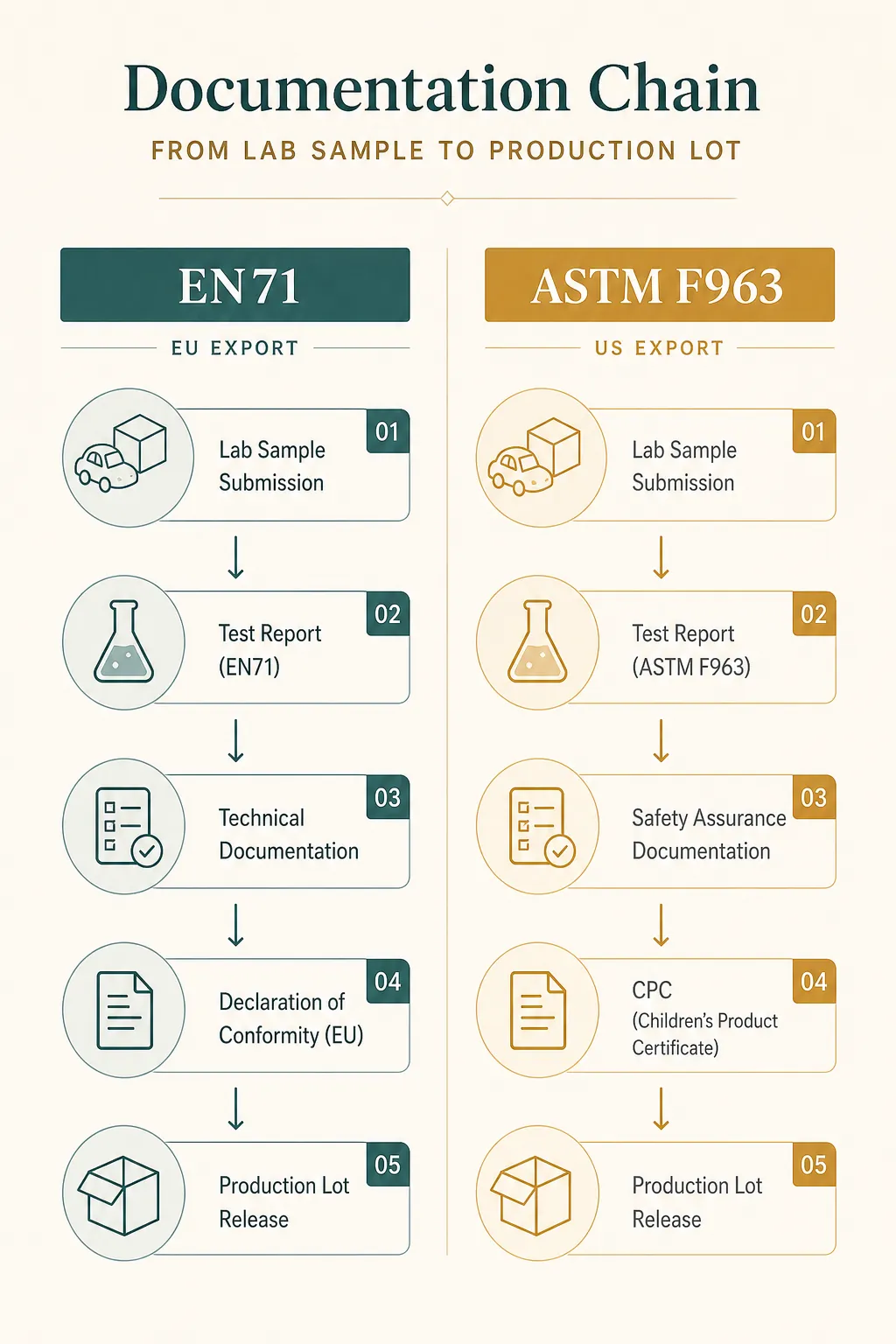
Accept compliance evidence only when the tested configuration can be traced to the goods shipped. That means matching the SKU, model, material, color, age grade, and sample construction on the test report to the golden sample and then to the actual production lot you are buying. A sealed golden sample with approved material, color, decoration, dimensions, and photos is a practical production-QC reference, but it does not replace required market testing. This article explains the documentation chain—from lab sample to production lot—and gives you a verification checklist that works for EU and US toy compliance.
Why the documentation chain matters for your shipment
A test report is useful only when the report identity matches the actual SKU, model, material, color, age grade, and sample construction. A report that describes a different configuration than the one you are importing is not evidence for your goods. The chain exists to connect three things: the golden sample that locks the approved design, the test report that proves compliance of that design, and the production lot that actually goes into your container. Break any link and the compliance claim weakens.
Regulators reinforce this. In the EU, the Toy Safety Directive 2009/48/EC requires toys to meet essential safety requirements, and the CE marking and EU Declaration of Conformity must be matched to the product scope and current version. In the US, CPSC guidance states that children's toys generally require testing at a CPSC-accepted laboratory and a Children's Product Certificate (CPC). Both frameworks are product-specific: a CPC or Declaration of Conformity is not a blanket factory certificate—it covers a defined product configuration, and it must be matched to the actual goods.
Key Takeaways
- A golden sample is a QC reference, not a compliance certificate; it never replaces required market testing.
- A test report only covers the goods if its SKU, model, material, color, age grade, and sample construction match the production lot.
- A type-test or golden-sample report does not automatically cover a later production lot; match report SKU, materials, colors, and production date/cohort to the PO.
- Any change—resin grade, surface finish, lighting condition, or decoration—breaks the documentation chain and requires updated evidence.
- Verify that the CPC or Declaration of Conformity lists the correct product identification and applicable standard edition, and that lot coding on the product matches the certificate.
How to build the documentation chain from lab sample to production lot
Start with the golden sample. The approved golden sample must include the material, color, decoration, dimensions, and photos. It is the benchmark against which production is checked. But it is not a test report. The golden sample tells you what the product should look like, not whether it passes safety tests.
The test report must identify the product configuration, age grade, and standard edition. For the US, the applicable edition of ASTM F963 should be read from the current regulation (16 CFR Part 1250) before quoting a report. The report should also list the CPSC-accepted laboratory and the date of testing. For the EU, the report should reference the Toy Safety Directive and the relevant harmonized standards.
The production lot should carry a unique identifier, such as a lot code or batch number, that links to the production date and cohort. The lot coding on the product and packaging should match the date and place of manufacture listed on the CPC or Declaration of Conformity. This is where the chain becomes concrete: the report covers the tested configuration, the lot code ties the shipped goods to that configuration, and the PO confirms you are buying that lot.
What identity checks should you perform at each step?
Check the report identity against the golden sample. The report describes a specific SKU, model, material, color, age grade, and construction. If the report says 'blue' but the golden sample is 'red', the chain is broken. If the report lists a different material grade than the golden sample, you need a new report.
Check the production lot against the report. Look at the lot coding, production date, and cohort. If the lot was produced after the report was issued, the report may not cover it. A type-test or golden-sample report does not automatically cover a later production lot. Match the report's SKU, materials, colors, and production date/cohort to the PO.
Check the physical goods. During inspection, compare the actual product to the golden sample. Pay attention to color matching: use the same resin grade, surface finish, lighting condition, and approved master sample because appearance changes with all four variables. If the production lot uses a different resin grade or a different decoration, the documentation chain breaks.
What about the bill of materials, photos, and approved changes?
The bill of materials (BOM) is the backbone of identity. It lists every material and component, including resin grades, additives, and surface finishes. The BOM must match the report and the golden sample. A change in the BOM—even a seemingly minor one like switching to a cheaper resin grade—can change the test results and invalidate the report.
Photos are part of the identity evidence. The golden sample photos, the report photos, and the inspection photos should all show the same configuration. This is especially important for color and decoration, which are hard to describe in text.
Approved changes must be documented. If the buyer or supplier changes any aspect of the product—material, color, decoration, dimensions, or construction—the change must be approved in writing and the test report must be reviewed. A change that affects safety (e.g., a different plastic grade) requires new testing. A change that only affects appearance (e.g., a new logo) may still require a report amendment if the report references the old configuration.
How to verify lot coding and inspection checks
Lot coding is the physical link between the documentation and the goods. The CPC and the tracking label should include the batch or run number. CPSC guidance says tracking information should be permanent and support product identification where applicable. Check that the lot code on the product matches the lot code on the packaging and the PO.
Inspection checks should verify that the production lot matches the golden sample and the report. Use the golden sample as the reference for material, color, decoration, dimensions, and photos. If the inspection finds a deviation, the documentation chain is broken until the deviation is resolved and re-tested if necessary.
Retained samples are a best practice. Keep a sealed sample from each production lot, along with the corresponding test report and lot code. This gives you a physical reference if a dispute arises. It also helps you demonstrate due diligence if a regulator asks for evidence.
What documentation should you request from your supplier?
Ask for the test report, the CPC or Declaration of Conformity, the golden sample, and the lot coding records. The CPC must include the seven elements required by CPSC: product identification, safety rule citations, certifier's identity, record-keeper contact, date and place of manufacture, date and place of testing, and identification of the third-party lab. The report should list the same product identification and the applicable standard edition.
For the EU, request the Declaration of Conformity and the test report. The Declaration should reference the Toy Safety Directive and the harmonized standards. For the US, request the CPC and the test report. The CPC must be in English and must list the correct ASTM F963 sections and any applicable CPSC regulations.
Request the golden sample or a photo of it, and the BOM. These documents help you verify that the tested configuration matches the shipped goods. If the supplier cannot provide the golden sample or the BOM, that is a red flag.
How to spot a broken documentation chain
A broken chain is often visible in the details. The report says 'large' but the PO says 'small'. The CPC lists a different manufacturer than the one on the packaging. The lot code on the product does not match the lot code on the PO. The report was issued in 2023 but the production date is 2026. These mismatches mean the evidence does not cover your goods.
Another red flag is a report that does not list the standard edition. For ASTM F963, the applicable edition must be read from the current regulation before quoting a report. If the report does not identify the edition, you cannot know if it applies. A report that lists a different age grade than the product's intended age group is not useful.
A golden sample that does not match the production lot is a broken chain. If the sample is 'red' but the lot is 'blue', the report covers the red sample, not the blue lot. The same applies to material: if the sample is ABS but the lot is EVA, the report does not cover the lot.
Documentation chain at a glance
| Golden sample | Sealed sample with approved material, color, decoration, dimensions, and photos. QC reference, not a compliance certificate. |
|---|---|
| Test report | Must identify SKU, model, material, color, age grade, and sample construction. Must reference the applicable standard edition. |
| CPC | Product-specific certificate listing product ID, safety rules, certifier, record-keeper, date/place of manufacture and testing, and lab ID. |
| DoC | Declaration of Conformity matched to product scope and current version of the Toy Safety Directive. |
| Lot coding | Unique identifier linking product to production date/cohort; must match CPC and PO. |
| Inspection checks | Compare production lot to golden sample for material, color, decoration, and dimensions. |
| Retained samples | Keep a sealed sample from each lot for reference and due diligence. |
FAQ
What does 'documentation chain' mean in toy compliance?
It means linking the golden sample, the test report, and the production lot through matching identity fields (SKU, model, material, color, age grade, construction). The chain is broken if any field changes or if the lot code does not match the report.
Can I accept a type-test report for a later production lot?
Not automatically. A type-test or golden-sample report covers the tested configuration, not every later lot. Match the report SKU, materials, colors, and production date/cohort to the PO before accepting it.
What should I check on a Children's Product Certificate (CPC)?
Check that it lists the correct product identification, the applicable safety rules (including ASTM F963 sections), the certifier and record-keeper, the date and place of manufacture and testing, and the CPSC-accepted lab. The date of manufacture should match the lot code on your goods.
What happens if the color changes between the golden sample and production?
The documentation chain breaks. Color matching depends on resin grade, surface finish, lighting condition, and the approved master sample. A color change requires a new golden sample and possibly a new test report.
Do I need a new test report for every batch I import?
Not necessarily, but the report must cover the specific production lot. If the configuration is unchanged and the report is still valid, you may use it. However, you must verify that the lot code, production date, and materials match the report. Any change requires updated evidence.
How do I verify lot coding on the product?
Look for a batch or run number on the product or packaging. CPSC guidance says tracking information should be permanent and support product identification. Check that the lot code matches the CPC and the PO. If it does not, the evidence does not cover your goods.
Sources
Request a Quote
If you are sourcing foam dart blasters or other toys and need to verify the documentation chain, contact our sourcing team. We can help you check that the test report, golden sample, and lot coding match your PO. Request a quote today.