Pick the supplier who can prove belt-feed repeatability and keep supplying replacement belts, not the one with the flashiest belt demo. A belt-feed system only creates lasting retail value when the belt links run consistently lot after lot and the factory treats spare belts as an orderable item, not a favor. Before you commit a PO, get six things in writing: belt-link dimensional spec, assembly fixture description, loading-test protocol and results, a spare-belt SKU with stock terms, a cross-lot compatibility statement, and a field replacement policy. If a factory can only answer the first two, treat the belt mechanism as a marketing feature rather than a serviceable product line.
If you are sourcing foam blasters from Chenghai or Shantou, this page covers the belt-feed and spare-part questions that no product photo answers. Note what the public record actually supports: neither CPSC toy safety guidance nor ASTM F963 documentation addresses belt-link consistency, assembly fixtures, loading tests, spare-belt availability, lot compatibility, or field replacement policy. Those are commercial capabilities you must verify supplier by supplier — the standards only tell you what a children's product must pass to enter the market.
What does belt-feed consistency actually mean in a blaster factory?
Belt-link consistency means each link in a production run feeds, indexes, and releases within the same dimensional and functional tolerance, so a belt bought in month three still runs in a blaster bought in month one. This is a tooling and process question, not a design question. Uneven cooling or unbalanced shrinkage can warp a molded part and cause problems that appear only after assembly — a warped link can pass a visual check and still jam the feed path. Injection-molding warpage is a well-documented failure mode, and belt links are exactly the kind of thin, long, cycle-time-sensitive part where it shows up.
When you ask a factory about belt-link consistency, do not accept 'same mold' as an answer. Ask for the dimensional spec on the link, the tolerance band, and whether they hold a golden sample from the approved first article. A golden-sample report is a reference point, not a shipment certificate: it does not automatically cover a later production lot, so importers should match report SKU, materials, colors, and production date or cohort to the PO. That single habit separates buyers who get consistent belts from buyers who get a first order that works and a second order that does not.
Do assembly fixtures and loading tests show up in the paperwork?
Usually not — and that is the point of asking. Assembly fixtures for belt-feed mechanisms are the jigs and locating features that hold links, springs, and the feed wheel in alignment during assembly. If a factory cannot describe its fixture, ask for a short video of the belt-feed sub-assembly station. A two-minute clip of the actual station tells you more than a page of capability claims, because a factory using a proper fixture will show a repeatable placement, not a hand-fit.
Loading tests matter more here than in a simple manual blaster. Ask what the factory cycles the belt through before packing: how many full belt cycles, at what rate, and what counts as a reject. Ask for the reject rate on the belt-feed sub-assembly specifically, not the finished-goods pass rate. And if the blaster is electronic, electromagnetic-compatibility evidence can be needed in addition to toy mechanical and chemical tests — an electronic belt-feed blaster is not covered by a mechanical test report alone.
Which certifications apply, and what should I actually demand?
For the US, children's toys generally require testing at a CPSC-accepted laboratory and a Children's Product Certificate; for the EU, the Toy Safety Directive 2009/48/EC sets the essential safety requirements a product must meet before it can carry CE marking. Those are product-scope documents. A CPC is product-specific and should not be treated as a blanket factory certificate, and a standard or guidance page never proves that a specific factory or SKU is certified. Read the current regulation text and confirm the applicable ASTM F963 edition before you quote anything in a listing.
The belt-feed angle adds a specific compliance trap. If you change the dart material, the belt polymer, or the feed geometry, that is a material change that can affect safety or compliance, and the retest decision should be documented even if the product name and SKU stay the same. CPSC guidance describes retesting affected requirements and issuing a new certificate from the resulting passing tests. During an OEM request, separate unchanged components from changed materials and ask who coordinates the document review — do not assume an earlier report covers the revised configuration.
The hazard class is not theoretical. Two historical CPSC recalls — recall 10-234 (2010) and recall 10-079 (2009) — involved toy dart gun sets where a soft, pliable plastic dart placed in a child's mouth could be inhaled or aspirated into the throat and impair breathing. Those named recalled products have no established connection to any supplier, customer, or SKU discussed here, and they are not this week's news. But they are the reason age grading, small-parts review, and dart-softness control belong in your belt-feed spec conversation. The small-parts rule connects directly to age grading: assemblies, detachable accessories, and packaging components need the same review discipline as the blaster body.
Comprehensive Manufacturers
A comprehensive factory in this category covers blaster bodies, belt-feed sub-assemblies, dart production, and packaging under one roof or one coordinated network. That vertical range matters for belt-feed products because the belt, the feed wheel, and the dart are a matched system — when three different vendors own those three parts, nobody owns the jam.
Chenghai, in Shantou, Guangdong, is the reference cluster for this product class. The district's advantage is not a single mega-factory; it is the depth of mold shops, injection houses, and sub-assembly workshops within a short drive, which is why a belt-feed blaster program can be tooled, sampled, and re-run without leaving the region. Shantou sits behind it with port access and a broader plastics base; Yiwu is the better fit for assembled-goods trading and mixed-container sourcing than for tooling-led belt-feed development. Choose Chenghai when the mechanism is the product. Choose Yiwu when you are filling a container with many categories and the blaster is one line among dozens.
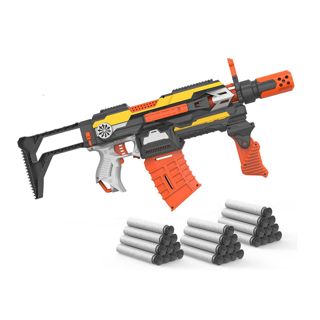
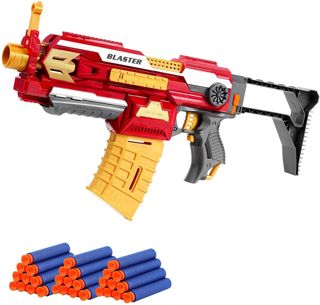
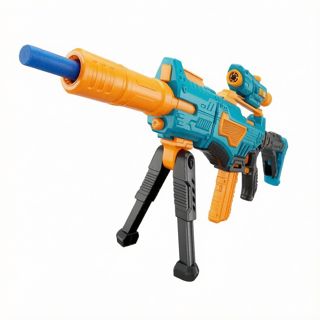
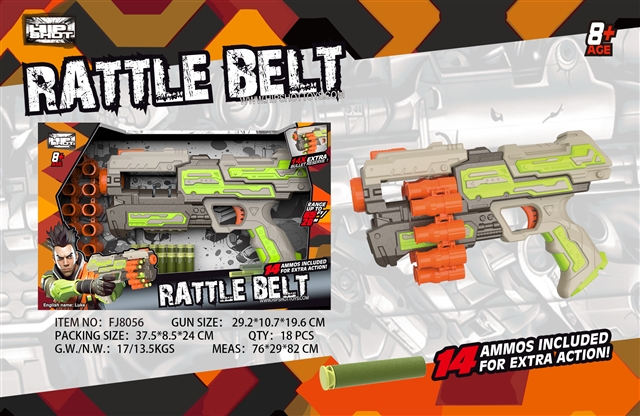
Within that cluster, a catalog line such as the Belt-Feed Foam Dart Blaster is a useful reference point for what the tier looks like commercially: a belt-feed concept at a low unit count and a per-unit figure in the single digits, listed at a minimum order quantity under a hundred pieces. Use that as a calibration point, not a promise — your actual MOQ, price, and tooling terms depend on the specific mechanism, packaging, and whether the belt is proprietary to your SKU.
The honest limitation: no public record tells you which Chenghai factories hold belt-feed fixture control, loading-test data, or a stocked spare-belt program. Public sources on belt systems cover heavy-industry conveyor components — belts, pulleys, idlers, rollers, drive units — and replacement-interval practice from that world does not describe a toy belt-feed mechanism. Treat every capability claim in this category as unverified until you have the documents in hand.
Manufacturers at a Glance
| Comprehensive blaster factory (Chenghai, Shantou, Guangdong) | Specialty: blaster bodies, belt-feed sub-assembly, darts, packaging under one network | MOQ: varies by spec (catalog belt-feed lines list from ~50–120 pcs on some items) | Origin: Chenghai / Shantou, Guangdong | OEM/ODM: both, typically | Certifications: ask for CPC + ASTM F963 test report, EN71 / TSD 2009/48/EC + EU DoC; verify SKU scope |
|---|---|
| Injection and mold specialist (Chenghai) | Specialty: tooling, molded parts, belt links and feed components | MOQ: varies by spec (tooling-driven) | Origin: Chenghai, Guangdong | OEM/ODM: ODM tooling, OEM molding | Certifications: not a finished-goods certifier; ask which lab and which SKU the report covers |
| Belt-feed mechanism sub-assembler (Shantou) | Specialty: feed wheel, link assembly, fixture-based sub-assembly | MOQ: varies by spec | Origin: Shantou, Guangdong | OEM/ODM: OEM sub-assembly | Certifications: ask for component-level test scope and the finished-goods report owner |
| Electronic blaster assembler (Chenghai / Shantou) | Specialty: motorized feed, electronic scoring, battery compartments | MOQ: varies by spec | Origin: Chenghai / Shantou, Guangdong | OEM/ODM: both | Certifications: ask for toy mechanical/chemical reports plus EMC evidence where applicable |
| Trading and mixed-container supplier (Yiwu) | Specialty: assembled goods, multi-category container consolidation | MOQ: varies by spec (often lower per line, higher per container) | Origin: Yiwu, Zhejiang | OEM/ODM: OEM packaging, limited ODM | Certifications: ask which factory holds the report; trading layers rarely own test data |
| Private-label program supplier (region-agnostic) | Specialty: your brand, your packaging, your belt spec | MOQ: varies by spec | Origin: Chenghai / Shantou / Yiwu | OEM/ODM: ODM-led | Certifications: ask for SKU-matched test reports, tracking-label plan, and change-control owner |
By Category (Plastic / Plush / Educational…)
Belt-feed blasters sit in the plastic, mechanical-action category, and the evaluation logic differs sharply by category. In plastic mechanical toys, the questions are tooling, fixture, and dimensional consistency. In plush, the same compliance discipline applies but the failure modes are seams, fill, and detachable parts — recall 26-727 (2026) involved a pull-string teething toy whose silicone strings were smaller and longer than permitted, posing a respiratory and choking hazard. In educational and activity toys, the risk concentrates in small detachable components — recall 26-775 (2026) involved a toddler busy board whose knobs could detach, violating the small-parts ban for children under three. Recall 26-456 (2026) involved a plastic cube that could break into small parts or sharp edges. None of those named products have any established connection to the suppliers discussed here; they are included because each one teaches a transferable question.
For belt-feed specifically, the plastic-category checklist is: link dimensional spec and tolerance, golden sample retention, fixture-based sub-assembly, a documented cycle test, and a spare-belt SKU. Add two more that buyers forget. First, lot compatibility — ask the factory to state in writing whether a belt from lot A fits a blaster from lot B, and what they do if the answer is no. Second, field replacement policy — how does an end user or your returns desk swap a belt, and does the replacement part ship with instructions. If a supplier has never been asked these questions, that is itself the answer.
Two adjacent material classes are worth flagging because they change the compliance map on a belt-feed SKU. Loose high-powered magnets violate the mandatory toy standard when they fit in CPSC's small parts cylinder — recall 26-319 (2026) shows the ingestion hazard — so if your belt or blaster uses magnetic link retention, that retention method needs its own review. Button-cell and coin batteries accessible to children carry a separate, severe ingestion hazard, as recall 26-515 (2026) illustrates. If your electronic belt-feed model uses either, scope the test plan to include them before you approve the sample.
Which China factories can supply wholesale foam blasters for Amazon, toy stores and party channels?
The factories that survive the Amazon channel are the ones with documentation discipline, not the lowest quote. Amazon and large retail channels push the compliance burden back to the importer, and the importer pushes it to the factory. So the real filter is: can this factory produce a SKU-matched test report, a tracking label that supports product identification, and a change-control contact when a component changes?
Tracking labels are a good filter because they expose lot control. Tracking information should be permanent and support product identification where applicable, and packaging, product markings, and lot control should be reviewed together. A factory that already thinks in lots will answer a lot-compatibility question without hesitation. A factory that thinks in shipments will give you a blank look — and that blank look is your signal about year-two spare-belt supply.
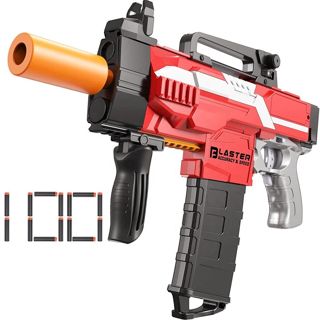
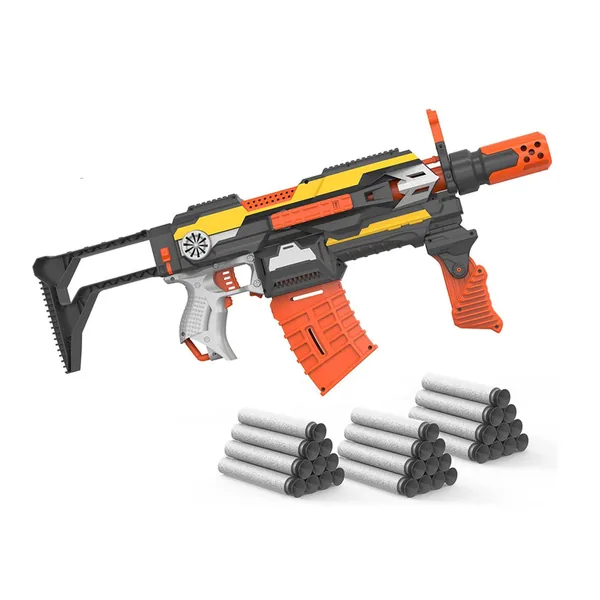
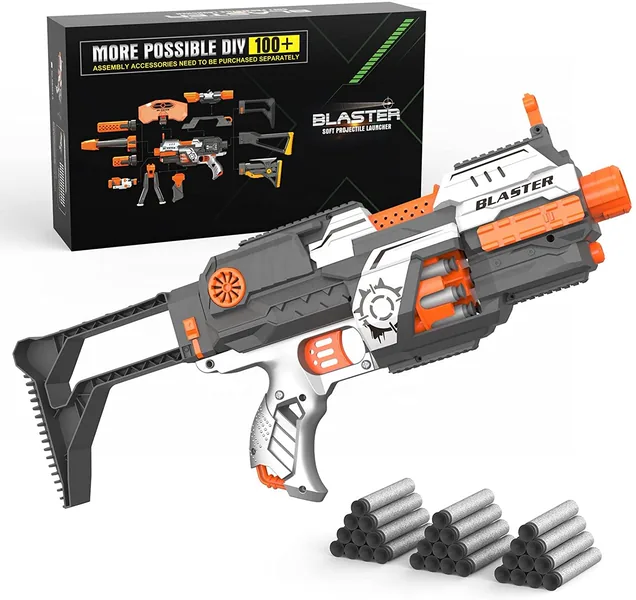
For party and gift channels, the same factory is often the right one, with a different packaging spec. Party-channel buyers care about per-unit cost and shelf appeal; the belt mechanism is still the durability risk. If you are running a motorized belt-feed program, a reference product like the Motorized Foam Dart Rifle Blaster shows the kind of SKU a full-service factory will quote alongside the belt-feed line, and it is the point at which you should be asking whether both SKUs share a feed architecture or a spare-part family.
Who are foam blaster manufacturers in Chenghai that support samples, OEM packaging and repeat orders?
Chenghai supports all three, but not from the same tier of factory, and the sample stage is where you find out which tier you are talking to. A tooling-led Chenghai factory will send a golden sample from the approved first article, quote OEM packaging separately as a cost line, and tell you which parts are shared with existing molds. A trading-led supplier will send a catalog sample and price the packaging as a round number. Both can work; only one of them can support a proprietary belt.
Quote packaging as its own line item so a switch from a window box to a polybag shows up as a number you can act on. Put your drawings, color standards, and test requirements into a non-disclosure and non-use agreement before you send them — a molder holding your tooling and artwork with no non-use clause is one slow season away from selling your product to someone else. That is not paranoia; it is the standard term sheet for OEM work in this cluster.
Repeat orders are the real test. Before the second PO, ask three questions: is the belt a shared mold or your proprietary tool, does the factory hold a golden sample tied to your approved lot, and what is the spare-belt order term. A factory that answers all three in writing is a factory you can build a belt-feed line on. One that answers two of three is a factory you can buy from once.
How do I verify a Chinese supplier before the first shipment?
Verify in this order: entity, scope, sample, documents, then factory visit. Confirm the legal entity name matches the bank account and the export documents. Confirm the factory's stated scope matches what you are buying — a mold shop is not a finished-goods assembler, and a trading company is not a factory. Then request a golden sample and hold it against the production lot. Only after that do you spend money on audits and lab tests.
On documents, match the report to the SKU. A test report should identify the product configuration, age grade, and standard edition; if it does not, it does not cover your product. Check the applicable ASTM F963 edition and the current regulation text before quoting a report in your listing, and a test report is not a shipment certificate — it describes a configuration, not a lot. If the factory cannot tell you which configuration the report describes, treat the report as unverified.
If you want a reference point for how one Chenghai-side supplier presents its catalog and product data, the foam blaster wholesale range at FoamBlasterSource.com is a useful comparison — not because a catalog page proves capability, but because you can hold its product descriptions next to the document requests above and see which answers are missing. That gap is the same gap you will find in most quotes in this category, and closing it is the whole job.
What MOQ and price should I expect for a belt-feed blaster program?
MOQ in this category is set by the mechanism, not the blaster. A belt-feed line needs its own tooling for links and feed components, and tooling is what moves the minimum. In the catalog data reviewed here, belt-feed and electric blaster lines carry minimum order quantities from roughly 50 to 120 pieces on some items, while simpler manual or mini blasters run higher — 216 to 500 pieces — because they are often shared-mold commodity lines. That inversion is worth understanding: the mechanism-heavy SKU can carry a lower minimum because it is priced for the mechanism, not for volume.
Price follows the same logic. The belt-feed reference product in this review is listed in the single-digit USD range per unit, and a motorized rifle line is listed far lower because it is a simpler build. Treat both as calibration only. Your landed cost depends on the belt material, dart spec, packaging, electronics, and whether the belt is proprietary. If a quote comes in far under the reference range for a belt-feed product, ask what part of the mechanism was simplified — that is where the jam will be.
What documents should I request in the first email?
Ask for eight items in one message and see how many come back complete. One: belt-link dimensional spec with tolerance. Two: golden-sample retention policy and the approved first-article record. Three: assembly fixture description or a short station video. Four: loading-test protocol, cycle count, and belt-feed reject rate. Five: spare-belt SKU, stock status, and order terms. Six: written cross-lot compatibility statement. Seven: field replacement policy, including whether the replacement belt ships with instructions. Eight: change-control procedure and the named person who coordinates document review after a material change.
A complete reply to all eight is rare. That is fine — the value is in which ones come back vague. In practice, items five, six, and seven are the ones that separate a supplier who can sustain a belt ecosystem from one who can ship a container. If a factory answers one, two, and four but goes silent on five through seven, you are looking at a one-order supplier, and you should price the risk accordingly.
FAQ
How do I test belt-link consistency before placing a bulk order?
Ask for the link dimensional spec with tolerance, hold a golden sample from the approved first article, and request the belt-feed sub-assembly reject rate rather than the finished-goods pass rate. Note that a golden-sample or type-test report does not automatically cover a later production lot — match report SKU, materials, colors, and production date or cohort to your PO.
Does a CPC or EN71 report prove a factory's belt-feed quality?
No. A CPC is product-specific and should not be described as a blanket factory certificate, and no public standard or guidance page proves belt-feed assembly quality, fixture control, loading tests, spare-belt availability, lot compatibility, or field replacement policy. Use certification documents to clear the market-entry gate, and verify belt-feed capability separately.
What changes trigger a retest on a belt-feed blaster?
A material change to a children's product can affect safety or compliance, and CPSC guidance describes retesting affected requirements and issuing a new certificate from the resulting passing tests. If you change the dart material, belt polymer, or feed geometry, separate unchanged components from changed materials and confirm who owns the document review before shipping.
Should I buy a spare-belt program with the first order or later?
Buy it with the first order. Ask for the spare-belt SKU, stock status, and order terms in the same quote as the blaster, plus a written cross-lot compatibility statement and a field replacement policy. If the factory cannot define a spare-belt SKU at the sampling stage, the replacement supply will not exist when your retail customers need it.
Is Chenghai or Yiwu better for sourcing belt-feed blasters?
Chenghai, in Shantou, Guangdong, is the stronger fit when the belt mechanism is the product, because mold shops, injection houses, and sub-assembly workshops sit close together. Yiwu suits assembled-goods trading and mixed-container sourcing across many categories. Choose by whether you are developing a mechanism or consolidating a container.
Do electric belt-feed blasters need extra compliance evidence?
Potentially yes. Electronic toys can need electromagnetic-compatibility evidence in addition to toy mechanical and chemical tests. If the model also uses accessible button-cell or coin batteries, or magnetic link retention, scope those into the test plan — both hazard classes have driven recent CPSC recalls.
Sources
Get a belt-feed quote with the spare-part terms attached
Send your belt-feed spec — link tolerance, dart material, target market, packaging format — and we will return a quote with the spare-belt SKU, lot-compatibility statement, and change-control contact included. If your priority is verification first, request a factory audit or a golden sample against your own approved first article, and we will walk you through the document set before any PO is issued.