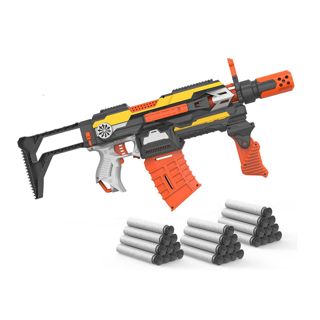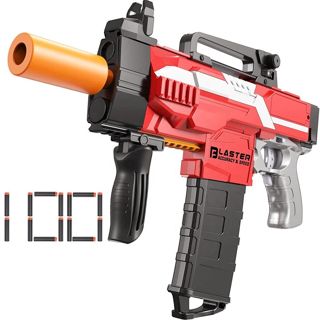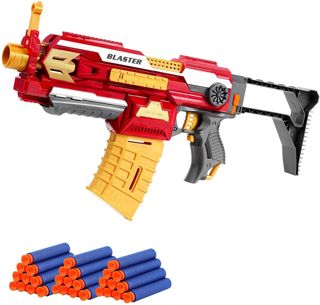
A foam crossbow passes inspection only when the limb, string, draw sequence, latch, and dart seating work together as one mechanism across repeated cycles — not when a single static shot looks fine on the table. That is the sign-off rule for this format, and it is why a standard blaster routine does not transfer: a crossbow loads through a different path, so the checks must follow that path. The checklist below covers limb condition, string attachment, draw sequence, latch engagement, projectile seating, wear, and replacement guidance, and turns each one into a wholesale decision you can put on a PO.
Key Takeaways
- Sign off on the crossbow mechanism and its projectile as a pair. A limb that seats cleanly with a dart that pinches in the channel is still a fail.
- Approve bulk against a sealed physical golden sample — colour, fit, flash, function — because photo-only approvals tend to surface problems on the second lot.
- Run repeated play-cycle testing, not a one-time static check; wear, loosening, cracking, and loss of function only appear under cycling.
- Lock the production standard to a tool number and revision card. A Canton Fair booth sample is often a hero unit and is not a production standard.
- Ask for the inspection plan on the PO rather than accepting an AQL figure quoted in a catalogue sentence.
Why does a foam crossbow need its own inspection path?
Because the energy in a crossbow-format toy is stored in a limb and released through a string and latch, every check sits on that load path — a blaster routine checks a breech, a plunger, and a muzzle, which is a different sequence. On a crossbow, the limb tips, the string attachment points, the draw, the latch catch, and the dart channel form a chain. If one link is loose, the symptom shows up somewhere else: a dart drops, a string slips off a tip, or the latch releases early. Inspect the chain, not the parts.
Returns on this format cluster around function, not appearance. A buyer who signs off on a good-looking unit and ships it meets the failure at the consumer end, where the cost is a refund plus the review.
Limb condition: what to check before anything else
Check the limb for straightness, uniform thickness at both tips, and rounded edges anywhere the string or band contacts it. Any part touching the string should have rounded edges; sharp or moulded-flash edges fray the string and produce uneven release. Flex both limbs by hand and listen and feel for cracking, whitening, or a soft spot — a limb that has already lost elasticity will not hold a consistent draw.
The limb material in the catalogue record tells you what to expect. ABS/EVA and EVA builds behave differently from rigid plastic, and limb material should be stated on the listing because it drives after-sales guidance. If the supplier cannot tell you the limb material and the tip geometry, that is a stop point, not a detail to resolve after the PO.
String and attachment: seating, centering, and twist
The string must seat fully in the groove or notch at each limb tip, sit centered without twist, and stay seated when the limb is flexed. Dry-fit the string with no dart loaded and pull the limbs by hand: a string that pops out of a notch under light hand pressure will not survive a retail customer. Inspect both tips, not one — asymmetric seating is the defect that hides on a quick look.
For band-style crossbows, inspect the band for cracks, dryness, stickiness, or fraying and confirm the band path is centered without a sharp angle at the front mount. A single light band with a low-tension design is easier to inspect consistently than a stacked or high-tension band system, and easier to replace when it wears. Replacement bands and strings should be standardized and easy to source, because wear on the string is expected, not exceptional.
Draw sequence and latch: the two checks that fail silently
Draw the string back in the sequence the instruction sheet describes and confirm the pull is smooth, centered, and not so heavy that a child cannot complete it under supervision. Uneven draw — one side tensioning before the other — points back to limb or string seating problems and should be rejected at the source.
The latch must hold the string lightly, release without forcing, and not crush, twist, or sharply pinch the string. Test the latch dry, with no projectile loaded, several times: it should move cleanly and return to position. A stiff, crooked, or unpredictable latch is not a unit to rework on the line — it is a mechanism to fix before the run. If the release needs more than light finger pressure, the design is wrong for the age grade.
Dart seating: loose channel, soft projectile, no pinching
The dart should rest in the channel loosely, sitting straight, with no pinching and no rattle that lets it fall out when the toy is tilted. A tight barrel or guide is a defect, not a tolerance to accept: it deforms soft darts and produces inconsistent flight. Confirm the channel is a guide, not a seal.
Compatible projectiles should be standardized and stated on the packaging, with clear warnings against hard or sharpened projectiles and against high-tension bands. Most misuse complaints start with a buyer substituting a projectile the toy was not built for, so this is a returns-control measure first.
Repeated cycles and wear: what a single check misses
Cycle the unit repeatedly and re-inspect after cycling. Repeated play-cycle testing can expose wear, loosening, cracking, and loss of function that a one-time static check misses. After cycling, look again at the limb tips, string seating, latch engagement, and dart channel, and compare the unit against the sealed golden sample on colour, fit, flash, and function. Emails do not settle a colour argument; the sealed piece on the QC shelf does.
Replacement guidance belongs in the box. Traditional crossbow maintenance guidance treats string replacement as routine — one maintenance guide puts string life at roughly 100–200 shots, another at 1,000–3,000 shots, and a stringer guide frames it as approximately 200–600 bolts — which tells you the right message for a toy: inspect the string regularly and replace it when it frays, cracks, dries, or loses elasticity. Those intervals come from adult crossbow maintenance and should be presented as inspection guidance, not as a warranty promise for a foam toy.
Worked example (illustrative, not a real shipment)
A buyer places one order of about 1,200 foam crossbow units across two destinations: a US retail assortment and an EU gift-channel pack. The packaging differs per destination, and the label artwork differs between the two. On the line, the new SKU starts with the previous SKU's labels still in the hopper; the run is stopped, labels, colours, and work instructions are cleared, and the line restarts. That is the step where this shipment would have been held: paperwork and labels mapped to the wrong market and lot. Because the release gate maps market, lot, and which file covers which test, the mismatched pack is caught before it ships rather than at the retailer. The units that cycle correctly against the sealed golden sample move; the rest stay behind for rework.
This example is illustrative only. Your own inspection plan, lot size, and destination paperwork come from the agreed PO, not from this article.
What to do when a lot fails
Isolate the failed lot, record the defect class, and release only after rework — do not blend suspect units back into good stock to protect the shipment date. Buyers who want a numeric sampling figure should get it from the agreed inspection plan on the PO, not from a catalogue sentence or a blog. That keeps the number tied to the actual lot and the actual test, and keeps the release decision auditable.
Foam crossbow sign-off checklist
| Limb condition | Check straightness, tip thickness, rounded string-contact edges, and flex for cracking or whitening. Red flag: sharp moulded flash at the tips. |
|---|---|
| String attachment | String seats fully in both notches, centered, untwisted, stays seated under hand flex. Red flag: one tip seats, the other does not. |
| Draw sequence | Smooth, centered pull in the documented order; both sides tension evenly. Red flag: one limb loads before the other. |
| Latch | Holds lightly, releases under light finger pressure, returns to position; dry-cycle several times. Red flag: stiff, crooked, or pinches the string. |
| Dart seating | Dart rests loosely and straight in the channel, no pinching, no fall-out when tilted. Red flag: tight barrel that deforms soft darts. |
| Repeated cycles | Cycle and re-inspect limb tips, string, latch, and channel against the sealed golden sample. Red flag: function degrades after cycling. |
| Wear and replacement | Inspect string and band for fraying, cracking, drying, loss of elasticity; ship replacement guidance. Red flag: no replacement guidance in the box. |
| Production standard | Tool number and revision card define the build; bulk compared to the sealed golden sample. Red flag: a Fair photo offered as the standard. |
| Line clearance | Labels, colours, and work instructions cleared before the crossbow run starts. Red flag: previous SKU's labels still in the hopper. |
| Paperwork to lot | Each file mapped to market, lot, and the specific test it covers. Red flag: one certificate offered for two different papers. |
| Failed lot | Isolate, record defect class, release only after rework; sampling figure from the PO inspection plan. Red flag: suspect units blended back into good stock. |
What to ask suppliers before you sign off
Can you show the sealed golden sample for this crossbow SKU, and will bulk be compared to it on colour, fit, flash, and function?
What is the tool number and revision for this crossbow, and will you refuse a Fair photo as the production standard?
What is the documented load path — limb, string, draw sequence, latch, projectile seating — and how does it differ from your standard blaster routine?
What line-clearance record do you keep for labels, colours, and work instructions before a crossbow run?
Which paperwork covers which market and which lot for this SKU, and can you map each file to its test?
What are the tooling fee, ownership, storage period, and idle-tool terms in writing?
If a lot fails, how do you isolate it, record defect class, and release after rework — and what inspection plan on the PO supplies the sampling figure?
What replacement guidance for string, band, and darts ships in the box, and what projectile types are stated as compatible?
What to check on the catalogue record for a crossbow SKU
Use the product record as the first filter before you request a sample. Confirm the limb material (ABS/EVA, EVA, ABS, or plastic), the MOQ tied to that SKU, and the unit price posture — these are the fields that decide whether the crossbow fits your channel and your landed cost.
Two crossbow-adjacent SKUs show how far the fields move: the Raging Shark Foam Dart Crossbow Blaster is an ABS/EVA build at an MOQ of 63 and 4.65 USD, while the Shark-Theme Foam Dart Bow is EVA at an MOQ of 90 and 4.3 USD. If your programme is a party or impulse channel rather than a crossbow-led range, the Mini Dinosaur Foam Dart Blaster sits at an MOQ of 480 and 0.96 USD, and the Motorized Foam Dart Rifle Blaster at an MOQ of 120 and 0.55 USD — different mechanism, different inspection path, but the same golden-sample and line-clearance rules apply.
FAQ
What is the single most important check on a foam crossbow?
The mechanism and the projectile must work together across repeated cycles. A unit that seats the string correctly but pinches the dart in the channel is still a fail, because the two parts are one load path.
How many cycles should I require before sign-off?
Set the cycle count in the agreed inspection plan on the PO rather than accepting a generic figure. What matters is that the test is repeated rather than static, since wear, loosening, cracking, and loss of function appear under cycling, not on a single check.
Should I approve a crossbow from a photo or a Fair sample?
No. Approve against a sealed physical golden sample compared on colour, fit, flash, and function, and lock the standard to a tool number and revision card. Booth samples are often hero units and Fair lighting misleads.
What do I do if a lot fails inspection?
Isolate the lot, record the defect class, and release only after rework. Do not blend suspect units back into good stock, and get any sampling figure from the agreed inspection plan on the PO.
Does string replacement guidance belong in the packaging?
Yes. String life is a maintenance event, and adult crossbow guidance frames replacement around fraying, cracking, drying, or loss of elasticity. For a foam toy, present inspection and replacement as user guidance, not as a warranty promise.
Which paperwork matters most for a crossbow SKU?
The file that maps to your destination market, your lot, and the specific test it covers. One certificate offered for two different papers is a red flag; paperwork that does not match the lot is not paperwork.
How do I compare a crossbow SKU against a blaster SKU in the same range?
Compare the catalogue fields first — limb material, MOQ, and unit price — then apply the crossbow load-path checklist rather than a blaster routine. The crossbow carries a different mechanism, so it needs its own sign-off.
Sources
Request a Quote
Send us your crossbow SKU, destination market, and packaging split, and we will map the load-path checks, the golden-sample comparison, and the paperwork-to-lot release gate onto your PO. Ask for the inspection plan in writing before the run starts.