The myth is that a saw-themed toy sells itself on the word "saw." It doesn't — and leaning on that word is exactly how a wholesale listing becomes a liability. For moving-disc and saw-themed novelty SKUs, the safe and commercially sound graphic direction is to describe what a user can actually see: the spinning disc, the detachable pieces, the color contrast between a moving part and the body. You build the brand story around verified motion and clear parts identification, never around untested cutting or power. This page gives you the terminology rules, the parts-inventory checklist, the instruction-graphic logic, and the refill-naming conventions to hand to a factory or a copywriter.
Two decisions drive everything else. First, decide whether each SKU is marketed on motion alone, needs a "decorative only" disclaimer, or must be flagged for golden-sample verification before you list it. Second, commit to a rule: no FPS, no range, no dart count, no certification number, and no MOQ in your marketing copy unless that exact figure appears in the SKU's catalog name. That rule keeps your claims traceable to what the product demonstrably does.
Key Takeaways
- Use motion-only verbs — "spins," "rotates," "detaches," "reassembles" — and ban "cuts," "slices," "power," or "speed" unless a golden sample demonstrates that function, which it almost never does for a novelty saw item.
- Inventory detachable parts strictly from a catalog image or golden sample; if a piece is not visible, exclude it from the parts list. An unverified part claim is a small-parts liability under 16 C.F.R. part 1501.
- Design instruction graphics around color contrast — "red disc on black body" — so a child can identify the moving part without text-heavy steps. Contrast aids assembly and draws attention to the actual mechanism.
- Name refills using the catalog SKU name verbatim (e.g., "disc refill"). Never add counts, quantities, or performance adjectives to a refill name, because those added numbers become unverified claims.
- Before listing, ask the supplier for a function statement: is the saw element decorative only, and is a "does not cut" on-pack disclaimer required? Route that wording through legal, not marketing.
Customization Options vs. Claim Risk
| Custom colors for body and moving part | MOQ varies by SKU (54-432 per SKU). Claim: color contrast is a factual, visual claim you can always make. Use it to highlight the rotating element. |
|---|---|
| Custom logo / private label | MOQ varies by SKU. Claim: logo placement is cosmetic. It does not change the motion or parts description. |
| Custom packaging (display box, retail-ready) | MOQ varies by SKU. Claim: packaging copy must carry any required choking-hazard warning per 16 C.F.R. § 1500.19, and the "decorative only" disclaimer if applicable. |
| Custom instruction graphic (assembly steps) | MOQ varies by SKU. Claim: graphics must reference the visible detachable-part inventory. No step may reference cutting or power. |
| Refill naming / SKU naming | MOQ varies by SKU. Claim: use the catalog name verbatim. Do not add counts or performance adjectives. |
What Can You Actually Describe on a Moving-Disc SKU?
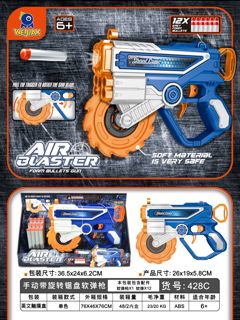
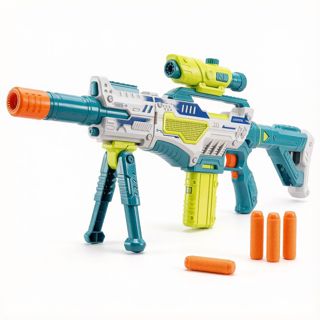
Start with the visible rotating feature. For an SKU like a Rotating Disc Soft Bullet Gun, the observable facts are that the disc rotates and that the body is made of ABS/EVA. You can say "spins" or "rotates" because those are visual facts. You cannot say how fast it spins, what powers the spin, or what the disc does to a target, because none of that is visible in a catalog image or confirmed by a golden sample.
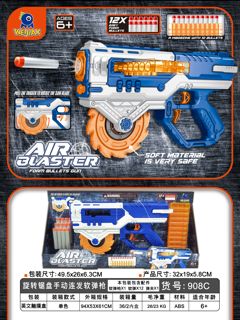
The same discipline applies to saw-themed items. A "Rotating Saw Soft Bullet Gun" has a saw-themed part that rotates. The safe copy says "rotates" and stops there. The unsafe copy says "cuts" or "slices." A novelty saw blade is almost always decorative — a visual motif, not a cutting tool — but that is a fact you must confirm with the supplier, not assume. Ask: "Is the saw element decorative only? Does your legal team require a 'does not cut' disclaimer on-pack?"
Then inventory the detachable parts. List every piece visible in the image: the disc, the saw blade, a magazine, a guard. If the catalog image is ambiguous — say, a single photo where you cannot tell whether the blade comes off — flag the SKU for golden-sample verification before writing any parts-based copy.
Why Color Contrast Drives the Instruction Graphic
The instruction graphic is not just assembly art; it is a safety tool. When a moving part is a different color from the body, a child can identify it at a glance. The copy should say "red disc on black body" or "orange saw blade on grey housing" so the graphic can highlight that part without long text steps.
Color contrast also serves the small-parts rule. CPSC guidance for toys intended for children under 3 bans objects that fit entirely into the small parts cylinder (16 C.F.R. part 1501). If a detachable disc is small enough to be a small part, no color contrast fixes that — you either design the part larger, or you label the choking hazard per 16 C.F.R. § 1500.19. When you brief the factory, ask for the base and accent colors of the rotating element per SKU, and confirm whether the detachable parts clear the small-parts cylinder for the intended age grade.
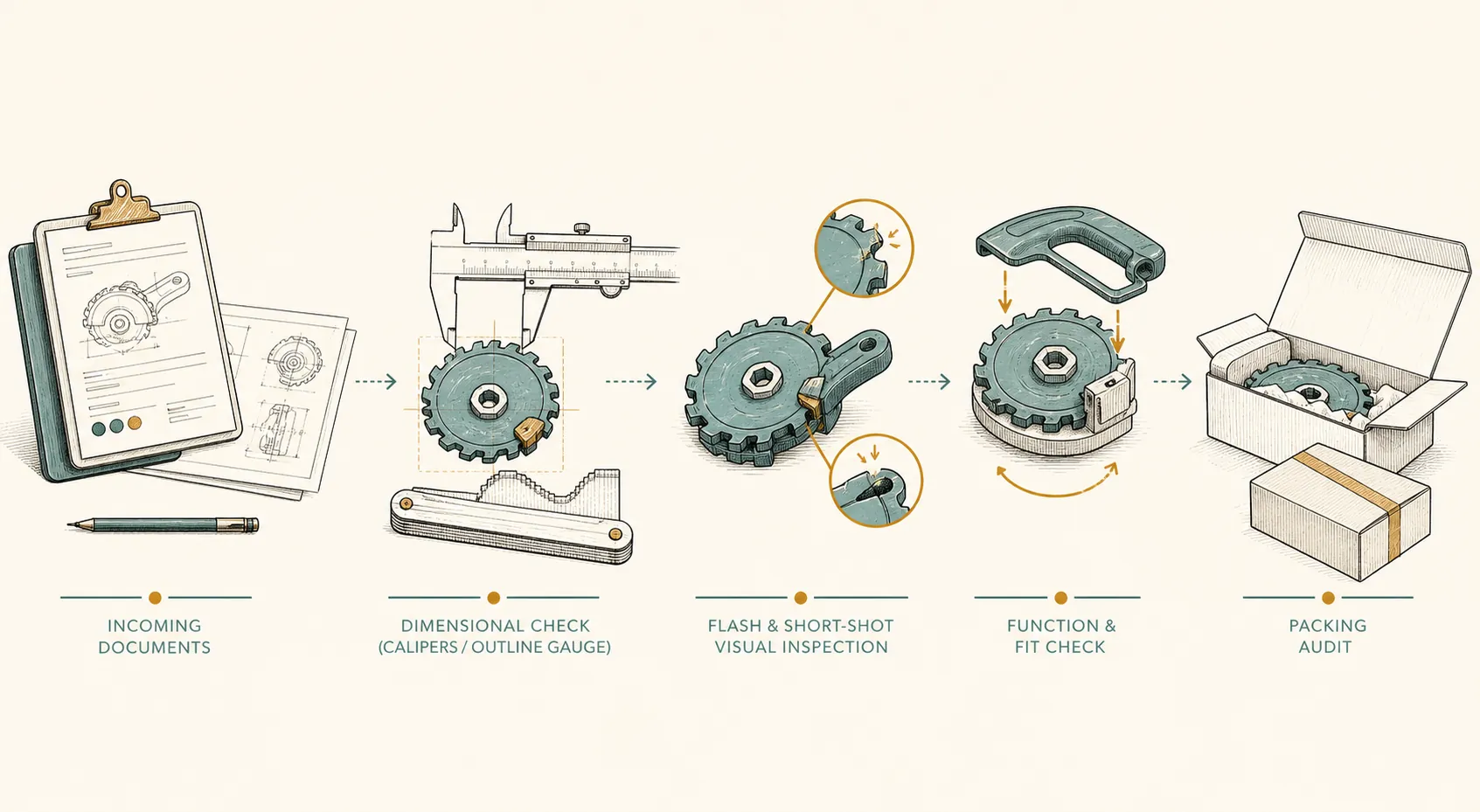
Color consistency itself is a QC check. A single approved first piece does not prove full-run consistency; color must be checked across cavities, shifts, and material lots. If you are ordering 144 units of a moving-disc SKU across two production shifts, ask the factory how they audit color from the first cavity to the last box.
Refill Naming: The Verbatim Rule
Refill naming is where listings usually go wrong. The rule is simple: use the catalog name verbatim. If the catalog calls it a "disc refill," your listing says "disc refill." You do not add "24-pack" or "high-speed" or "premium" to the name, because those added figures become claims you cannot verify from the catalog.
The same verbatim rule protects you on the parent SKU. The catalog name "48-Dart Electric Soft Bullet Blaster" lets you say "48-dart" because the number is in the name. The catalog name "Rotating Disc Soft Bullet Gun" does not let you say "spins at high speed" or "fires 30 feet" because those numbers are not in the name. Write the claim only when the exact support exists in the supplied materials.
If you want to change the refill name as part of your private label, you can — MOQs vary by SKU — but the new name must still describe only visible parts and quantities you can count. "Saw blade set" is fine if the set actually contains blades. "5-blade saw set" is only fine if you can count five blades in the sample.
The 5-Step Graphic Direction Workflow (With Supplier Questions)
Each step below has a checkpoint and a question to put to the supplier.
Step 1 — Verify observable motion. Confirm from the golden sample or catalog image whether a moving disc or rotating element is visible. If motion is not visible, mark the SKU as decorative-only or verification-required. Supplier question: "For SKU [ID], what is the exact visible motion mechanism — manual spin, gear-driven, or friction?" You need this to describe motion without implying motorized power.
Step 2 — Document the rotating mechanism. Describe the rotating element using only observable terms: "spins," "rotates," "turns." Do not state the power source, speed, or function. Checkpoint: the words "cut" or "power" do not appear in your draft copy unless the golden sample demonstrates that function.
Step 3 — Inventory detachable parts. List only parts visible in the golden sample or catalog image: blades, discs, guards. Exclude any piece not visually confirmed. Supplier question: "Which parts are detachable and which are fixed? Provide a parts diagram or golden-sample photo." Checkpoint: your parts list matches visible detachable pieces only.
Step 4 — Map color contrast. Note the base color versus the accent color of the moving part. This supports the instruction graphic. Supplier question: "What are the base and accent colors of the rotating part for each SKU?" Checkpoint: your instruction graphic highlights the moving part by color, not by text-heavy steps.
Step 5 — Assign the marketing stance. Categorize each SKU as marketable on motion alone, requires a "decorative only" disclaimer, or flagged for golden-sample verification before listing. Supplier question: "Is decorative-only language required on-pack (e.g., 'does not cut')? If so, provide the exact wording your legal team approves."
What to Check on the Factory Floor (Line Clearance and Labels)
The graphic direction on your listing means nothing if the physical product contradicts it. The most common failure is a mixed-label shipment: a new SKU starts production with the previous SKU's labels still in the hopper, and a mislabeled box reaches a retailer. The fix is a line-clearance protocol: before a new SKU run, the factory stops the line, clears labels, colors, and work instructions, then starts. Line clearance is boring until a mixed label reaches a retailer.
Ask your supplier to confirm their line-clearance step in writing and to show you the record for your specific SKU. Also check the tracking label content. A pretty barcode with no manufacturer, date, or lot content is decoration, not a label. US children's product shipments need a CPC matched to the SKU, not to the factory door, and a tracking label should carry the manufacturer, date, and lot on the product or pack as required.
Worked Example (Illustrative, Not a Real Shipment)
A US gift distributor orders 144 units of a rotating-disc blaster and 72 units of a saw-themed blaster, one SKU each. The distributor's listing copy says "spinning disc blaster" for the first and "decorative saw blaster" for the second — motion-only language, no cutting claims. Packaging includes the choking-hazard warning on both because the detachable discs pass the small-parts cylinder but are still a risk for the under-3 age grade.
At production, the factory runs the rotating-disc SKU first, then switches to the saw-themed SKU. Without a line-clearance check, a box of saw-themed units ships with rotating-disc labels. At the distributor's inbound QC, the mixed label is caught and the lot is held. The fix would have been a documented line-clearance sign-off before the second SKU run, plus a tracking label with manufacturer, date, and lot on each pack.
The takeaway: graphic direction is a cross-functional discipline. It covers the copy on your listing, the parts inventory on your instruction sheet, the color contrast on your packaging, and the label content on the factory floor.
FAQ
Can I say my saw-themed toy 'cuts' if it looks like a saw?
No. Unless a golden sample demonstrates a cutting function — which novelty saw-themed items almost never have — the word 'cuts' is an untested performance claim. Use motion-only verbs: 'spins,' 'rotates.' Ask the supplier for a function statement and a 'decorative only' disclaimer if applicable.
What MOQ do I need to private-label a moving-disc blaster?
MOQ varies by SKU. For example, the Rotating Disc Soft Bullet Gun has a 144-unit MOQ, while the Rotating Saw Soft Bullet Gun has a 72-unit MOQ and the Manual EVA Soft Bullet Gun with Rotating Magazine has a 54-unit MOQ. Confirm the exact MOQ for your chosen SKU with the supplier before quoting.
What is a small part and how does it affect my saw-themed toy?
A small part is any object that fits entirely into the small parts cylinder, a gauge approximating a child's throat, per 16 C.F.R. part 1501. For toys intended for children under 3, detachable discs or blades that fit the cylinder are banned. Either design the part larger or apply the choking-hazard warning label per 16 C.F.R. § 1500.19.
Who owns the mold if I commission a custom color for a disc blaster?
Mold ownership is a commercial term to negotiate per order. For two-shot molding, the tooling can create multi-material or multi-color parts in one system, but the interface and shrinkage of both shots need validation. Ask the supplier for the tool-release document identifying the final revision, cavity count, approved resin, and maintenance owner.
Will the supplier sign an NDA before I share my packaging artwork?
NDA signing is standard practice in OEM/ODM, but confirm it in writing before sending artwork. Also confirm the line-clearance protocol: a new SKU must start with cleared labels, colors, and work instructions so your packaging does not get mixed with a previous SKU's labels.
Can I name my refill '24-disc pack' if the catalog does not say 24?
No. Refill naming must use the catalog SKU name verbatim. Adding a count like '24-disc' makes it an unverified quantity claim. If you want a count in the name, verify the actual quantity from a golden sample first, then confirm the new name with the supplier.
Sources
Request a Quote
Send your SKU list and target market to get a custom quote with per-SKU MOQ, lead time, and a confirmed function statement for each moving-disc or saw-themed item. We will confirm the visible motion mechanism, the detachable-parts inventory, and the color contrast of the rotating element so your listing copy is compliant from day one.