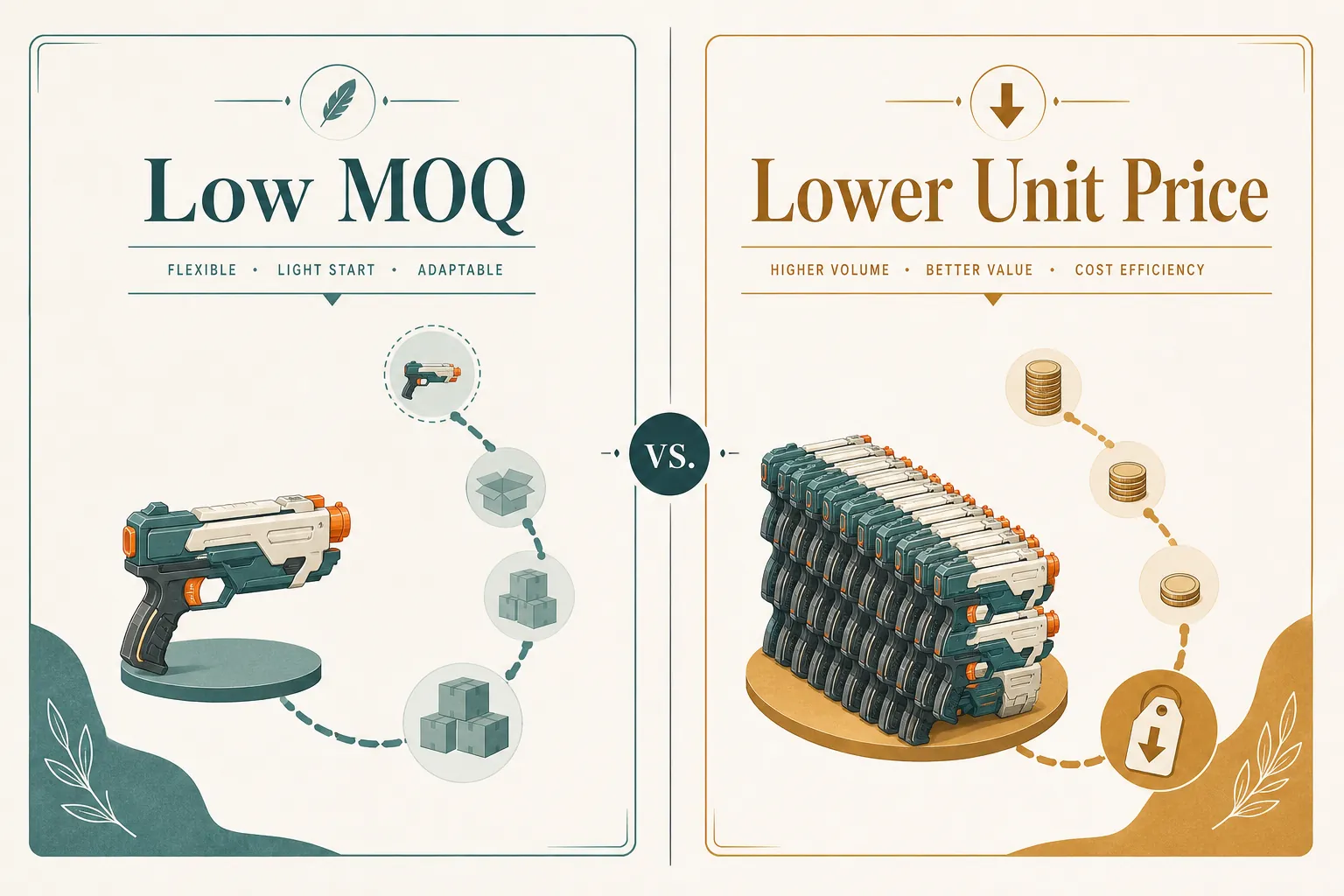
The cheapest quote is rarely the cheapest order. When sourcing foam blasters, the real decision is not whether to chase a low MOQ or a lower unit price—it's which trade-off protects your cash flow without sacrificing quality controls. This guide ranks the available options by inventory exposure, customization depth, packaging setup, testing allocation, freight efficiency, and reorder confidence, so you can choose the quantity-cost balance that fits your channel.
Start with your demand certainty. If you are testing a new market, a low MOQ (12–72 units) lets you validate sell-through with minimal capital at risk. If you have proven demand, a higher MOQ (216–288 units) unlocks better per-unit pricing, but only if you can move the volume before it ties up cash and shelf space.
Key Takeaways
- A low MOQ (e.g., 12 units for the Soft-Bounce Alloy Edition) minimizes first-order capital exposure and lets you test multiple SKUs, but spreads testing and packaging setup costs over fewer units, raising per-unit landed cost.
- A lower unit price (e.g., 2.28 USD for the Tactical 6-Dart Foam Blaster at MOQ 216) improves gross margin only if you can sell through the volume; otherwise, holding costs and obsolescence risk erase the price advantage.
- Customization depth is constrained by MOQ—lower MOQs reduce the cost of iteration, but confirm whether the MOQ is per style or per color/component, and whether custom packaging carries its own minimum.
- Testing allocation scales inversely with order size: a single ASTM F963 test costs far more per unit at MOQ 12 than at MOQ 216, so ask whether compliance testing is included in the quote or billed separately.
- Reorder confidence comes from golden-sample verification: compare bulk production to a sealed physical reference (color, fit, flash, function), not to a photo or a Canton Fair hero unit.
Foam Blaster MOQ vs Unit Price: Options at a Glance
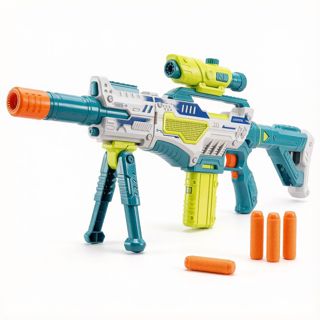
| Soft-Bounce Alloy Edition 6-Shot Blaster (MOQ 12, 9.48 USD, ABS/EVA) | Lowest inventory exposure; documented material supports golden-sample QC. Electroplated finish may conflict with low-price impulse positioning. Testing cost per unit high. |
|---|---|
| Pump-Action Foam Dart Shotgun Blaster (MOQ 54, 3.55 USD, ABS/EVA) | Moderate exposure with documented material; good balance for market testing. Packaging and testing setup spread over 54 units—ask if custom packaging has a separate minimum. |
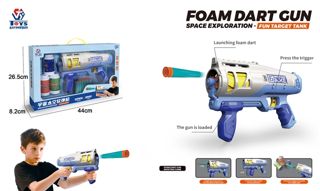
| Electronic Scoring Target and Foam Dart Blaster Set (MOQ 72, 4.20 USD, ABS/EVA) | Higher value-add with electronics; requires button-cell compartment verification (screw closure, tool access, warning labels) before function testing. |
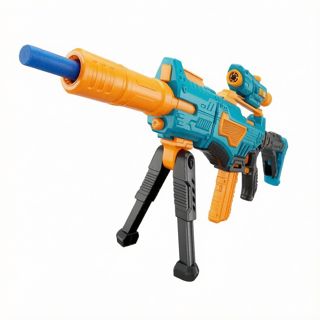
| Tactical 6-Dart Foam Blaster (MOQ 216, 2.28 USD, material unspecified) | Best unit price, but highest exposure among listed options. Material not documented—ask for TDS or material spec before committing to a large volume. |
Which MOQ Band Fits Your Buying Scenario?
Match the MOQ to your demand certainty, not to the lowest number on the page.
If you are testing a new channel or a new product line, choose a low-MOQ SKU like the Soft-Bounce Alloy Edition (MOQ 12) or the Pump-Action Foam Dart Shotgun Blaster (MOQ 54). You pay more per unit, but you limit your downside if the SKU does not sell. This is the classic 'start low, reorder winners' strategy—it lets you validate demand before scaling.
If you have proven demand from existing wholesale customers or a track record on a specific SKU, move to a higher-MOQ option like the Tactical 6-Dart Foam Blaster (MOQ 216) to capture the lower unit price. But only do this if you have the cash to hold the inventory and the channel to move it. A lower unit price does not help if it sits in a warehouse for six months.
For a diversified first order, follow the precedent of a successful importer: mix several low-to-mid MOQ SKUs (e.g., 6 SKUs at 50–72 units each) rather than betting on one high-volume SKU. This spreads risk and lets you learn which models your customers actually prefer.
Total Cost: MOQ Is Not the Price You Pay
The listed unit prices (2.28–9.48 USD) are FOB figures, but your landed cost per unit is what matters. For the Tactical 6-Dart Foam Blaster at 2.28 USD with MOQ 216, freight and customs per unit will be lower than for the Soft-Bounce Alloy Edition at 9.48 USD with MOQ 12, simply because you ship more units in one container. If you cannot sell 216 units quickly, the holding cost and capital lockup may erase the unit price advantage.
Packaging setup is a hidden cost that scales with MOQ. Custom blister or display packaging often has its own minimum and tooling fee, separate from the product MOQ. For the Electronic Scoring Target and Foam Dart Blaster Set at 4.20 USD with MOQ 72, a custom box might require a 300-unit minimum, forcing you to over-order. Before committing, request a full breakdown: product cost, packaging cost, tooling amortization, and QC inspection fees.
Testing allocation is another per-unit cost that does not scale linearly. A single ASTM F963 test for a foam blaster might cost hundreds of dollars, but the cost per unit drops as order volume rises. At MOQ 12, the test cost per unit is prohibitive; at MOQ 216, it is negligible. Do not assume the test is included—ask whether the quoted price covers compliance testing or if it is billed separately. Also, confirm which test report covers which lot; paperwork that does not match the lot is not paperwork.
Freight disputes start with vague Incoterms. Confirm whether the FOB quote names a specific port (e.g., Shantou or Shenzhen) and the Incoterms version. A quote that says 'FOB' without a named place is not a complete quote.
Sample to Mass: Verify Before You Scale
A low MOQ lets you test a product with minimal risk, but a sample is not a production unit. A booth sample is often a hero unit: hand-polished or tuned for display, not representative of mass production. When you order the Pump-Action Foam Dart Shotgun Blaster at MOQ 54, request a pre-production sample from the actual tool, not a photo or a Fair sample. Ask for the tool number and revision on the sample label, and compare it to the production standard.
For foam blasters, performance verification is critical but often undocumented. Do not rely on catalog FPS or range claims—request a TDS that specifies dart type, muzzle velocity, and test conditions. If the supplier cannot provide a TDS, ask for a test protocol: which dart, which distance, which chronograph. For ABS/EVA materials, request Shore hardness and tear strength data from the TDS. If the supplier cannot provide a TDS, mark that cell as 'ask TDS' and treat the material as unverified.
The sample-to-mass transition is where cost overruns happen. A low MOQ order (e.g., 12 units of the Soft-Bounce Alloy Edition) may be produced on a different line or with different tooling than a high-volume order. Ask the supplier to confirm that the mass production tool is the same as the sample tool, and request a golden sample for comparison. If customization is involved (colors, branding), the revision control becomes even more critical—a small change in electroplating or foam density can alter performance and compliance.
Compliance and Testing: One Short Check
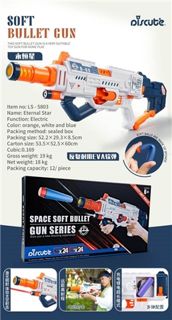
For foam blasters sold in the US or EU, expect ASTM F963 or EN71 testing—but do not rely on a single certificate for all markets. Confirm which standard applies to your destination, and ask for the test report that covers your specific lot. For electric blasters (e.g., the 48-Dart Electric Soft Bullet Blaster), button-cell compartment safety is a separate check: screw closure, tool access, and warning labels must be verified before function testing. A certificate that does not match your lot or market is not paperwork—it is a marketing slide.
FAQ
What MOQ should I expect for a first foam blaster order?
Catalog MOQs range from 12 to 288 units depending on the SKU. For a first order, choose a low-MOQ option (12–72 units) to test the market, unless you have proven demand and can handle the inventory risk of a higher MOQ.
How do I know if a lower unit price is worth the higher MOQ?
Calculate your total landed cost per unit: add freight, duties, warehousing, and testing costs to the FOB price. If you can sell through the higher volume within your cash flow cycle, the lower unit price may improve margin; otherwise, the holding cost may erase the savings.
What hidden costs should I ask about before signing a PO?
Ask for a breakdown of packaging setup (tooling fees and minimums), QC inspection fees, compliance testing costs, and freight (confirm Incoterms version and named port, e.g., FOB Shantou). Hidden MOQs can apply to custom packaging, so confirm whether the product MOQ and packaging MOQ are the same.
How do I verify foam blaster quality before mass production?
Request a pre-production sample from the actual tool, not a photo or a trade-show hero unit. Compare the sample to a sealed golden sample on color, fit, flash, and function. Ask for a TDS that specifies material (e.g., ABS/EVA), Shore hardness, and any performance claims like dart velocity.
Which certification applies to foam blasters sold in the EU or US?
Expect ASTM F963 for the US and EN71 for the EU, but confirm which standard applies to your destination market and request the test report that covers your specific lot. For electric blasters, button-cell compartment safety is a separate check—verify screw closure and warning labels.
Can I negotiate a lower MOQ if I accept a higher unit price?
Often yes. Suppliers may lower MOQs if you accept a higher unit price, simplify the design, or commit to reorders. Ask about tiered MOQs and price breaks above the listed minimum to plan a scale-up strategy.
Sources
Request a Quote
Ready to compare foam blaster options for your market? Request a quote with your target MOQ and destination, and ask for a full landed-cost breakdown including packaging, testing, and freight. Use the decision framework above to choose the SKUs that fit your cash flow and quality requirements.