
Do not print "Nerf-compatible" on your OEM dart pack unless your legal team clears it. Compatibility language is a trademark and safety minefield, not a marketing slogan. For private-label buyers, the safe path is to document neutral dimensional specs—tip type, shaft diameter, foam length, pack count—verified against a sealed golden sample, and to route any "compatible with" phrasing through legal review before it touches a printed carton. This article walks importers, Amazon sellers, and distributors through the verification and approval steps that keep a compatibility claim honest and defensible.
Key Takeaways
- Use neutral dimensional language (e.g., "fits standard 12mm foam dart barrels") instead of third-party brand names—this avoids trademark exposure while still communicating fit.
- The sealed golden sample on the QC shelf is the only true reference for colour, fit, flash, and function; photos, emails, and booth samples do not count as production standards.
- Any compatibility claim must be reviewed by legal before print approval—no exceptions; unauthorized use of a trademark like "Nerf" can trigger listing removal or legal action.
- AQL numbers and defect classes belong in the PO inspection plan, not in a catalogue sentence; buyers who want a number must get it from the agreed plan.
- Certificates (e.g., CPC, UKCA) must be mapped to the specific lot, SKU, and market; a type-test report does not automatically cover a later production lot.
What Can You Customize on an OEM Dart Pack?
An OEM dart pack is your design, your brand, and your risk. The factory builds to your specifications, but you own the dimensional accuracy and the claims you make on the box. Customizable elements include pack count, tip type (foam, suction, or dart-style), foam length and diameter, shaft material (ABS, EVA, plastic), colour and surface finish, packaging design, and printed branding.
Ask the factory for the sealed golden sample and its revision date before you specify. That physical piece is the reference for every dimension you will print. If you approve a photo instead of the sample, you are approving a guess.
Customization Options: What's Possible, What It Costs
| Pack count (e.g., 10, 20, 50 darts) | Custom per your spec; MOQ varies by factory |
|---|---|
| Tip type (foam, suction, soft dart) | Standard tooling; no new mold for existing types |
| Foam length and diameter | May require tooling modification; confirm with golden sample |
| Shaft material (ABS, EVA, plastic) | Material change possible; check compatibility and bond |
| Colour and surface finish | Custom; must match golden sample, not a photo |
| Packaging and printed branding | Custom; legal review required for any compatibility claims |
How to Verify Dimensions from the Golden Sample
The golden sample is your only trustworthy dimensional reference. On the QC shelf, it is sealed and labelled with a tool number and revision. When a production lot arrives, compare bulk units against that physical sample—colour, fit, flash, and function. If the factory shows you a booth photo at a fair, refuse it as a standard. Fair lighting lies; the revision card does not.
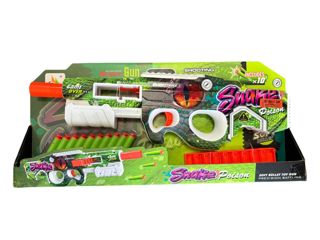
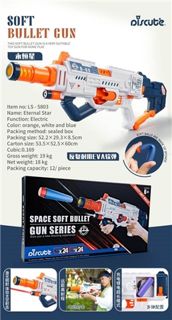
Record the exact tip type, shaft diameter, foam length, and pack count from the golden sample or your catalog SKU. Use neutral language in your spec sheet, such as "fits standard 12mm foam dart barrels." Avoid naming any third-party brand. The Manual UV Snake-Print Soft-Bullet Gun uses ABS/EVA materials; its dimensions are verified against its golden sample, not against a competitor's product.
Legal Review: Why 'Compatible With' Language Needs Approval
Compatibility claims are legal claims. Writing "works with Nerf blasters" on your pack implies a relationship or endorsement that may not exist. It also risks trademark infringement if the brand name is protected. Your legal team must review any such phrase before it goes to print.
The safest alternative is to describe the fit in dimensional terms, not brand terms. For example, "designed to fit standard 12mm foam dart barrels" is neutral and testable. That wording does not require brand permission, and it survives scrutiny better than a claim that names a competitor.
PO Inspection: AQL and Defect Classes Belong in the Plan
Do not rely on a factory's general claims about quality. AQL numbers and defect classes must be written into the PO inspection plan, not pulled from a catalogue sentence. If your plan specifies an AQL of 2.5 for major defects, that is your number. If it does not, you have no number.
Failed lots are isolated, defect class is recorded, and release happens only after rework. Your inspection plan should define what constitutes a major or minor defect (e.g., flash that interferes with fit, colour mismatch beyond a tolerance) and the rework protocol. Ask the factory: "What AQL and defect classes are specified in the PO inspection plan for this lot?"
Packaging and Booking: Where Claims Are Won and Lost
The box is the last place a compatibility claim can fail. If you print "compatible with [brand]" without legal sign-off, you have a liability on the shelf. If you ship a carton with a tracking label missing required content—manufacturer, date, lot—you have a customs problem. Both are avoidable with the same discipline.
Write packaging specs into the booking instruction: double-wall cartons, corner boards, ECT rating, pallet height. A claim is won on the booking file, not on a thank-you note. Every certificate—CPC, UKCA, VOC—must map to the specific lot and SKU. A report that does not match the lot is not paperwork; it is a problem.
Certificate-to-Lot Mapping: Matching Paper to the Product
A type-test report or golden-sample certificate does not automatically cover a later production lot. Importers must match the report's SKU, materials, colours, and production date to the PO. If the factory offers one certificate for multiple markets or product types, reject it. Ask for a mapping: which certificate covers which market, lot, and test for this SKU?
For EU sales, note that EC type-examination certificates under Directive 2009/48/EC remain valid until 1 February 2031, subject to transition rules. Confirm each shipment is covered by a current, lot-matched certificate.
Worked Example (Illustrative, Not a Real Shipment)
Imagine a US Amazon seller orders 10,000 units of a 24-dart pack (SKU 1234) from a Chenghai factory. The pack says "fits standard 12mm foam dart barrels." The golden sample, sealed on the QC shelf, has a revision date of June 2026. The seller's legal team approves the neutral wording. The PO inspection plan specifies AQL 2.5 for major defects, with major defined as darts that do not seat in the barrel or foam that splits on insertion.
At inspection, the factory isolates 200 units with a colour mismatch (minor defect class). They rework and re-inspect. The seller's agent reviews the certificate-to-lot mapping: the CPC matches SKU 1234, production date July 2026. The booking instruction specifies double-wall cartons and corner boards. The shipment clears customs and arrives without damage. The claim is defensible because the wording was neutral, the sample was golden, and the paperwork matched the lot.
FAQ: OEM Dart Pack Compatibility Claims
Can I print "Nerf-compatible" on my dart pack?
Only if your legal team explicitly clears it. Unauthorized use of a trademark like "Nerf" can lead to listing removal, legal action, or customs seizure. Use neutral dimensional language instead.
What is the minimum order quantity (MOQ) for a custom dart pack?
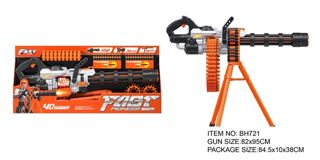
MOQ varies by factory and design. For example, MOQs in our catalog range from 8 units for a battery-operated rifle to 500 for a DIY blaster, but a custom pack may have a different MOQ. Confirm the MOQ with the factory before committing to a PO.
Do I need a mold for a custom dart pack?
If you change the tip type, foam length, or shaft shape, you may need a new mold or tooling modification. Standard pack configurations with existing tooling require no new mold. Confirm with the factory which parts are standard.
How do I verify that my darts fit a specific blaster without naming the brand?
Measure the barrel diameter and dart dimensions from the golden sample, then describe the fit in neutral terms (e.g., "fits barrels with a 12mm inner diameter"). Test the actual darts against the blaster you have in hand, but do not print the brand name without legal approval.
Will the factory sign an NDA to protect my design?
Most OEM factories will sign an NDA if you ask. Include confidentiality clauses for your specs, golden sample details, and packaging artwork. Mold ownership should be defined in the contract: typically the buyer owns the mold if they paid for it.
What happens if my inspection plan does not specify AQL?
Then you have no agreed defect threshold. AQL numbers must be in the PO inspection plan. Without them, the factory can release lots that fail your expectations, and you have no contractual basis for rejection.
Sources
Request a Quote for Your OEM Dart Pack
Ready to source a dart pack that is safe, compliant, and defensible? Send your dimensional specs, pack count, and packaging artwork to our team. We will verify against the golden sample and provide a custom quote with a clear MOQ and lead time. For product reference, see the Manual UV Snake-Print Soft-Bullet Gun as an example of a golden-sample-verified blaster.