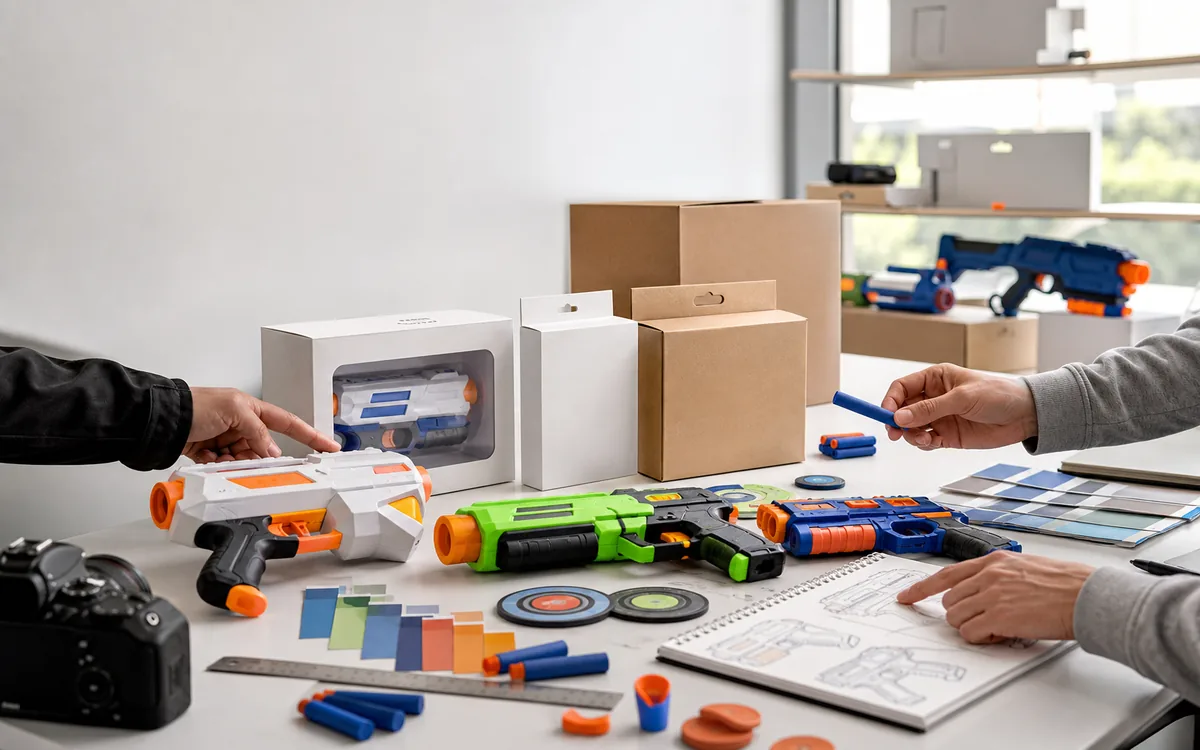
OEM and ODM foam crossbow kits can be customized in colorway, projectile type, target inclusion, packaging, and printed instructions — but the customization that matters most is not the logo. It is whether the product, the refill darts, the target, and the instruction sheet all speak one vocabulary. Approve the complete kit story only after every component and operating step is fixed.
A common myth among first-time importers is that a crossbow kit is a single SKU. In practice it is a system: the blaster, the projectile identity, the target, the warning placement, and the gift narrative all have to be signed off together. Lock the crossbow color and leave the dart tip or warning placement open, and the second production lot will not match the first. That is a retailer chargeback, not a quality debate.
Key Takeaways
- The kit is the SKU. Crossbow colorway, projectile identity (suction cup versus hook-and-loop), target inclusion, and instruction sequence should be approved as one unit, not as separate line items.
- A sealed golden sample on the QC shelf — not a photo and not a trade-show booth unit — is the only enforceable standard for color, fit, flash, and function on subsequent lots.
- Projectile toys carry eye, puncture, force, and improvised-projectile risk regardless of how soft the foam feels, so warning placement belongs in the design gate, not the print stage.
- Tooling terms — fee, ownership, storage period, and what happens if the tool sits idle — must be written into the contract; a handshake is not a tooling policy.
- Reorder rhythm drives your MOQ decision: a channel that reorders every 6–8 weeks needs color consistency across lots more than it needs a lower first-order quantity.
Customization Options for OEM Foam Crossbow Kits
| Crossbow colorway (OEM — your design) | Full custom color to your Pantone or reference sample; requires your artwork or color standard and a sealed golden sample. Tooling: only if the shell geometry changes, otherwise new color run on existing tool. |
|---|---|
| Crossbow colorway (ODM — our existing design + your brand) | Pick from the factory's existing colorways; no new tooling. Fastest path to a branded kit. |
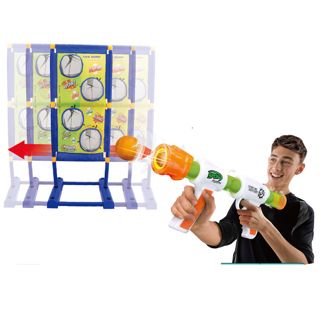
| Projectile identity (suction cup vs hook-and-loop vs plain foam) | Can be mixed within one kit. Must be fixed in the golden sample because tip material, length, and fit affect both function and warning language. |
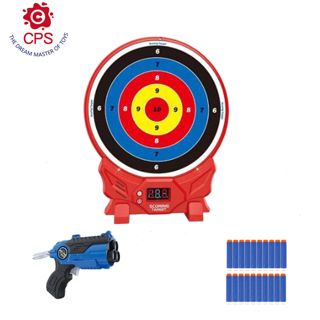
| Target inclusion (window cling, stand target, bottle target, inflatable) | Decide whether the target ships in-box or as a separate accessory SKU. This changes carton dimensions and the gift narrative. |
| Instruction sequence and language | Customizable: step order (cock, load, aim, fire), language set, and diagram style. Warning placement is part of the instruction approval, not a print afterthought. |
| Packaging and private label | Open box, closed box, or blister; your logo, brand story, and barcode. Artwork proof required before print. |
| MOQ | varies by spec — the factory's existing crossbow SKUs sit in a 63–120 piece band per color; a fully new tooled design is a different conversation. |
| Tooling cost | varies by spec — depends on whether shell geometry changes. New color on an existing tool is not a mold cost; a new shell is. |
| Sample lead time | varies by spec — existing-design sample is faster than a new-colorway or new-shell sample. Confirm against your target ship window. |
| Mass production lead time | varies by spec — depends on tool status, color run, packaging print, and whether the target and darts are produced in the same facility. |
What parts of a foam crossbow kit can actually be customized?
Everything the buyer sees can be customized: crossbow colorway, projectile tip type, target style, packaging format, logo, instruction language, and the warning block. What cannot be customized away is the safety assessment. Foam darts, suction-cup projectiles, and launcher parts still need eye, puncture, force, and improvised-projectile assessment — the material being soft does not remove the risk class.
The practical split is cosmetic versus structural. Cosmetic changes — color, print, logo, packaging, instruction language — usually run on the existing tool and are the right first OEM step. Structural changes — a new shell, a new cocking mechanism, a different limb geometry — require a new tool and a different commercial conversation. For a first private-label crossbow kit, start cosmetic. Prove the channel, then invest in structure.
One customization decision buyers often miss: whether the target ships inside the box. A kit with an included window-cling target reads as gift-ready; the same crossbow sold without a target reads as a refill purchase. That single choice changes your carton dimensions, your shelf presence, and your reorder pattern.
How do you run the OEM/ODM process from inquiry to shipping?
Treat the process as a sequence of approvals, not a sequence of emails. Each step below has a checkpoint and a question to put to the factory.
Inquiry and specification. Send your target market, age grade, colorway reference, projectile preference, target decision, and packaging format. Checkpoint: the factory confirms it can quote against your spec, not against a generic crossbow. Ask: which existing tool number and revision would produce my kit, and what changes if I alter the colorway?
Quotation and commercial terms. The quote should separate unit price, tooling fee (if any), sample cost, packaging cost, and shipping terms. Checkpoint: tooling fee, ownership, storage period, and idle-tool outcome are stated in writing. Ask: if I pay a tooling fee, who owns the tool, where is it stored, and for how many years?
Sampling and proofing. You receive a physical sample, not a photo. Checkpoint: the sample becomes the sealed golden sample once you approve it, and it stays on the QC shelf as the bulk comparison piece. Ask: will you seal this approved sample and compare bulk against it for color, fit, flash, and function?
Tooling or mold (only if the design is structurally new). Checkpoint: tool number and revision are recorded, and the contract freezes ownership and storage. Ask: what is the tool number and revision for my order, and what is the release condition if I move production later?
Mass production. Before the run starts, the line must be cleared of the previous SKU's labels, colors, and work instructions. Checkpoint: a line-clearance record exists for your changeover. Ask: what is your line-clearance procedure between colorways and SKUs, and can I see the record?
Quality control and inspection. The inspection plan belongs on the PO, not in a catalog sentence. Checkpoint: a failed lot is isolated, the defect class is recorded, and release happens only after rework. Ask: what is the agreed inspection plan on the PO, and which defect classes do you record?
Packaging and label check. This is where mixed labels from a previous SKU reach a retailer if line clearance was skipped. Checkpoint: your barcode, warning block, and language set are verified against the approved artwork. Ask: can you show the pre-shipment label and packaging check against my approved artwork?
Shipping and documentation. Confirm which test file covers which market and which lot. Checkpoint: certificate-to-market-to-lot mapping is documented. Ask: which test file covers which market and which lot for this SKU?
Reorder. The first order proves the kit; the second order proves the factory. Checkpoint: bulk color and function match the sealed golden sample. Ask: what is the reorder lead time, and how do you hold color consistency across lots?
Worked example (illustrative, not a real shipment)
A buyer orders roughly 3,000 foam crossbow kits for two destinations: a US toy retailer and an EU gift wholesaler. Same crossbow, same dart count, same target. The packaging differs: the US carton carries an English warning block and a retail barcode; the EU carton carries a different language set and a different responsible-person panel.
The US lot clears. The EU lot is held at the packaging step because the warning block on the EU carton still shows the US language set — the printer ran the US artwork revision, and no one checked the artwork against the destination. The crossbow and darts are fine; the paperwork and the printed warning are not. The fix is a reprint and a re-label, not a re-manufacture, but it costs a week and a repack.
The lesson is not about that buyer's luck. Two destinations in one purchase order create two approval chains, and the warning block, language set, and responsible-person panel must be frozen per destination before the packaging run starts. One approved sample per destination, one sealed golden sample per colorway, and a line-clearance record per changeover.
Which warning and compliance points belong in the crossbow kit design gate?
Projectile toys are assessed for eye, puncture, force, and improvised-projectile risk, and that assessment should happen before the toy function is finalized. For an Australian projectile toy that launches a projectile more than 300 mm or with kinetic energy greater than 0.08 joules, the packaging or instructions need the required eye and face warning. If your destination includes Australia, that threshold belongs in your spec sheet from day one, because it changes the warning block and possibly the projectile.
Button-cell compartments are a second design gate. If your kit includes an electronic target or a sound-and-light module, the compartment must close with a screw, must require a tool to open, and the warning must be placed before anyone discusses how cute the toy is. A compartment that opens with fingernails does not ship.
Third, keep paperwork mapped to market and lot. A UKCA file and a VOC file are different papers; one certificate does not cover both. A phthalate test should cover the accessible plasticized components and the current restricted list for your target market. Reusing one certificate across markets fails not because the certificate is wrong, but because the file no longer matches the lot.
Timing caution: the Digital Product Passport, GPSR, and toy safety directive requirements are separate regimes. Do not merge them into one deadline. Where the official text does not confirm the date this product category actually applies, write that the timeline is not confirmed from official text rather than assuming a mandatory date.
What MOQ and tooling logic should a crossbow kit buyer expect?
MOQ tracks the tool, not the toy. A crossbow kit made on an existing tool in an existing colorway has the lowest MOQ because the factory is only changing labels and packaging. A new colorway on the same tool sits in the middle. A new shell geometry requires a new tool and a higher commitment.
For reference, the factory's existing crossbow and blaster SKUs sit in a 63–120 piece band per color, with target-set SKUs and electronic variants at the higher end. A fully new tooled design is a different conversation and should be quoted separately. Do not assume a low MOQ applies to a new mold.
The tooling decision is really a volume decision. If you own the design and your channel can absorb the volume, a tool makes sense because you control the geometry, the color, and the revision. If you need speed and a low first order, choose stock plus your logo: pick an existing crossbow, print your brand on the box and the instruction sheet, and skip the mold entirely. That is the honest recommendation for a first private-label run.
How should sampling and lead time be planned for an OEM crossbow kit?
Sampling is the cheapest insurance in the whole project. A physical sample lets you check color against your reference, fit of the dart in the barrel, flash on the molded parts, and function of the cocking and trigger sequence. A photo cannot do any of that. Buyers who approve from a photo pay for it on the second lot.
Plan lead time around the slowest component, not the crossbow. If the target is produced in a different facility, or the packaging printer is running a new language set, that is the schedule driver. Confirm the sample lead time and the mass production lead time separately, and confirm them against your retail ship window rather than against a general promise.
A reorder rhythm of every 6–8 weeks — common in party-favor and impulse channels — puts pressure on color consistency. That is exactly why the sealed golden sample matters. The argument that ends a color dispute is the physical piece on the QC shelf, not an email thread.
How do you protect your branding and your tool in a crossbow kit OEM deal?
Start with an NDA before you share artwork, color standards, or packaging design. That is standard and reasonable to request at the inquiry stage.
On tooling, freeze four things in writing: the fee, who owns the tool, how long it is stored, and what happens if the tool sits idle. A buyer who pays a fee without those four clauses can end up unable to move production later. Tooling policy is a document, not a handshake.
On branding, keep your logo, packaging artwork, and instruction design as your property, and require the factory not to sell your branded configuration to another buyer. If the crossbow itself is an existing factory design, your protection is the packaging and the brand, not the shell — which is another argument for owning the tool only when your volume justifies it.
How do you choose a foam crossbow kit supplier in China?
Shortlist on process, not on price alone. A supplier who can show a sealed golden sample, a written line-clearance procedure, a tooling policy with ownership and storage terms, and a certificate-to-market-to-lot map is a different risk class from one who quotes the lowest unit price and answers questions with a photo.
Ask for the tool number and revision for your kit, the inspection plan that will appear on the PO, and the reorder lead time. If a supplier cannot answer those three questions, the crossbow is not the problem — the process is.
For target-set assortments that pair a blaster with an electronic scoring target, the button-cell compartment check and the warning-block placement belong in supplier qualification, not in a post-order surprise. Buyers sourcing electronic target sets should request the compartment and warning documentation before requesting a quote.
FAQ
What is the minimum order to customize a foam crossbow kit with my logo?
It depends on whether you change the tool. Printing your logo on an existing crossbow and its packaging usually runs at the factory's existing color MOQ, which for current crossbow and blaster SKUs sits in a 63–120 piece band per color. A new shell geometry or new colorway on a new tool is a different, higher commitment. Confirm the exact MOQ against your chosen tool and colorway before you budget.
How much does a sample cost, and can I get a custom sample before placing a bulk order?
Yes, a physical sample is the standard first step for an OEM crossbow kit, and you should insist on it rather than approving from a photo. Sample cost varies by spec — it depends on whether the sample uses an existing tool or a new colorway, and whether custom packaging is printed. Ask for the sample cost and the sample lead time separately from the mass production lead time.
Who owns the mold if I pay a tooling fee for a custom crossbow design?
Ownership should be stated in the contract, not assumed. Freeze four terms in writing: the tooling fee, who owns the tool, the storage period, and what happens if the tool sits idle. Buyers who pay a fee without those clauses can lose practical access to their own tool later. Ask for the tool number and revision that will produce your order.
Can you print our logo and packaging, and put our brand on the instruction sheet?
Yes. Logo, packaging artwork, brand story, barcode, instruction language, and warning block are all part of private-label customization. The warning block and language set must be frozen per destination before the packaging run, because a mixed or mismatched warning is the most common reason a shipment gets held at the packaging step.
Will you sign an NDA before we share our crossbow kit design and packaging artwork?
Request an NDA at the inquiry stage, before you share artwork, color standards, or packaging design. It is standard and reasonable. Keep your logo, packaging artwork, and instruction design as your property, and require that your branded configuration is not sold to another buyer.
What lead time should I plan for a 3,000-piece OEM crossbow kit order?
Plan around the slowest component, not the crossbow. If the target is produced elsewhere or the packaging printer is running a new language set, that drives the schedule. Confirm sample lead time and mass production lead time separately, and check both against your retail ship window. Ranges vary by spec, so treat any quoted number as tool-and-colorway specific.
What warning or safety requirements apply to a foam crossbow kit for the US, EU, and Australia?
Foam darts, suction-cup projectiles, and launcher parts still need eye, puncture, force, and improvised-projectile assessment. For an Australian projectile toy that launches a projectile more than 300 mm or with kinetic energy greater than 0.08 joules, the packaging or instructions need the required eye and face warning. For the US and EU, button-cell compartments, phthalate testing of accessible plasticized components, and market-specific paperwork must be mapped to the lot. Confirm the applicable regime and its actual application date against official text for your destination.
Sources
Send your crossbow kit spec for a custom quote
Send your target market, age grade, colorway reference, projectile preference, target decision, and packaging format. The reply should confirm which existing tool and revision fits, what changes if you alter the colorway, and what the sample and production schedule looks like. The best time to freeze the kit story is before the mold is cut — not after the second lot arrives.