Yes — foam ball refills can be run as OEM or ODM on an existing EVA ball blaster line, but the launch gate is physical, not commercial: match the refill to the retained production sample before you print a single bag. A refill package is a compatibility promise, and that promise has to be backed by ball dimensions and lot control. If you own the artwork and the blaster tooling and can commit to a real program, go OEM. If you want your logo on an existing ball spec with the shortest path to shelf, go ODM or Stock+Logo. This page covers how a toy gets made step by step, where tooling money actually goes, what QC looks like at each stage, and the seven refill data fields to collect before any wholesale order.
How Is a Toy Made, Step by Step?
Design intent comes first, and for a refill it is unusually narrow: you are not designing a toy, you are specifying a consumable that must feed through someone else's mechanism. The design brief for a ball refill should state nominal diameter, foam grade, color reference, pack count, bag format and the host blaster models it is intended to serve. Get this wrong and no amount of good molding saves you.
Proofing turns the brief into a physical sample. Ask the factory for a pre-production refill sample built to the brief plus a written comparison against your retained production sample — diameter, weight, color, and how it feeds. This is the step where a 'close enough' ball becomes a jam complaint six months later. Keep at least one sealed sample of the approved refill and one of the host blaster's original ball.
Tooling or plate-making follows only after the sample is signed. For foam balls the cost driver is usually the forming mold or die and any print plate for bag artwork, not complex multi-cavity injection tooling. For the blaster itself, injection molds for ABS shells dominate the budget. Ask for a tooling list in writing that separates mold cost, plate cost and first-article cost — a single lumped 'mold fee' hides what you actually own.
Production is where the material decision shows up on the invoice. EVA foam is the common body material for refill balls and darts; some ball formats are specified in PU instead. Your purchase order should name the material grade, not just 'foam', because the same nominal diameter in a different density behaves differently in the feed mechanism.
Assembly and packing carries the most private-label exposure. Bags get heat-sealed, zip-locked or header-carded; cartons get a lot code. If your bag closure is a heat seal, there is no reseal after opening — decide whether that matches your channel. A resealable zip is friendlier for repeat-play retail but adds a closure component to the BOM.
QC and shipping close the loop. Final inspection checks ball diameter against the approved sample, pack count against the declared quantity, and label text against the approved artwork. Then cartons ship, typically FOB, with the lot code tying every bag back to a production window. None of these steps require a third-party lab to be meaningful — they require a written standard and a sample to compare against.
Who Owns the Mold, and What Does Tooling Actually Cost?
You pay for the tool once, and the tool should be yours. For a ball refill line the moldable item is the ball itself; the bag artwork is a print plate, not a mold. For the blaster, the injection molds for the ABS shell are the real capital. Ask which line item is a mold, which is a plate, and which is a one-time first-article charge — they have different ownership and different reuse economics.
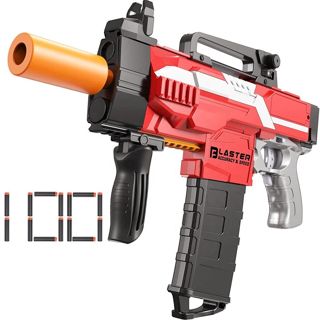
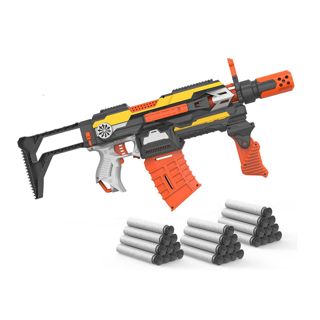
Reference catalog data shows where MOQ sits across an EVA ball blaster line. The Space-Theme EVA Ball Blaster carries a reference MOQ of 72 units with 24 units per carton and a reference price of 3.86 USD; the Pump-Action EVA Ball Target Set is recorded at a reference MOQ of 1 with 12 units per carton and a reference price of 9.8 USD. Treat both as catalog references only — reconfirm sample, current quote, age evidence and destination documents before you plan a PO.
Choose OEM if you own the design or the host blaster tooling and your volume justifies paying for a dedicated ball mold plus dedicated print plates. Choose ODM if you want your brand on an existing ball spec and can accept the factory's dimensions and pack format. Choose Stock+Logo if you need speed and a low entry quantity and your only customization is a sticker or a printed bag over an existing ball.
Do not buy a refill mold before you have confirmed the host ball's nominal diameter and the feed behavior on your retained sample. A mold cut to the wrong nominal is scrap metal, and the cheapest time to discover that is before the PO, not after.
Quality Control at Each Stage
Incoming material check is the first gate. Confirm the foam sheet or pellet supplier's material declaration matches the grade you specified, and that color masterbatch matches your reference. For a refill this is where a color shift or a density change enters the program permanently.
In-process checks cover forming, cutting and print. Ball diameter and roundness get measured against the approved sample; printed bag artwork gets compared to the approved proof for spelling, pack quantity and any compatibility sentence. Watch the compatibility wording specifically — it is the sentence most likely to drift between revisions.
Final inspection checks pack count and lot identity. Open bags from the top, middle and bottom of the carton and count the contents against the declared quantity. Verify the lot code on the bag matches the lot code on the carton. A refill with no lot identity cannot be traced if a batch is questioned, and a pack-count mismatch is a returns problem in every channel.
Certification is a separate conversation from QC. Catalog records for this product family list standards such as EN71, ASTM F963, CE, 10P, CPSIA, CPC, EMC and 3C across blaster SKUs, but a catalog listing is not a test report. According to the applicable standards bodies, EN71 and CE apply to EU placement and ASTM F963 and CPSIA to the US market; if your destination market requires documentation, ask for the report covering the exact SKU and the exact production window you are buying, and confirm the applicable documents for your destination before the PO — not after.
Process at a Glance
| Stage | What happens / Timeline / QC check |
|---|---|
| Design & brief | Refill spec written: ball diameter, foam grade, color reference, pack count, bag format, intended host blasters / varies by spec / Brief signed against retained production sample |
| Proofing & sample | Pre-production refill sample built to brief and compared to retained sample / varies by spec / Diameter, weight, color, feed behavior recorded |
| Tooling / plate-making | Ball mold and bag print plate cut; tooling list issued in writing / varies by spec / First article reviewed against approved sample |
| Production | Foam forming/cutting and bag printing at declared material grade / varies by spec / Diameter and roundness vs approved sample |
| Assembly & packing | Bag closure applied (heat seal, zip or header card); pack count set / varies by spec / Pack count vs declared quantity; closure type confirmed |
| Final QC & shipping | Lot code applied to bag and carton; cartons consolidated / varies by spec / Lot identity match; artwork, spelling, compatibility wording verified |
Worked example (illustrative, not a real shipment)
One order: 10,000 private-label EVA ball refill bags, split across two destinations — 6,000 to a US Amazon prep warehouse, 4,000 to a UK distributor. The US portion is specified in a printed polybag with a header card; the UK portion needs a resealable zip bag and a bilingual label. Same balls, two pack formats, two label proofs.
The step that would hold this shipment is final packing, not production. The balls come off the line fine. The US header-card bags run clean. The UK zip bags arrive with the closure component short, or the bilingual label proof was approved in a version that still carries the old pack quantity after the count was changed. Either one stops the UK cartons at final inspection while the US cartons are already cleared to ship.
The fix is procedural and cheap: freeze both bag formats in writing with separate artwork approvals, and require a pre-production packing sample for each format — one header card, one zip. Two samples cost less than one air-freighted rework. This scenario is illustrative; it is not a real order and no specific factory or shipment is described.
FAQ
What is the minimum order to customize foam ball refills?
It depends on how deep the customization goes, and you should never accept a blanket number. Catalog reference MOQs on this blaster line range from 1 unit for the Pump-Action EVA Ball Target Set to 72 units for the Space-Theme EVA Ball Blaster, but a refill program with custom tooling or custom print plates will sit far above those figures. Ask for the MOQ attached to each specific option — stock ball with a sticker, stock ball with a printed bag, or a custom-molded ball — and get it in the quote.
Do I pay for samples, and what does a refill sample cost?
Expect to pay freight at minimum, and expect to pay for tooling-related first articles once you go beyond stock. Some suppliers quote sample parts at no charge with freight on the buyer; that is a commercial concession, not a standard, and it does not cover a custom ball mold. Get the sample cost, the tooling cost and the first-article cost as separate lines so you can see which one you are actually approving.
Who owns the mold and the print plate?
You should, and it should say so in writing. If a supplier will not state mold and plate ownership in the contract, treat that as the answer. Ownership language should cover the physical tool, the artwork files you supplied, and a non-use clause preventing the tool or artwork from being run for another buyer. A tooling invoice is not an ownership document.
Can the factory print our logo and our own packaging?
Yes, that is the normal ODM/private-label path. You supply the logo and bag artwork, the factory prints the bag or applies the label, and the pack count and compatibility wording on that artwork are your responsibility to freeze. Approve a physical printed bag sample, not just a PDF proof — spelling and pack-count errors survive PDF approval and die at the bag sample.
Will you sign an NDA before we share our design and artwork?
Ask for it before you send drawings, color standards or test requirements, not after. The scope should cover the ball specification, the bag artwork, and any host blaster data you share. A mutual NDA plus a written non-use clause on your tooling and artwork is the minimum package; if a supplier resists signing before receiving your files, move on.
How do we word the compatibility claim on the bag?
Word it from the retained production sample and nothing else. State the ball diameter and the host blaster models you have physically verified, and avoid naming any brand you are not licensed to reference. If a ball has not been matched to a host blaster on your sample bench, it does not go on the bag. This one sentence drives more returns than any other line of copy on the package.
Sources
- 4 5cm EVA Foam Darts Refill for Nerf Blasters Blue Red Tip
- 50Pcs/lot Rounds Foam Ammo Replace Bullet Balls Pack Children Kids Toy Compatible Rival Blasters Apollo Refill Bullet Ba
- Are these safe for children?
- DX DA XIN Foam Balls 40 PCS for Air Popper Gun Blaster - Refill Bullets Toys Foam Blasters Replacement Bullet Launcher
Send Your Refill Spec for a Custom Quote
Bring the ball diameter, foam grade, color reference, pack count, bag format and intended host blaster models. We will come back with the customization options, the MOQ attached to each one, and the sample and tooling lines quoted separately so you can decide where the money goes. If you are still scoping the host product, start from the Manual and Electric & Automatic blaster ranges to pick the line your refill will serve, then spec the ball around it.