Approve a private-label foam crossbow only after its distinct components and its refill path are documented on paper — a sealed physical golden sample, a named tool number and revision, a limb and string specification, a projectile fit check, defined artwork zones, warning text, carton protection, and refill packs as their own line item. A crossbow is not a rifle with a different shell; the limb, string and latch are a separate launch system with their own failure modes, and a generic blaster checklist will miss them.
Procurement planning for private-label foam crossbows runs on product-specific controls rather than a reused dart-blaster template. The sections below give you the checkpoint sequence, the supplier questions that force answers into the PO, and an illustrative worked example of where a shipment actually gets held. Prices, MOQs and lead times vary by specification and are set by the quotation on your PO — not by a catalogue sentence.
Key takeaways for crossbow buyers
- Specify the launch mechanism as its own sub-assembly: limb material and geometry, string type and tension, latch and trigger interface, and the projectile fit test. A rifle or pistol checklist does not cover these.
- Make the sealed golden sample the production standard. Bulk is compared against that physical piece on colour, fit, flash and function; a photo approval is not a standard and usually costs you on the second lot.
- Name the revision on the PO. Tool number plus revision card travels with the order; a trade-show or Fair photo is a hero unit under exhibition lighting, not a production reference.
- Treat refill packs as a separate approval line with their own packaging, quantity and warning text — not as an accessory afterthought bolted onto the carton.
- Put the inspection plan and Incoterms version with named place in writing before production. Buyers who want a sampling number get it from the agreed inspection plan on the PO, not from a blog or a catalogue sentence.
Why does a foam crossbow need a different checklist than a foam rifle?
Because the launch mechanism is a different system. On a rifle or SMG the energy path is usually a spring or motor driving a piston; on a crossbow it runs through limbs that flex, a string that stretches and returns, and a latch that has to release cleanly every time. Those three parts create failure modes a generic blaster checklist does not ask about: limb creep after storage, string fray or stretch at the nock, latch drag, and a projectile that seats differently than it does in a barrel.
That is the contrarian part of this plan. Most buyers build one dart-blaster checklist, run every SKU through it, and assume the crossbow is covered. It is not. The specialty mechanism needs its own sample, its own functional test and its own spare-parts question, because a crossbow that fires three shots well and then loses string tension is a returns problem, not a manufacturing curiosity.
The same logic applies to the projectile. A crossbow bolt or dart that is specified only by the catalogue name — with no fit check against the actual nock and rail — is an unverified interface. Do not accept FPS, range or dart counts that are not in the supplied specification; if a supplier quotes a performance number, ask which test setup produced it and whether the same setup will be used on the production lot.
What must be locked in the private-label specification before tooling?
Lock the specification before any production deposit moves. That means a written, signed document that separates the crossbow from a generic blaster: the mechanism sample and its approved function, limb and string specification, projectile fit, artwork zones, warning placement, package protection and the refill pack. Vague drawings get built the cheapest way available, and the cheapest interpretation of a crossbow limb is not the one your sample showed.
Stage the money against the document. Tooling payments belong in stages tied to design sign-off and first parts off the mold; the production deposit follows a locked specification, a signed contract and an approved sample; the balance waits for a pre-shipment inspection. Confirm in writing who owns any mold or tool used for the crossbow before the tool is cut — owning a mold buys control of one tool, not exclusivity, and a competitor can cut their own.
Decide public versus owned tooling for the real reason. A public mold keeps minimums low and gets you to market fast, but competitors can rent the same shape. Own tooling adds cost and weeks. If your private-label story rests on the shell artwork and the packaging rather than on a unique mechanism, public tooling plus locked artwork zones is often the better commercial call.
Crossbow procurement checkpoints and their red flags
| Mechanism sample | What to check: a sealed physical golden sample held on the QC shelf, compared against bulk on colour, fit, flash and function. Red flag: approval given from a photo or an email description only. |
|---|---|
| Limb and string specification | What to check: material, geometry, string type and tension written into the spec, with a functional test on the assembled unit. Red flag: 'same as our other blaster' with no crossbow-specific line. |
| Projectile fit | What to check: the supplied projectile seated in the actual nock and rail, checked on the production lot. Red flag: performance figures quoted without a stated test setup. |
| Artwork zones | What to check: print-ready files with correct sizes, colours, barcodes and market labelling, mapped to defined zones on the shell and pack. Red flag: artwork approved as a rough layout with no dimensions. |
| Warnings and closure | What to check: warning text and placement confirmed, and where the SKU has a compartment, screw closure and tool access verified before any function discussion. Red flag: a compartment that opens with fingernails. |
| Package protection | What to check: a carton sample validated with the actual toy, inserts, labels and accessories, because failures cluster at the interfaces between components. Red flag: carton dimensions taken from a preliminary artwork file. |
| Refill packs | What to check: refill pack specified, packed and approved as its own item with its own quantity and warning text. Red flag: refills treated as a loose addition to the master carton. |
| Paperwork to lot | What to check: each certificate or file mapped to market, lot and the test it actually covers. Red flag: one document offered for two markets or two SKUs. |
| Tracking and labelling | What to check: manufacturer, date and lot content on the product or pack as required, with the compliance file matched to the SKU. Red flag: a barcode with no tracking-label content. |
| Incoterms | What to check: Incoterms version and named place written as actually booked. Red flag: FOB with no named place — the fastest route to a freight argument longer than production. |
Which certification applies to a private-label foam crossbow, and to which lot?
Certification is a mapping exercise, not a sticker. What you need is a document that names the market, the SKU and the test it covers. The same physical toy shipped to two markets can require different files, and a chemical test report is not a substitute for a construction and warning review. According to the Australian projectile-toy standard, that regime covers design, construction and warning labelling rather than only a chemical test report — so a clean chemical file alone does not close that market.
Keep the file matched to the lot, not to the factory door. A certificate that does not match the shipped lot is not paperwork. Where a warning regime applies to your SKU, confirm the warning text and its placement on the product and pack before the run; warning and closure questions belong ahead of any conversation about performance or play features.
One short compliance box for the private-label buyer: confirm the destination market, name the standard that applies to that product category, map each file to market plus lot, and store the sealed sample alongside the file. If the official text does not state when a requirement actually applies to this product category, write 'timeline not confirmed from official text' and plan around the confirmed rule you do have.
How should refill packs be planned as their own line item?
Refill packs are a second product, so plan them that way. They carry their own artwork, their own quantity statement, their own warning text and their own carton position. Buyers who fold refills into the master carton as a loose addition usually discover the problem at the retail counter, not at the factory: the pack does not match the crossbow, or the count does not match what the listing promised.
On the procurement side, refills also drive inventory decisions. They are the SKU most likely to be reordered between crossbow runs, so they need their own reorder point and their own quality check. If your refill pack shares tooling or a print run with the crossbow carton, say so in the spec; shared interfaces are where packaging failures appear.
How should packaging, artwork zones and carton protection be validated?
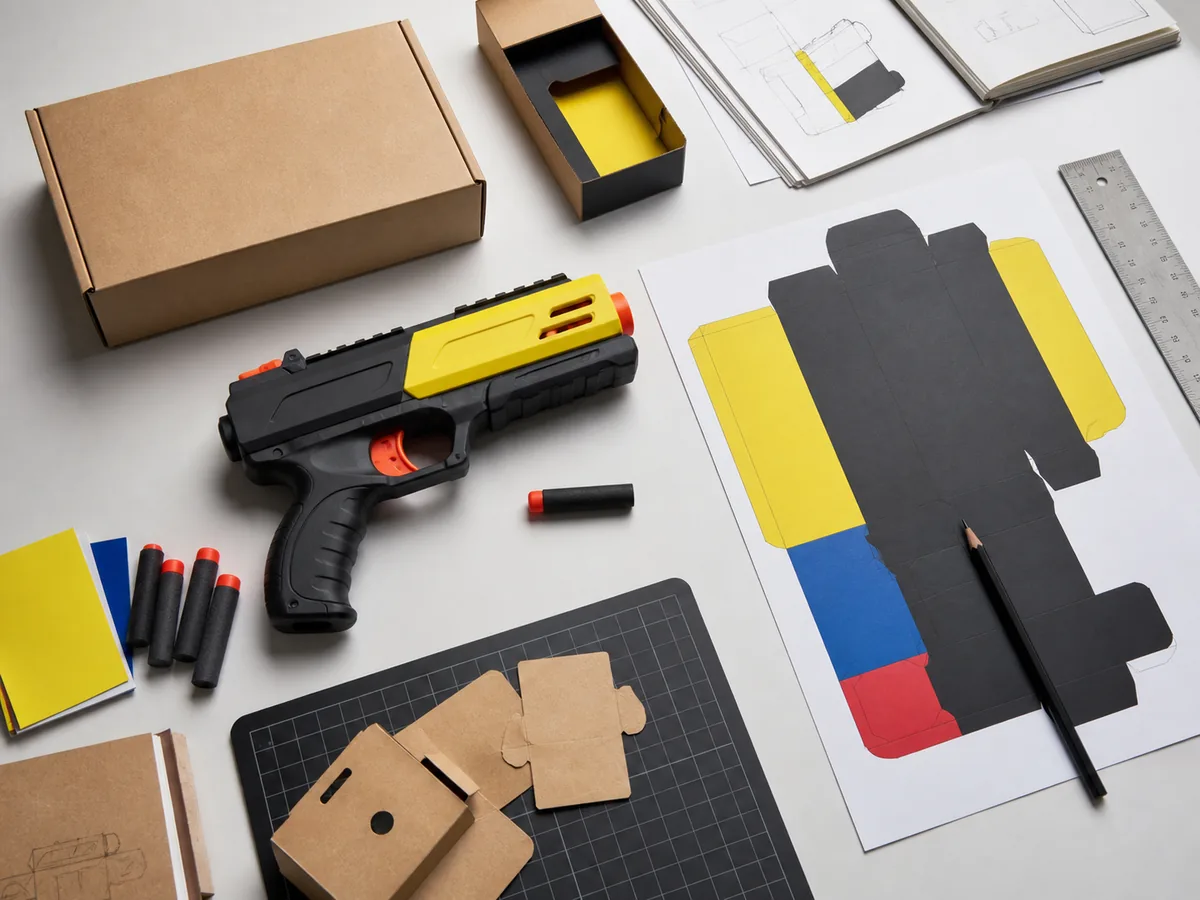
Validate with the real thing in the box. A carton sample should be checked with the actual toy, inserts, labels and accessories, because packaging failures often occur at the interfaces between components — where the limb meets the insert, where the refill pack presses against the shell, where the label sits under a fold. A carton approved from a preliminary artwork file has not been tested against any of that.
The same rule applies to dimensions. Package dimensions and quantity per inner or carton should be based on measured production packaging, not only a preliminary artwork file. Measured packaging is what your freight quote, your Amazon dimensions and your pallet plan are built from; a preliminary file is a guess with a logo on it.
Artwork zones need names. Define the zone, the file, the colour reference and who signs it off. If the crossbow shell carries a pattern across a parting line or over the limb, confirm on the sealed sample that the artwork aligns in production, not just on the render.
Worked example (illustrative, not a real shipment)
Worked example (illustrative, not a real shipment): a buyer places one order of private-label foam crossbows split across two destinations — one EU-bound carton set and one US-bound carton set — with the same crossbow shell but different pack artwork, different warning text and a refill pack included in each. The order is planned as a single production run with two packaging versions.
Where this typically gets held: the packaging step. The artwork zones were approved as a layout, not as measured production packaging, so the EU carton dimensions were taken from a preliminary file. When the carton sample is checked with the actual toy, inserts, labels and refill pack, the interface between the limb and the insert does not close cleanly, and the refill pack presses against the shell. The lot is isolated, the defect class recorded, and release waits for rework of the insert and the carton — not for a new crossbow.
The second hold point is paperwork. The US-bound cartons need manufacturer, date and lot content on the product or pack, and the compliance file matched to the SKU. If the buyer supplied one document for both destinations, the mapping has to be redone before either carton ships. Neither hold point is a mechanism failure — which is exactly why the crossbow-specific checklist has to cover packaging and paperwork, not just the launch system.
What should be written into the PO before production starts?
Write the commercial frame at the same time as the technical one. Incoterms version and named place, the agreed inspection plan, the defect-class recording rule if a lot fails, the refill pack as a separate line, and the packaging version per destination. The named place matters: FOB without a named place has started freight arguments that outlasted production, so state Shantou or Shenzhen as actually booked.
Agree the failed-lot rule in advance. On the floor, a failed lot is isolated, the defect class recorded, and release happens only after rework. Buyers who want a sampling number should get it from the agreed inspection plan on the PO, not from a catalogue sentence — and both sides should know before the run which defect classes trigger a hold.
Qualify a second supplier. Not because the first one is bad, but because a price increase or a capacity crunch on a specialty mechanism is expensive to absorb mid-season. Switching factories on a private-label toy may change the unit, the barcode or the visible product, which can force a new marketplace listing.
What to ask suppliers — RFQ checklist for private-label foam crossbows
1. Can you provide a sealed golden sample for this crossbow, and will bulk be compared against it on colour, fit, flash and function?
2. What is the tool number and revision for this crossbow, and will that revision card be the named production standard?
3. Which components are specific to this launch mechanism versus a generic blaster, and how is each one specified — limb material and geometry, string type and tension, latch and trigger interface?
4. How is the projectile fit verified against the actual nock and rail, and on which lot?
5. How is the refill pack specified, packed and approved as its own item, including quantity and warning text?
6. Does this SKU have a compartment or closure requirement, and what are the screw closure and tool-access details?
7. Which certificate or file covers which market, which SKU and which lot, and which test does each file actually cover?
8. What manufacturer, date and lot content appears on the product or pack, and how is the compliance file matched to the SKU?
9. What Incoterms version and named place will be written on the PO, and what is the agreed inspection plan?
10. What happens to a failed lot — how is it isolated, how is the defect class recorded, and what releases it?
11. What are the package dimensions and quantity per inner or carton, measured from production packaging rather than a preliminary artwork file?
12. Will a carton sample be validated with the actual toy, inserts, labels and refill pack before the run?
FAQ
Who supplies private-label foam crossbows with electric, manual and target-set assortments?
Suppliers that build foam blaster assortments usually list the crossbow alongside rifles, pistols and motorized units, so the assortment question is answered by the supplier's catalogue range rather than by the crossbow alone. Ask for the catalogue page that names each SKU, its material and its packaging version, then request the crossbow's own mechanism sample — do not accept a rifle sample as proof of the crossbow mechanism.
What MOQ should I expect for a private-label foam crossbow order?
MOQ varies by specification, tooling choice and packaging version, and no single figure applies across suppliers. A public-mold crossbow with standard packaging normally sits at a lower minimum than an owned-tool program with custom artwork and a refill pack. Get the number in the quotation with the packaging version and destination stated, and treat any MOQ quoted without those two details as provisional.
Can I approve a private-label crossbow from photos or a trade-show sample?
No. A booth sample at a trade fair is often a hero unit, and exhibition lighting flatters colour and finish. Require a sealed physical golden sample held on the QC shelf, with the tool number and revision labelled, and make bulk comparison against that piece the written standard. Buyers who approve only a photo typically pay for it on the second lot.
How do I handle warnings and closure for a crossbow with an electronic compartment?
Treat it as a compartment and warning problem before you discuss the toy function. Check screw closure, tool access and the warning text, and confirm the warning placement on the product and pack. A compartment that opens with fingernails does not ship — the closure design and the warning are the same conversation, and both belong in the spec before production.
Should the refill pack be ordered with the crossbow or as a separate SKU?
Order it as a documented line item within the same production run, but approve it as its own item. That gives you one shipment with two packaging versions, while keeping the refill pack's artwork, quantity and warning text independently signed off. It also gives you a cleaner reorder path when refills sell faster than the crossbow.
What paperwork should travel with the lot?
Manufacturer, date and lot content on the product or pack as required, plus a compliance file matched to the SKU and the destination market. Map each certificate or report to the market, the SKU and the test it actually covers; a document that does not match the shipped lot is not paperwork. If the official text does not confirm when a requirement actually applies to this product category, record that the timeline is not confirmed from official text.
Sources
Get a private-label crossbow quotation
Send your crossbow specification — mechanism sample status, limb and string requirements, projectile fit, artwork zones, warning text, packaging version per destination and refill pack — and ask for a quotation that states MOQ, packaging version and Incoterms with a named place. If you are still comparing foam blaster platforms, our Manual Modular QBZ-Style Foam Rifle and Graffiti M416 Electric Automatic Foam Rifle pages show how mechanism and packaging data are presented for a wholesale enquiry.