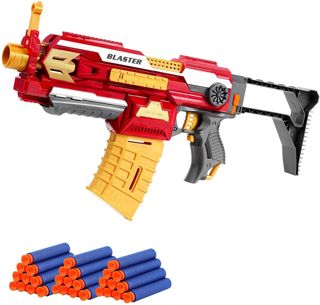
Refill basket observation cannot be answered from this evidence set. The material available for a 2026-10-09 scoped catalog snapshot covers four blaster SKUs by format, recorded material, packing, reference MOQ, units per carton and reference price — and nothing about which projectile packs buyers attach to a blaster, how often they reorder, or where stockouts occur. If you are deciding which projectile ecosystem deserves deeper inventory, the honest starting point is a per-SKU record comparison plus a compliance checklist, not an attachment-rate claim.
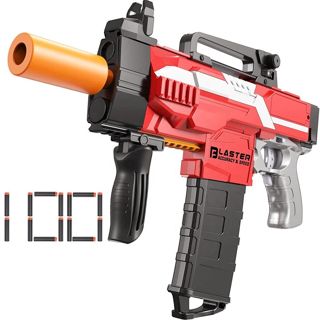
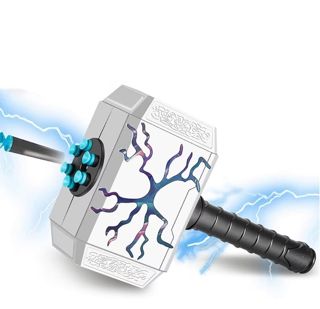
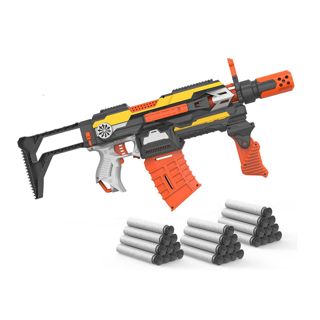
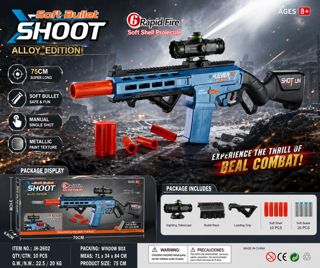
Two formats appear in the record. Dart-format electric blasters — a 48-dart unit and a 12-dart unit, both recorded as ABS/EVA in a Display Box at a reference MOQ of 50 and 10 units per carton — sit alongside a ball-format blaster recorded as EVA in a Window box at reference MOQ 72 and 24 units per carton, and a foam dart crossbow recorded as ABS/EVA in a Display Box at reference MOQ 63 and 21 units per carton. Reference prices span 9.65, 7.28, 3.86 and 4.65 USD. Treat every one of those as a dated catalog record that needs sample, quote, age evidence and destination-document reconfirmation before it becomes a purchasing number.
What follows is narrow on purpose: one dated fact from the last 14 days, an explicit list of what that fact cannot be stretched into, and the buyer questions a sourcing team actually needs answered before committing slotting or open-to-buy to any single projectile platform.
What does the 2026-10-09 catalog snapshot actually document?
The only hard, checkable record here is the catalog snapshot itself, dated 2026-10-09, capturing four SKUs at a single point in time. As of late September 2026, industry commentary describes collectible hunting as a defining consumer behavior for 2026 — buyers pursuing specific items within a line rather than accepting whatever assortment is presented. That is a behavioral claim from a dated commentary piece, not a measurement of projectile-pack attachment or of any blaster category's volume.
Everything else — the collectible framing, the refill-basket question in the title — is either qualitative signal or an open gap. If a supplier or an internal deck presents the collectible trend as proof that refill packs sell through at a given rate, that is a category error, not a data point.
What can a four-SKU snapshot not tell you?
Do not read volume, revenue or rank out of a four-SKU snapshot. The record shows that within the dart format, the 48-dart electric blaster carries a higher reference price than the 12-dart electric blaster, and that the ball-format SKU carries the lowest reference price of the four. That is a catalog-level association between format, packing and reference price. It is not evidence that dart platforms outsell ball platforms, that one format holds better margin, or that either deserves a larger inventory position. Four SKUs in one snapshot cannot carry that weight.
Do not convert the collectible-hunting commentary into a sales statistic. It describes a behavior pattern; it does not quantify refill attachment, repeat timing, stockout frequency or price sensitivity — none of which appear anywhere in the supplied material. Those four topics are exactly the ones the title asks about, and the correct output for each is 'unknown, needs direct observation.'
Do not treat MOQ, carton structure or packing as a stable commercial term. The snapshot records reference MOQ of 50 with 10 units per carton for the two dart-format electric units, 72 with 24 units per carton for the EVA ball blaster, and 63 with 21 units per carton for the crossbow. Reference means reference: reconfirm current quote, sample condition and destination documents before you build a landed-cost model on them.
Do not turn a compliance framework into a certification claim. The Toy Safety Directive, CPSC toy guidance, 16 CFR Part 1250 and ASTM F963, the Children's Product Certificate process, the GPSR, tracking-label guidance and small-parts guidance all describe process requirements. None of them certifies any of these four SKUs, any factory, or any packing configuration. A standard, a guidance page or an audit framework is not a certificate.
What can you compare across the four SKUs?
Format and packing split cleanly in the record. The dart-format electric units and the crossbow are recorded in Display Box packing with ABS/EVA material; the EVA ball blaster is recorded in a Window box with EVA only. For a retail or e-commerce buyer, that difference is operational before it is strategic: Display Box versus Window box changes shelf presence, carton cube, and how much of the product a shopper can see without opening anything.
MOQ and carton structure move together in this snapshot. Higher units per carton pairs with higher reference MOQ on the EVA ball blaster and the crossbow; the two dart-format units sit at the lower reference MOQ with fewer units per carton. If your warehouse takes full cartons only, that pairing sets your true entry order size — not the headline MOQ alone.
Reference price spread is wide enough to matter for channel fit. At 9.65 and 7.28 USD, the dart-format electric units read as a higher-ticket electric assortment; at 3.86 and 4.65 USD, the EVA ball blaster and the crossbow read as promotional or basket-filler price points. That is a positioning observation from catalog data, not a margin conclusion. For a private-label or OEM programme, the practical move is to sample both ends of that spread and confirm which one your channel can actually sell through before you commit tooling or artwork.
Compliance due diligence to run per SKU, not per supplier
Age grading and small-part risk attach to the actual configuration, so run the check per SKU rather than per factory. Projectile products introduce detachable components and packaging pieces that need the same review discipline as the blaster body, and according to CPSC small-parts guidance, age grading is tied directly to that assessment. A single 'our factory is compliant' statement does not cover four different configurations.
For the US market, according to CPSC toy safety guidance, children's products intended primarily for children 12 or younger that fall under a CPSC-enforced safety rule require third-party testing and a written Children's Product Certificate issued by the domestic manufacturer or importer, based on results from a CPSC-accepted laboratory, in English. The certificate is product-specific — it identifies the product, cites each applicable rule, and names the responsible parties and testing laboratory. It is not a blanket factory certificate, and it should never be presented as one. Confirm current filing requirements with US Customs and Border Protection for your specific product rather than assuming a single rule covers everything you ship.
For the EU, according to Toy Safety Directive 2009/48/EC, toy products placed on the market must meet the applicable essential safety requirements, with CE marking and an EU Declaration of Conformity matched to the product scope. The GPSR is a separate instrument from the Toy Safety Directive, and importer, manufacturer and product-identification information should be mapped to your market role before publication of any listing. Keep packaging wording and product markings as controlled fields — they change with the SKU, and according to CPSC tracking-label guidance, tracking information should be permanent and support product identification where applicable.
Because the blaster and the projectile are separate purchase decisions at retail, document them separately. If a projectile pack is sold as an accessory rather than as part of the tested configuration, that distinction belongs in your compliance file, not in a footnote.
How to close the refill-basket gap yourself
Since no basket or attachment data was supplied, generate your own. Run a short controlled observation on a live listing or a pilot door: record which projectile packs appear in the same order as a blaster, note the interval between first blaster purchase and first refill purchase, and log whether the refill pack goes out of stock while the blaster stays available. Those three observations answer the compatibility, repeat-timing and stockout questions that no catalog snapshot can.
Keep compatibility as a written field, not an assumption. If the 48-dart electric soft bullet blaster and the 12-dart unit share a projectile type in your range, say so explicitly in your listing copy and your buyer sheet; if they do not, say that too. Cross-SKU confusion is a merchandising problem you can fix with copy and pack naming — and it is cheaper to fix before a container lands than after.
Scale carefully. One format earning deeper inventory should be a conclusion you reach after a pilot, not before. Start with the format whose reference price and carton structure fit your channel, hold the second format as a test SKU, and revisit after one full repeat cycle.
FAQ
Does the data show demand growing for dart or ball blasters?
No. The supplied material contains no demand, volume or sales data for either platform. The only platform-level differences documented are catalog records: format, recorded material, packing type, reference MOQ, units per carton and reference price. Treat any growth claim about either format as unsupported by this evidence.
Which format should I stock deeper — dart or ball?
The evidence cannot pick one for you. What it does show is a price and carton split: dart-format electric units recorded at 7.28 and 9.65 USD with reference MOQ 50 and 10 units per carton, versus an EVA ball blaster at 3.86 USD with reference MOQ 72 and 24 units per carton. Choose based on your channel's price ceiling and carton handling, then validate with a pilot door.
What is the best season to place a refill or projectile order?
Unknown from this material — no seasonality, repeat-timing or stockout data was supplied. Build your own timing signal by tracking the interval between blaster purchase and first refill purchase in a pilot listing, and by watching whether refill packs stock out before blasters do.
Do these SKUs come with certification I can rely on?
No certification is established for any of the four SKUs. The catalog snapshot is a catalog record only — not certification, age suitability, licensing, stock or capacity evidence. For the US, children's products under a CPSC-enforced rule need third-party testing and a product-specific Children's Product Certificate based on a CPSC-accepted laboratory's results; for the EU, CE marking and an EU Declaration of Conformity must be matched to the product scope. Request both per SKU.
Can I treat the reference MOQ and prices in this article as quotes?
No. They are dated catalog records from a 2026-10-09 snapshot and must be reconfirmed. Reference MOQ 50, 63 and 72, units per carton of 10, 21 and 24, and reference prices of 9.65, 7.28, 4.65 and 3.86 USD are starting points for a sample request and a current quote, not commitments. Verify sample condition, current pricing, age evidence and destination documents before you raise a PO.
How do I check dart compatibility across my own assortment?
Write it down per SKU rather than assuming it. For each blaster in your range, record the projectile type it accepts, whether refill packs are sold separately, and whether the pack is part of the tested configuration or an accessory. Publish that mapping in your listing copy so cross-SKU confusion is resolved at the point of sale instead of in customer service.
Sources
Need the catalog records and samples side by side?
If you are weighing which projectile platform earns deeper inventory, we can share the current catalog records, sample options and packing data for the electric and manual ends of the range so your team can compare them against your own channel economics. Bring your target market and price ceiling, and we will tell you plainly which parts of the picture are still unknown.