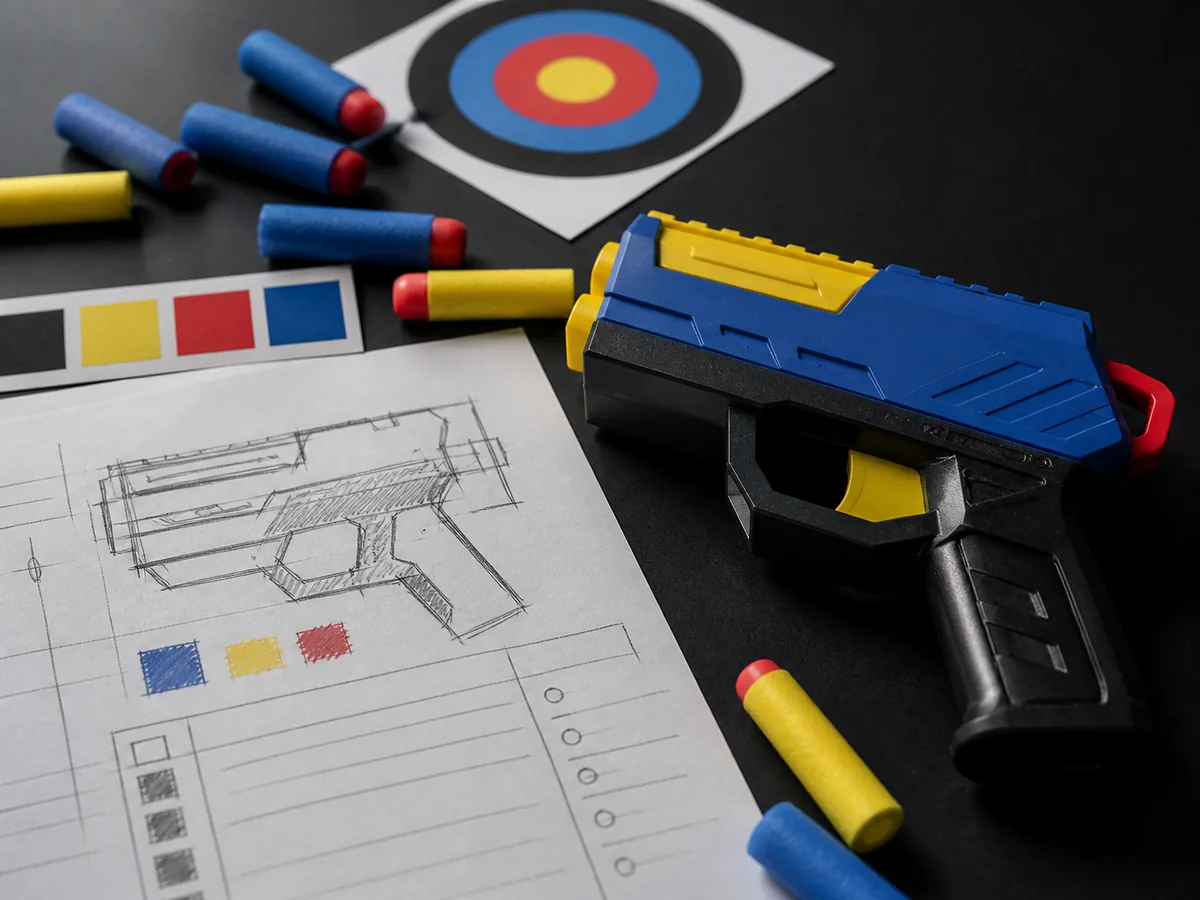
Quarantine only the units you can tie to a specific lot, report and certificate — hold everything else only if your own evidence is missing. Broad category holds on every foam blaster you stock cost you sell-through; a hold scoped by model, lot and test report costs you one purchase order. That is the whole decision rule for foam projectile buyers.
The reason is structural, not seasonal. Foam projectile toys sit inside the US mandatory toy standard as a defined hazard class: ASTM F963 section 4.21 requires that projectiles are not small parts and cannot exert excessive force, and that stored-energy toys prevent the use of improvised projectiles (CPSC toy safety business guidance, codified at 16 CFR part 1250). A question about one SKU therefore lands on a specific clause, a specific test report and a specific age grade — not on the whole foam category. Your hold should mirror that precision.
Key Takeaways
- Scope the hold to SKU, lot and test report, not to "all foam blasters." A CPC is product-specific and is not a blanket factory certificate.
- Check the age grade first. CPSC testing and Children's Product Certificate requirements apply to products intended primarily for children 12 or younger; toys aimed at 13+ may still fall under ASTM F963 without triggering third-party testing and a CPC.
- For any stored-energy blaster, confirm the report covers ASTM F963 section 4.21: projectiles not small parts, no excessive force, and design that prevents improvised projectiles.
- Verify that the model number, factory address and report address match. A borrowed test report is the single most common reason a scoped hold turns into a full-container hold.
- Treat the July 8, 2026 electronic certificate filing requirement as a documentation deadline, not a safety finding — and confirm the date in current CPSC text before relying on it.
Did a new foam projectile rule take effect?
No new foam-projectile-specific rule is confirmed from official text in the material reviewed here, so treat "what took effect" as three separate questions rather than one. First, entered into force: the Toy Safety Directive 2009/48/EC has been in force since 2009, and it is a separate legal instrument from the General Product Safety Regulation 2023/988 — do not merge their dates into one deadline. Second, actually applies to this product category: whether a given foam blaster is a toy under EU or US rules depends on its age grading and how it is marketed, and that has to be read from the current consolidated text, not from a summary. Third, uncertain: for any recall or enforcement action tied to a specific foam projectile model, the timeline is not confirmed from official text in the material available here.
One date is confirmed and worth planning around: CPSC states that beginning July 8, 2026, importers of most regulated consumer products must electronically file certificates of compliance with US Customs and Border Protection via a Partner Government Agency Message Set. That is a filing-mechanism date. It is not a new projectile-performance requirement, and it is not the same as any EU deadline. If you have seen "2026" attached to a toy safety headline, check whether the source is describing this filing change, a standard edition, or a proposal — they are three different things.
Who is responsible for the CPC, the technical file and the shelf check?
Responsibility splits by role, and each role can verify something concrete. Manufacturers and their authorized representatives hold the technical file: bill of materials, resin grade and color, and the test reports that identify the product configuration, age grade and standard edition. Importers certify compliance and issue the CPC for covered children's products; the certificate must be based on testing at a CPSC-accepted laboratory, must be in English, and must carry seven required elements including product identification, the applicable rules, the certifying party's contact details, and date and place of manufacture. Distributors and retailers hold the shelf-side obligation: they can verify markings, tracking labels and lot identity, and they are the ones who pull product when a question is raised.
The practical point for a buyer is that "the factory is certified" is not a verifiable statement. A CPC is product-specific and should never be described as a blanket factory certificate. If a supplier sends a certificate that names no model, no rule citation and no date or place of manufacture, you cannot use it to scope a hold — you only have the factory's word.
What should change in your RFQ and documentation process?
Change the RFQ first. Add a line that asks the supplier to state, in writing, the model number, age grade, applicable standard edition, and whether the item uses stored energy to release the projectile. That last question determines whether ASTM F963 section 4.21 applies to your item at all, and it is a question most foam blaster quotes currently do not answer.
Change what you accept as evidence. A test report should identify the product configuration, age grade and standard edition, and the applicable edition should be read from the current regulation before you quote it to a retailer. For a multi-color or multi-material blaster, ask for component-level evidence rather than one sheet for the finished item — a declaration covering an empty shell does not automatically cover the populated assembly. Where a plastic part carries the safety argument, ask for the resin grade, color and additive package in the bill of materials, because generic names such as ABS or plastic are not enough for repeatable production and give you nothing to investigate against later.
Change how you store documentation. Resin lot or batch traceability is what links a molded toy back to a material supplier when a later chemical or mechanical result changes; without it, a hold has to expand. Keep the CPC, the test reports and the tracking-label artwork together per SKU so that a recall question can be answered in hours. Tracking information should be permanent and support product identification where applicable, and packaging markings should be treated as controlled fields — they change with the SKU, and a packaging change is a document change.
Change the golden sample. Approve a signed sample with color chips attached before production, and treat it as the physical reference for identity checks. When a question arrives, a sample check against your catalog SKU answers "is this even the affected item" faster than any email thread. The configuration fields a scoped hold depends on — material, age grading and packaging — should be recorded on the sample approval sheet for every SKU you carry.
What is still unknown about foam projectile recalls?
Unknown: whether any specific foam projectile model, brand or supplier is currently the subject of a recall notice. The material reviewed here contains no confirmed recall scope, no affected supplier list, no projectile-tip specification and no lot numbers. Any article or email that supplies those details should be checked against the issuing authority's own notice before you act on it.
Unknown: the application date of any pending change to toy safety rules for this product category. Where official text does not confirm an application date, the correct internal wording is "timeline not confirmed from official text" — not "mandatory from" a given day. Do not let a secondary article's headline year stand in for a legislative timetable.
Unknown: whether a given factory's current certificate covers the exact configuration you are importing. This one is resolvable by document request rather than by research, so it should never stay on the unknown list for more than a week.
Obligation checklist by role
| Manufacturer / authorized representative | Duty: hold the technical file — BOM, resin grade and color, test reports identifying product configuration, age grade and standard edition. Verify: request the report and confirm the model number matches your purchase order. Unknown: whether the file covers every color variant. |
|---|---|
| Importer (US, children's products) | Duty: certify compliance based on testing at a CPSC-accepted laboratory and issue the CPC with all seven required elements, in English. Verify: check the CPC cites each applicable rule and names the certifying party and the individual maintaining records. Unknown: whether your specific SKU falls under a children's product rule at all — that depends on age grading. |
| Importer (US, eFiling) | Duty: electronically file certificates of compliance with CBP via a PGA Message Set beginning July 8, 2026, per CPSC. Verify: confirm the date and scope in current CPSC text before building a process around it. Unknown: system readiness on your broker's side. |
| Distributor / retailer | Duty: verify product markings, permanent tracking information and lot identity on receipt; pull product when a question is raised. Verify: check that the tracking label resolves to a manufacturing lot, not just a batch of cartons. Unknown: whether your WMS stores lot data at unit level or only at PO level. |
| Any role, stored-energy blasters | Duty: confirm ASTM F963 section 4.21 coverage — projectiles not small parts, no excessive force, prevention of improvised projectiles. Verify: read the clause reference in the test report, not the marketing sheet. Unknown: whether the report reflects the current accepted edition. |
| Any role, EU market | Duty: meet the applicable essential safety requirements of Toy Safety Directive 2009/48/EC, with CE marking and an EU Declaration of Conformity matched to the product scope. Verify: map the declaration to the SKU; note that the GPSR is a separate instrument from the Toy Safety Directive. Unknown: consolidated text and scope changes applicable to your category — read the current text. |
FAQ
Do I need to pull every foam blaster I stock when I hear about a recall?
No — hold only what you can tie to the affected model, lot and test report, and hold the rest only if your own documentation is missing. A CPC is product-specific, so it lets you separate a covered SKU from a lookalike. If you cannot identify the lot, the hold expands by default, which is why lot data should live at unit or carton level.
Does every foam projectile toy need a Children's Product Certificate?
No. CPSC testing and CPC requirements apply to products designed or intended primarily for children 12 or younger. A foam blaster aimed at a 13+ audience may still fall under ASTM F963 requirements but would not need third-party testing at a CPSC-accepted laboratory or a CPC. Confirm the intended age grading before you assume either way.
What exactly does ASTM F963 require for projectile toys?
ASTM F963 section 4.21 covers toys that can fire projectiles: projectiles must not be small parts or must not exert excessive force on impact, and stored-energy toys must prevent the use of improvised projectiles. Ask your supplier for a report that cites the clause, and read the clause in the current accepted edition rather than a summary.
What should I ask my supplier for before releasing a held shipment?
Ask for four things in writing: the model number and age grade, the test report with its standard edition and configuration, the CPC with all seven required elements in English, and the tracking-label artwork. Also confirm that the factory address on the documents matches the address on your purchase order — a mismatch is the most common reason a scoped hold becomes a full-container hold.
Is there a 2026 deadline I should be planning for?
CPSC states that beginning July 8, 2026, importers of most regulated consumer products must electronically file certificates of compliance with CBP via a PGA Message Set. Treat that as a filing change and verify it in current CPSC text. For any toy safety rule change affecting foam projectiles, if official text does not state an application date, record it internally as not confirmed rather than as mandatory from a fixed day.
How much inventory should I hold while I investigate?
Hold at the smallest unit you can prove — ideally the affected model and lot only. Full-category holds are a last resort for when traceability is absent. If your supplier cannot provide resin lot or batch traceability, expect the hold to widen, because there is no way to link a molded part back to a material supplier when a later result changes.
Sources
Request a Quote
Send us the SKU, age grading and destination market, and we will return the configuration fields, documentation set and packaging details you need to scope a hold or clear one. If you are rebuilding an RFQ after a compliance question, tell us which fields your retailer is asking for and we will map them to the documentation set.