For camp programs, the buying decision for foam dart blasters starts and ends with operator controls, not with the product's shooting features. If your camp cannot document who authorizes blaster use, maintain a staff-to-child supervision ratio during play, and track each blaster by number from storage to return, stop the sourcing process before you compare a single FPS figure. This guide walks institutional buyers through a 12-step workflow that gates every purchase decision on the operator's ability to maintain supervision and equipment accountability, then translates the findings into a clear proceed or no-proceed call. The rules that matter — program permission, age labels, supervised-use requirements, protective eyewear, equipment numbering, dart refill tracking, locked storage, and incident procedures — are checked first. Only after those gates clear do you evaluate which SKU fits your lot size and budget.
The stakes are real. In December 2024, the CPSC issued a warning on NLFGUW Electric Gel Ball Blaster Toy Guns sold on Amazon.com, citing a violation of federal regulations for projectile toys and an eye injury hazard; the seller did not respond to a recall request. A separate July 2024 recall covered Victor Electric Folding Soft Bullet Toy Guns for a missing blaze orange tip and projectile eye injury hazard. None of this makes every blaster unsafe. It makes supplier verification and a written operating plan non-negotiable for any camp buyer.
Key Takeaways
- Gate on supervision first: Before reviewing any product spec, require a documented supervision model: named adult authorizer, staff-to-child ratio during play, and a designated play area. No document, no purchase.
- Check button-cell compartments before function: For any electronic blaster, verify screw closure and tool access for the battery door. If the compartment opens with fingernails, reject the SKU regardless of how appealing the toy function is.
- Map paperwork to the SKU and lot: CPC for the US market, UKCA for the UK, and VOC for the EU are different documents covering different tests. A certificate that does not match the specific SKU and lot is not paperwork you can rely on.
- Put the inspection plan on the PO: AQL numbers and defect classes belong in the agreed inspection plan attached to your purchase order, not in a catalog description. If the plan is not on the PO, do not release the order.
- Write tooling terms or walk away: If you pay a tooling fee, get written terms for fee amount, ownership, storage period, and idle-tool conditions before paying. A handshake is not a tooling policy.
What Changed Recently and Why It Matters Now for Camp Buyers
Regulators are paying close attention to projectile toys, and the pattern of recent actions should shape your sourcing checklist. The CPSC's December 2024 warning on the NLFGUW electric gel ball blaster centered on failure to comply with federal regulations for projectile toys and the resulting eye injury hazard. The seller had been issued a Notice of Violation but did not respond to the recall request. The product was sold online for about $29, which tells you this is not a niche compliance issue — it is a mainstream channel problem.
The July 2024 recall of Victor Electric Folding Soft Bullet Toy Guns adds a second lesson: the toy lacked the required blaze orange tip to distinguish it from a real firearm, and its projectiles posed an eye injury hazard. The importer was named as a toy factory in China, and the remedy required consumers to destroy the toy and send a photo for a refund. For a camp buyer, the operational takeaway is straightforward: verify the blaze orange tip on any realistic-looking blaster, confirm projectile compliance, and build a recall response plan into your program manual before the first dart is fired.
CPSC's Regulatory Robot can help you identify potentially applicable rules, but its screening result does not replace the actual rule text or your certification program. Use it as a starting point, not as your compliance answer.
Step 1: Document Program Permission and the Supervision Model
The first gate is not about the product at all. Write down who at the camp authorizes blaster use — a program director, a unit leader, or a named activities coordinator. Then define the staff-to-child ratio during play and the designated play area. If the camp cannot document this, the sourcing process stops here. This is the single most important operating control because every subsequent decision — age labels, eyewear, storage — depends on an adult being present and accountable.
Ask the supplier for nothing yet. Ask yourself and your camp operations team for a one-page supervision plan that names the authorizer, the ratio, and the boundaries of the play zone.
Step 2: Verify Age Labels and Warning Statements on Each Target SKU
Once the supervision model is documented, move to the product. Check each target SKU's catalog listing for age grading and any warning language. If the listing does not state an age grade, that becomes a formal supplier question — do not assume the product is appropriate for your camp's age range just because it is foam.
For the US market, remember that the EU toy-safety Regulation covers products for children under 14, and EN 71-8 covers activity toys like swings and slides — neither of those replaces your destination market's age grading requirements. The camp's age range must match the product's age label, and the label must be printed on the product or pack, not just in a digital listing.
Step 3: Run the Button-Cell Compartment Check on Every Electronic Blaster
For any electronic blaster on your shortlist, the battery compartment is a gate, not a detail. Verify screw closure, tool access, and the presence of the button-cell warning before you discuss the toy function. A cute electronic blaster that opens with fingernails fails this check and must be removed from the shortlist. US button-cell rules and the compartment door design are the same conversation — if the door is not secure, the product does not ship, no matter how well it performs.
This is a physical check, not a paperwork check. Ask the supplier for a production sample and test the compartment yourself with the tools a child would realistically have — fingers, a coin, a small screwdriver.
Step 4: Confirm the Eyewear Requirement and Who Supplies It
Projectile toys carry an eye injury hazard, and the CPSC's recent actions make the eyewear question unavoidable. Determine whether each blaster ships with protective eyewear or whether the camp must supply it separately. If the catalog does not state eyewear inclusion, add it to your supplier questions — do not assume goggles are in the box just because the product is foam.
For the camp's operating plan, write the rule: no eyewear, no play. That rule lives in your program manual, not on the product label.
Step 5: Build the Equipment Numbering and Accountability System
Equipment numbering is a buyer-side operational control, not a supplier feature. Define how each blaster will be numbered or tagged for camp inventory — a permanent marker on the stock, a printed label, or a color-coded band per cabin group. The system must let staff know, at any moment, which blaster is with which child and which blaster is in storage.
This is the accountability backbone of the whole program. If you cannot track a blaster from storage to play and back, you cannot supervise its use, and you should not buy it.
Step 6: Plan the Dart Refill and Inventory Tracking
Identify the dart type and count per the catalog name — do not invent counts beyond what the product name states. Then determine how refills are sourced and whether the camp can track dart inventory. Darts disappear, get stepped on, and end up in pockets; a camp needs a refill plan and a count-back routine after each session.
Ask the supplier for the exact dart type and the refill SKU. If the answer is vague, treat it as a red flag — you need a reliable refill source for a program that runs all summer.
Step 7: Define Storage and Charging Protocols
For electronic blasters, confirm the battery type and charging requirements. Then define a locked storage procedure for when blasters are not in supervised use. The storage location must be inaccessible to children outside program hours, and charging should happen only under staff supervision.
Rain, temperature cycling, sand, and dirt can affect outdoor toy joints, labels, batteries, and coatings — so the storage protocol should also protect the equipment from the elements between sessions.
Step 8: Map Market-Specific Paperwork to the Lot
For the destination market, list the required documents: a Children's Product Certificate (CPC) for the US, UKCA for the UK, and a VOC for the EU. Each document must cover the specific SKU and lot you are buying — not the factory door in general. UKCA plus a VOC are different papers covering different tests; you cannot use one certificate for both.
Also verify the tracking label content. A US children's lot shipped with a pretty barcode but no manufacturer, date, or lot information is not compliant. The CPC must be matched to the SKU, and the tracking label must carry the required content. Paperwork that does not match the lot is not paperwork.
Step 9: Get Tooling Ownership and Storage Terms in Writing
If you pay a tooling fee for a custom blaster, obtain written terms for the fee amount, tool ownership, storage period, and what happens if the tool sits idle. A buyer once asked who owned the tool after paying a fee, and the contract had not frozen storage years or release conditions. Tooling policy is a document, not a handshake. If the terms are not in writing, do not pay the fee.
Step 10: Require Line Clearance and Label Verification Before Production
Before production starts, require the supplier to confirm line clearance — meaning no previous SKU's labels, colors, or work instructions remain in the hopper. A new SKU once started with the last SKU's labels still in the machine; the line had to stop, clear, and restart. Line clearance is boring until a mixed label reaches a retailer. Ask for a label proof showing manufacturer, date, and lot before production begins.
Step 11: Lock the Golden Sample and Revision Control
Ask for the production standard sample with a tool number and revision label. Do not accept a booth photo from a trade fair as the production standard — fair lighting lies, and the revision card does not. The golden sample is the physical reference for your inspection; the photo is just a photo.
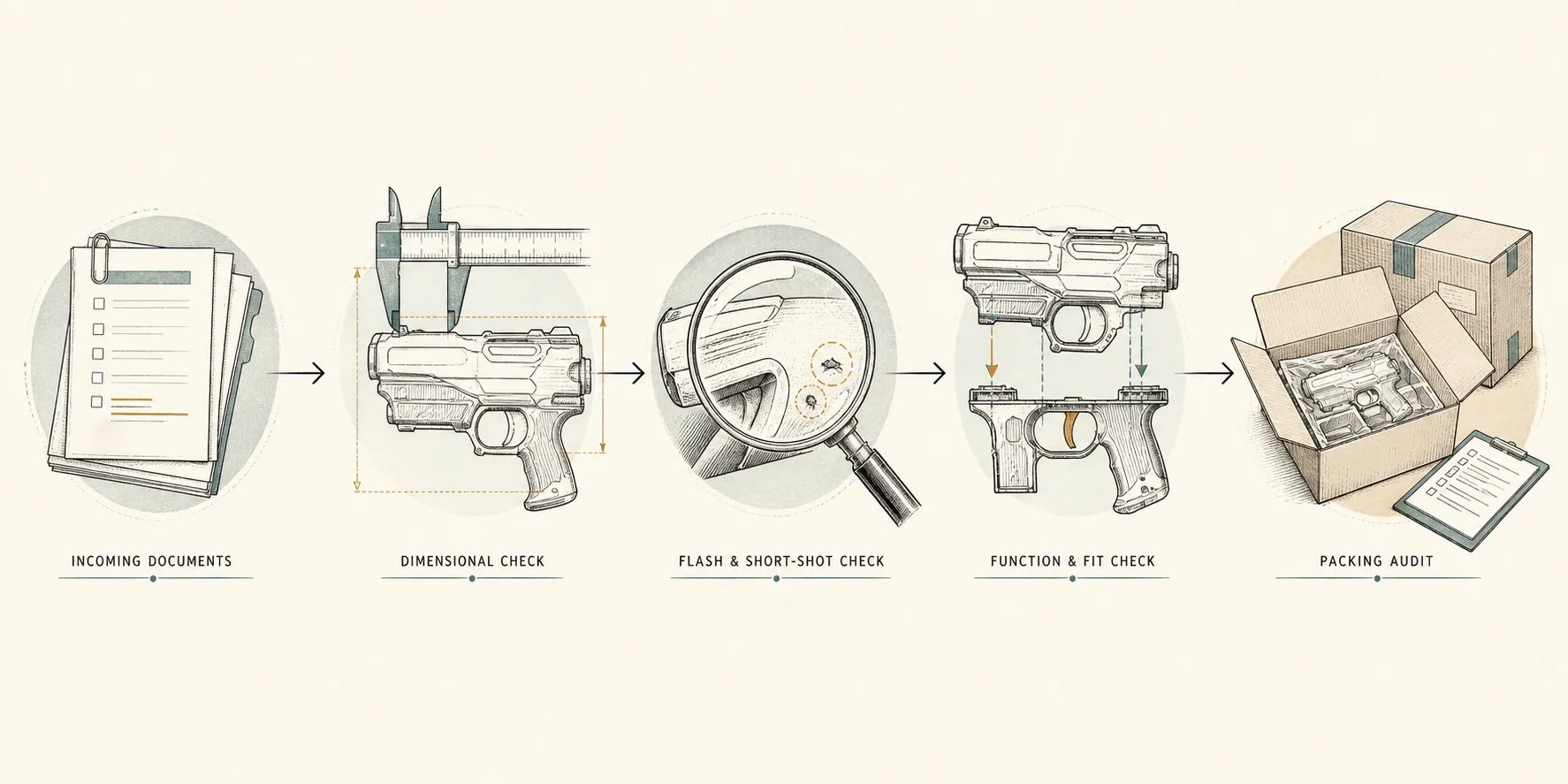
Step 12: Attach the Inspection Plan to the Purchase Order
The final gate is paperwork on the PO. Attach the agreed AQL, defect classes, and rework/release procedure to the purchase order. Do not rely on catalog statements; a buyer who wants a number gets it from the agreed inspection plan on the PO, not from a catalog sentence. If the inspection plan is not attached, do not release the order. On the floor, a failed lot gets isolated, defect class recorded, and released only after rework — that procedure should be written into your contract.
Supplier Vetting Checklist: What to Check at Each Gate
| Gate 1 — Supervision model | What to check: Named authorizer, staff-to-child ratio, designated play area. Red flag: Camp cannot document adult supervision; stop sourcing. |
|---|---|
| Gate 2 — Button-cell compartment | What to check: Screw closure, tool access, warning label on electronic blasters. Red flag: Compartment opens with fingernails; remove SKU. |
| Gate 3 — Market paperwork | What to check: CPC, UKCA, VOC mapped to specific SKU and lot. Red flag: Certificate covers factory door, not the lot; do not proceed. |
| Gate 4 — Tooling terms | What to check: Written fee, ownership, storage period, idle-tool conditions. Red flag: Terms not in writing; do not pay the fee. |
| Gate 5 — Inspection plan | What to check: AQL, defect classes, rework/release procedure attached to PO. Red flag: Plan not on PO; do not release the order. |
| Cross-cutting — Eyewear | What to check: Does the blaster ship with protective eyewear, or must the camp supply it? Red flag: Requirement unclear; write the rule into the program manual. |
| Cross-cutting — Blaze orange tip | What to check: Realistic-looking blasters have the required blaze orange tip. Red flag: Missing tip on a realistic design; recall risk. |
What to Ask Suppliers Before You Commit (RFQ Checklist)
Copy these eight questions into your RFQ. They cover the operating controls that matter for camp programs, not just the product specs.
1. What is the age grade for each target SKU, and is it printed on the product or pack? 2. Does the blaster ship with protective eyewear, or must the camp supply it separately? 3. What is the dart type and count per the catalog name, and what is the refill SKU? 4. For electronic blasters: what battery type is used, and what is the charging time and supervision requirement? 5. Which certificate (CPC, UKCA, VOC) covers which test for which market and lot? Can you provide the document mapped to the specific SKU? 6. What are the written terms for tooling fee, ownership, storage period, and idle-tool conditions? 7. Can you confirm line clearance procedures and provide a label proof showing manufacturer, date, and lot before production? 8. What is the golden-sample revision number and tool number for the production standard?
Worked Example: A 2,000-Unit Camp Order (Illustrative, Not a Real Shipment)
To see how the gates work in sequence, walk through a hypothetical order. A camp buyer plans to order 2,000 foam dart blasters — a mix of manual pump-action units for younger groups and electric blasters for older teens. Two destinations are involved: one lot to a US camp in Ohio and a smaller lot to a UK camp in Surrey.
Gate 1 passes: the camp director signs a one-page supervision plan naming two staff per 20 children during blaster sessions, with a fenced field as the play area. Gate 2 passes for the manual units, but the electric blaster's battery compartment opens with a fingernail — that SKU is removed from the shortlist and replaced with a model that requires a screwdriver. Gate 3: the supplier provides a CPC for the US lot mapped to the exact SKU and production date, and a separate UKCA file for the UK lot. The buyer checks that the UKCA is not the same document as the EU VOC — it is not; the UK file covers the UKCA marking, and the VOC is a separate EU document. Gate 4: the buyer pays a tooling fee for a custom color, but only after the contract states the fee is refundable if the tool is not used within 18 months. Gate 5: the PO includes the agreed AQL 1.5 for major defects and a rework-and-release procedure for any failed lot, so the buyer releases the order.
Where would the shipment be held? At Gate 3, if the supplier had tried to use one certificate for both the UK and EU lots, the buyer would have stopped the order. At Gate 5, if the inspection plan had not been attached to the PO, the buyer would not have released the funds. This is how the workflow protects the camp program: every failure point is caught before the product reaches a child.
Which Blaster SKUs Fit a Camp Program?
After the gates clear, you can look at the catalog with a camp lens. The SKUs below are listed with their material and MOQ as reference points for your lot planning. Remember: the MOQ is the supplier's minimum, not the camp's ideal order size, and no FPS, range, or dart count beyond the catalog name is available — do not invent those figures.
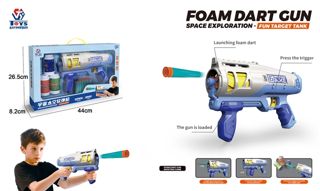
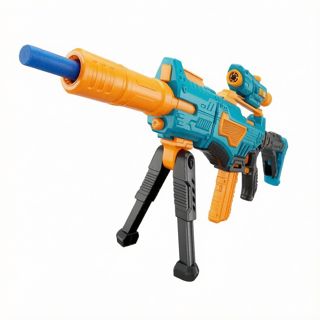
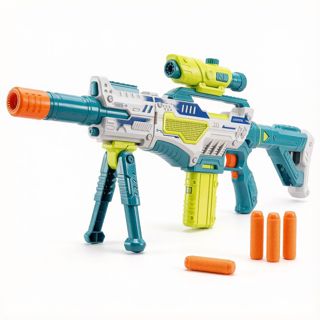
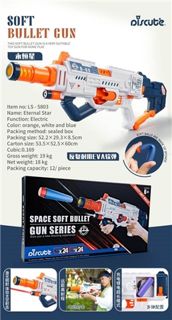
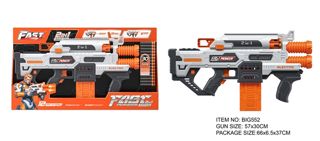
For younger campers, consider the Graffiti Mini Manual Soft Dart Blaster (MOQ 432), the Compact Graffiti Mini Foam Blaster (MOQ 240), or the Graffiti Multi-Port Mini Foam Blaster (MOQ 144). These are manual, lightweight, and easier to supervise. For older groups, the Pump-Action Foam Dart Shotgun Blaster (MOQ 54) or the Belt-Feed Foam Dart Blaster (MOQ 54) offer more engaging play. The Space-Theme Foam Dart Blaster (MOQ 72) fits a camp with a space or science theme. The Electronic Scoring Target and Foam Dart Blaster Set (MOQ 72) adds a scoring element that works well for structured games. The 12-Dart Electric Soft Bullet Blaster (MOQ 50) and 48-Dart Electric Soft Bullet Blaster (MOQ 50) bring electric performance — but remember, any electric blaster must pass the button-cell compartment check from Step 3.
The Tactical 6-Dart Foam Blaster (MOQ 216) and Compact Tactical Foam Blaster (MOQ 288) are higher-MOQ options that suit larger camp networks or distributors serving multiple sites. Material is ABS or ABS/EVA across the catalog, which is standard for foam dart blasters.
What to Watch This Year in US Compliance
If you are sourcing for the US market, check the CPSC's Regulatory Robot as a screening tool, but remember it does not replace the actual rule text or your certification program. For projectile toys specifically, verify compliance with the federal regulations for projectile toys — the December 2024 warning and the July 2024 recall both cite this rule. Also confirm the blaze orange tip on any realistic-looking blaster.
On ASTM F963, note that section 4.2 on flammability is not a mandatory requirement under 16 CFR 1250.2, while other hazardous-substance rules can still apply. Use the actual rule text, not a summary, to map your obligations. The timeline for any new or updated rules is not confirmed from official text unless a specific applicability date is published; check the CPSC website for the current status of any rule affecting projectile toys.
Frequently Asked Questions
What is the first thing I should check before buying blasters for a camp?
Document the supervision model: who authorizes blaster use, the staff-to-child ratio during play, and the designated play area. If the camp cannot document this, stop the sourcing process — no product feature review happens before this gate.
Do I need protective eyewear for foam dart blasters at camp?
Yes. Projectile toys carry an eye injury hazard, and recent CPSC actions on gel blasters and soft bullet toys cite this risk. Determine whether the blaster ships with eyewear or the camp must supply it, and write the rule 'no eyewear, no play' into the program manual.
What should I check on an electric blaster's battery compartment?
Verify screw closure, tool access, and the button-cell warning label. If the compartment opens with fingernails, reject the SKU. This is a physical check on a production sample, not a paperwork check.
Which certificates do I need for blasters shipped to the US, UK, and EU?
For the US, a Children's Product Certificate (CPC) mapped to the specific SKU and lot. For the UK, UKCA. For the EU, a VOC. These are different documents covering different tests — you cannot use one certificate for two markets. Confirm each document covers the exact lot you are buying.
How do I set the AQL for my blaster inspection?
The AQL number comes from the agreed inspection plan attached to your purchase order, not from a catalog description. Define defect classes and the rework/release procedure in the PO, and do not release the order until the plan is attached.
What is the minimum order quantity for camp blasters?
MOQs vary by SKU, from 50 units for electric blasters to 432 units for budget mini blasters. Use the catalog MOQ as a planning reference, but the right order size depends on your camp's headcount, age range, and supervision capacity — not the supplier's minimum.
Sources
Request a Quote
Ready to move past the gates? Get a quote for the SKUs that fit your camp's supervision model and age range. Attach your supervision plan and destination market to the RFQ so the supplier can map the right certificates and inspection plan to your lot.