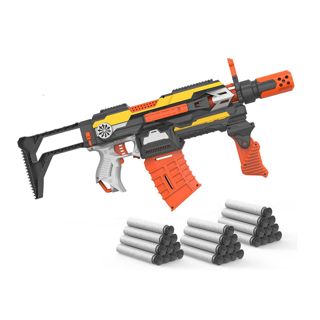

A suction dart does not "stick to anything" — suction performance depends on both tip condition and the target surface, so any surface claim you accept should be tied to a tested production dart on a named surface. That is the single fact that should govern how a wholesale buyer reviews tip material specs, attachment method, intended-use wording, and residue or marking concerns before issuing a PO.
This page covers what can be documented today about suction dart tip materials (including TPE, which can give a rubber-like feel while still being processed as a thermoplastic grade), how tip attachment and small-part status interact with age grading, where migration and appearance checks become configuration-specific, and how to convert all of it into a truthful target-use instruction and a checkable RFQ. The practical outcome: you should be able to state only surface behavior that has been tested with the production dart, and mark everything else as unconfirmed.
What buyers should decide before accepting a suction claim
- Treat "sticks to any smooth surface" as an unverified claim until you hold a test record naming the surface, the tip material, and the production configuration.
- TPE is a material-property choice, not a performance claim: it can deliver a rubber-like feel in grips, seals, or overmolded surfaces while remaining a thermoplastic grade. It does not by itself establish suction, retention, or release behavior.
- Residue, marking, and transfer questions are configuration-specific. Migration testing is material- and use-specific, and different materials, colors, coatings, and age grades can require different extraction conditions, so a single result cannot be generalized across a dart family.
- Color and appearance matching depends on four variables together — resin grade, surface finish, lighting condition, and the approved master sample. A tip that matches in a photo has not been matched.
- Age grading drives both small-part assessment and which testing and documentation route applies; it must be assessed for the actual product configuration, including assemblies, detachable accessories, and packaging components.
Why does a suction dart "stick" to one surface and slide off another?
Because suction is a surface-and-tip interaction, not a property of the dart alone. A tip that seals well on a clean, non-porous, flat panel can fail on a textured wall, a coated shelf, or a dusty window, and the same tip can behave differently again once it has picked up lint, oil, or dust from handling. A single demo video proves very little about a wholesale batch.
The material side of the equation is where most supplier language gets loose. TPE grades can provide a rubber-like feel in grips, seals, or overmolded toy surfaces while still being processed as thermoplastic grades — useful when you want a soft, compliant tip feel without moving to a thermoset rubber process. That statement describes feel and processing, not adhesion. Nothing in it tells you how a dart tip will hold on glass, laminate, painted drywall, or a retail display panel.
Attachment is the second half of the mechanism, and it is also the half buyers most often skip. Whether a tip is press-fitted, overmolded, or mechanically retained changes what happens under repeated impact, what the removable-part risk looks like to a child, and which small-part questions your compliance reviewer will ask. If your supplier cannot state the attachment method per SKU, you do not yet have a specification — you have a sample.
What can be documented about tip materials today — and what cannot
Documentable: material class, resin grade, color, surface finish, the approved master sample, and the RFQ fields you specified. Color matching should use the same resin grade, surface finish, lighting condition, and approved master sample, because appearance changes with all four variables. That gives you a controlled, auditable field rather than an opinion.
Not documentable from a catalog page: tested suction or retention on any named surface, detachment force, residue or marking behavior, and any performance figure. If a listing claims a range, a dart count beyond the catalog name, or a specific attachment strength, ask which production-dart test produced that number. If no test exists, the claim should be removed from your listing copy, not softened.
Residue deserves its own line item because it is the complaint most likely to reach a marketplace review. Migration behavior is material- and use-specific: different toy materials, colors, coatings, and age grades can require different extraction conditions. A passing result on one color of one grade says nothing about a second color, a printed tip, or a different age grade. If residue on walls or glass is a real use case for your channel, that has to be specified as a test request up front.
Which age grade and small-part questions does a suction dart raise?
Age grading and small-part risk are connected and must be assessed for the actual product configuration, according to U.S. CPSC small parts guidance. Assemblies, detachable accessories, and packaging components need the same review discipline as the dart body. A tip that can be pulled off is a different product, from a compliance standpoint, than a tip that cannot.
That has a direct commercial consequence. The U.S. framework ties third-party testing obligations to whether a toy is designed for children 12 or younger; toys for that group generally require testing at a CPSC-accepted laboratory and a Children's Product Certificate. A CPC is product-specific and should not be described as a blanket factory certificate, so the document you review must match the exact SKU, tip material, and age grade you are buying.
Projectile design is a separate thread worth raising with your supplier, because suction darts are projectiles. According to CPSC toy safety guidance, projectile provisions were added to address entry into the mouth, and CPSC enforcement discretion applies kinetic energy density requirements only to projectiles above a stated energy threshold. Whether that provision is in scope for your SKU, and at what measured energy, is a question for your testing lab and your compliance file — not something to assert in marketing copy.
How do EU and US documentation routes differ for a suction dart SKU?
They are separate systems and should never be merged into one line on a spec sheet. In the EU, toy products placed on the market must meet the applicable essential safety requirements, and CE marking and an EU Declaration of Conformity belong to the conformity process and must be matched to the product scope. In the US, the route runs through testing at a CPSC-accepted laboratory and a Children's Product Certificate. A document issued for one market does not satisfy the other.
One more distinction that gets flattened constantly: the General Product Safety Regulation 2023/988 is a separate legal instrument from the Toy Safety Directive. Importer, manufacturer, and product-identification information should be mapped to the relevant market role before publication of any compliance statement — meaning you need to know whether you are acting as importer, distributor, or both for that SKU in that market.
Tracking and marking belong in the same review. According to CPSC tracking label guidance, tracking information should be permanent and support product identification where applicable, and packaging, product markings, and lot control should be reviewed together. For a suction dart, that means the tip material and lot should be traceable to the same production record your test report references — otherwise a report and a shipment can drift apart without anyone noticing.
Which document covers which question for a suction dart SKU
| EU — Toy Safety Directive 2009/48/EC | Region: EU. Covers: essential safety requirements for toys placed on the EU market; CE marking and EU Declaration of Conformity matched to product scope. Proof document: EU Declaration of Conformity plus supporting test reports for the SKU. Check the current consolidated text and product scope before relying on it. |
|---|---|
| EU — General Product Safety Regulation 2023/988 | Region: EU. Covers: general product safety obligations as a separate instrument from the Toy Safety Directive; importer, manufacturer and product-identification mapping to market role. Proof document: role-specific identification and traceability records. |
| US — ASTM F963 as incorporated via 16 CFR Part 1250 | Region: US. Covers: the mandatory toy safety standard for toys for children 12 and under, including clauses for surface coating and small parts. Proof document: test report identifying product configuration, age grade and standard edition. Read the applicable edition from the current regulation before quoting a report. |
| US — Children's Product Certificate (CPC) | Region: US. Covers: certification based on third-party testing at a CPSC-accepted laboratory, citing the applicable rules and responsible parties. Proof document: the CPC itself, product-specific, not a blanket factory certificate. |
| US — Tracking labels | Region: US. Covers: permanent tracking information supporting product identification where applicable. Proof document: label artwork plus lot control records reviewed together with packaging and product markings. |
| Surface behavior on a named surface | Region: any. Covers: suction, retention, release, residue or marking on a specific surface. Proof document: production-dart test records on that named surface. If these do not exist for your SKU, the claim is unconfirmed — varies by spec. |
| Tip attachment method and detachment behavior | Region: any. Covers: press-fit, overmold, adhesive or mechanical retention and what happens under repeated use. Proof document: per-SKU attachment specification plus golden-sample check. Not established by a catalog page. |
How do you write a truthful target-use instruction?
Write only what you tested, and name the surface. "Tested on clean glass and smooth laminate with the production tip" is a usable instruction. "Sticks to any smooth surface" is not, because it silently promises painted drywall, textured tile, and dusty shelving you never evaluated.
Labeling, warnings, and manufacturer markings sit outside third-party testing in the U.S. framework, which means nobody downstream will catch an overreaching use statement for you. The manufacturer remains responsible for accurate warnings — and as the importer or brand owner, so are you. Treat packaging wording and product markings as controlled fields that can change with the SKU, and version them like artwork.
A practical rule for marketplace listings: every surface mentioned in your copy should appear in a test record or be deleted. Where a surface matters commercially but was not tested, say so in the listing or drop the claim. Buyers who skip this step usually discover the gap through returns, not through a lab.
How to choose a suction dart supplier you can hold to a surface claim
Choose the supplier that can answer in specifics before you negotiate price. Supplier qualification should evaluate capability, material control, quality records, compliance evidence, capacity claims, and subcontracting rather than relying on a catalog page. A supplier who cannot name the tip material grade and the attachment method for a given SKU will not be able to support a surface claim either.
Put the claim in the RFQ, not in the follow-up email. A useful toy RFQ states destination market, age grade, materials and colors, packaging language, requested tests, sample policy, tooling terms, and the requested trade term. Those fields are what turn a marketing sentence into something a lab can measure and a contract can enforce.
Then decide by channel. If you sell into classrooms, therapy, or party channels where walls and glass are the real target, require production-dart surface testing on your named surfaces and price the testing into the program. If you sell a mixed assortment where the dart is one of several components, keep the instruction narrow, keep the age grade conservative, and treat any surface statement as a specification to be confirmed rather than a feature to advertise.
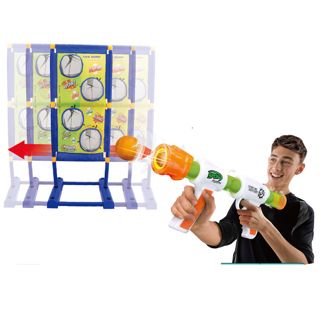
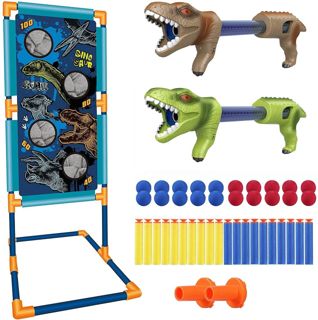
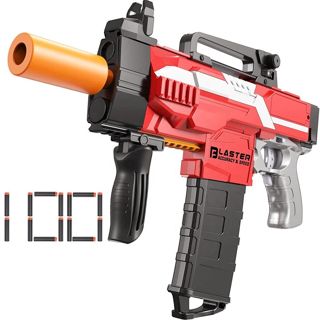
Catalog configurations in this category span ABS, ABS/EVA, EVA, and plastic bodies, with documentation sets that vary by item — EN71, ASTM F963, CPSIA, CPC, PAHs, 10P, and CD appear across the range, but never as a single blanket pack. Verify the certificate set against the exact SKU and the destination market before you quote your own customers.
FAQ
Do wholesale foam blaster suppliers provide EN71, ASTM or CE documents by SKU for US and EU export?
Yes, but only if you ask for documents tied to the exact SKU, age grade, and destination market — not a factory-level pack. In the EU the relevant package is the EU Declaration of Conformity with CE marking matched to product scope; in the US it is a Children's Product Certificate based on testing at a CPSC-accepted laboratory. Treat any general "we have certificates" reply as incomplete until the certificate names the product and the applicable rules.
Can a supplier claim a suction dart sticks to walls, glass, or whiteboards?
Only if that behavior has been tested with the production dart on that named surface. Suction performance depends on both tip condition and the target surface, so a claim without a named surface and a test record is unconfirmed. Write it as a specification to be verified, and delete the surface from your listing copy until the record exists.
Does the tip material alone decide whether a suction dart leaves marks?
No. Migration behavior is material- and use-specific, and different materials, colors, coatings, and age grades can require different extraction conditions. A clean result on one color or grade does not transfer to another. If marking or residue is a real complaint risk in your channel, specify it as a test request in the RFQ and confirm it per color.
What age grade should a suction dart be sold under?
It depends on the actual configuration, because age grading and small-part risk are connected and must be assessed for the product as shipped — including assemblies, detachable accessories, and packaging components. If a tip can be pulled off, the assessment changes. In the US, the age grade also determines whether third-party testing and a CPC apply, so confirm the grade before finalizing packaging.
What should I put in the RFQ to make surface and tip claims checkable?
State destination market, age grade, materials and colors, packaging language, requested tests, sample policy, tooling terms, and the requested trade term. Add the specific surfaces you intend to reference in marketing, and ask for production-dart test records on those surfaces. Those fields give you a document set that can be verified against a shipment instead of a promise.
Is a factory certificate enough to cover a suction dart SKU in both the US and the EU?
No. The US and EU routes are separate, and a CPC is product-specific rather than a blanket factory certificate; an EU Declaration of Conformity is likewise matched to product scope. The General Product Safety Regulation 2023/988 is also a separate instrument from the Toy Safety Directive, so the obligations and identification requirements are not interchangeable between markets.
Sources
Build the specification before the artwork
If you are preparing a suction dart or target-set program for US or EU retail, start with the RFQ fields, the named surfaces, and the document set you will accept. Send your destination market, age grade, tip material requirement, and the surfaces you intend to reference, and the sourcing team can respond with matching configurations and the documentation status per item.