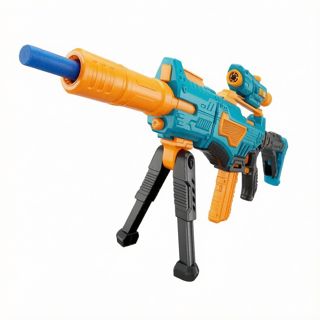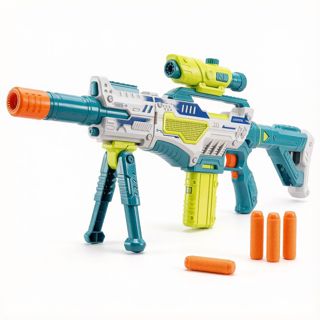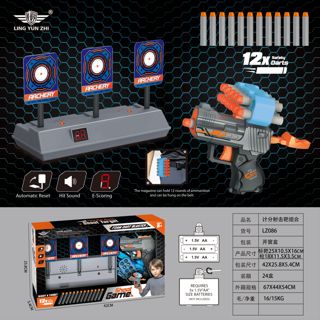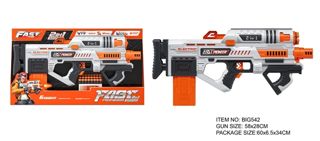
For 2026 bulk orders, shortlist suppliers that combine verified manufacturing credentials, clear MOQ and pricing tiers, and a documented quality-inspection process — then validate each candidate with a first-article inspection and a pilot order before scaling. This guide compares the five supplier types that dominate the market, explains how to evaluate MOQ, lead time, compliance (ASTM F963, EN71, UKCA), and gives you a concrete checklist to vet any supplier for long-term sourcing.
Key Takeaways for Bulk Foam Blaster Sourcing
- Channel mix: Use B2B platforms (Alibaba, Global Sources), trade shows (Canton Fair, Hong Kong Toys & Games Fair), and factory-direct sourcing in Chenghai/Shantou; each channel has different MOQ and risk profiles.
- MOQ expectations: MOQs vary widely: stock models may start at 500–1,000 units, custom OEM runs often require 3,000–5,000+ units per SKU; always confirm MOQ and per-unit pricing tiers in writing.
- Compliance gate: For US sales, ASTM F963 and CPSIA are non-negotiable; for EU, EN71 and the updated Toy Safety Directive apply. Verify certificates match the exact lot and market.
- Inspection rule: Use AQL sampling (ISO 2859-1) with separate limits for critical, major, and minor defects; never skip first-article inspection before mass production.
- Long-term fit: Evaluate tooling ownership, document retention, and change-control procedures; a supplier that maintains sealed golden samples and clear records is built for repeat orders.
Wholesalers vs Distributors: Which Channel Serves Your Bulk Order?
A wholesaler buys directly from manufacturers and sells to retailers or other resellers, typically with a minimum order quantity and lower per-unit pricing. A distributor holds inventory and provides faster fulfillment, regional warehousing, and value-added services like repackaging or marketing support — but at a higher cost per unit.
For foam blasters, you might work with a factory-direct wholesaler (like many in Chenghai, China) for the lowest cost per unit and full customization, or with a regional distributor (like Dart Zone Blasters, which has a wholesale page) for faster restocking and less administrative burden. Choose factory-direct if you need OEM or large volumes; choose a distributor if you need smaller, frequent orders or faster lead times.
How to Find Foam Blaster Suppliers for Bulk Orders
B2B platforms are the first stop. Alibaba and Global Sources list thousands of toy manufacturers, and you can filter by location, verification status, and years in export. Search for “foam blaster manufacturer” and shortlist companies with factory audits (e.g., BSCI, Sedex) and trade assurance.
Trade shows remain a reliable way to meet suppliers in person. The Canton Fair (Guangzhou) and Hong Kong Toys & Games Fair are the two biggest for toys, and most serious foam-blaster factories exhibit there. A face-to-face meeting lets you assess production capacity and negotiate MOQs directly.
Factory-direct sourcing in Chenghai, Shantou is the most direct route for custom foam blasters. Chenghai is the world’s largest toy production cluster, and many factories there specialize in blasters. Use local sourcing agents or visit the cluster to shortlist manufacturers, but always verify their export history and certifications yourself.
Wholesale directories and industry associations (like the Toy Industry Association) also list vetted suppliers. Dart Zone Blasters, for example, has a wholesale page, but note that it discloses no MOQ or pricing publicly, so you must contact them directly.
Supplier Evaluation Matrix for Foam Blaster Bulk Orders
| Manufacturing capability | Check injection molding capacity, assembly lines, and whether they do in-house tooling. Red flag: outsourcing core production without disclosure. |
|---|---|
| MOQ & pricing tiers | Request a tiered price list for 1K, 5K, and 10K units. Red flag: MOQ changes after sample approval or pricing not in writing. |
| Compliance & documentation | Verify ASTM F963, CPSIA, EN71, UKCA certificates match the product and market. Red flag: certificates from a different product or expired. |
| Quality control process | Ask for their QC plan: incoming material inspection, in-line checks, and final AQL inspection. Red flag: no first-article inspection or no sealed golden sample. |
| References & track record | Ask for export records and client references (with permission). Red flag: vague claims about 'big clients' but no verifiable proof. |
| Financial & operational stability | Check business license, years in export, and payment terms. Red flag: insistence on 100% T/T upfront without any assurance. |
How to Evaluate Suppliers for Long-Term Sourcing
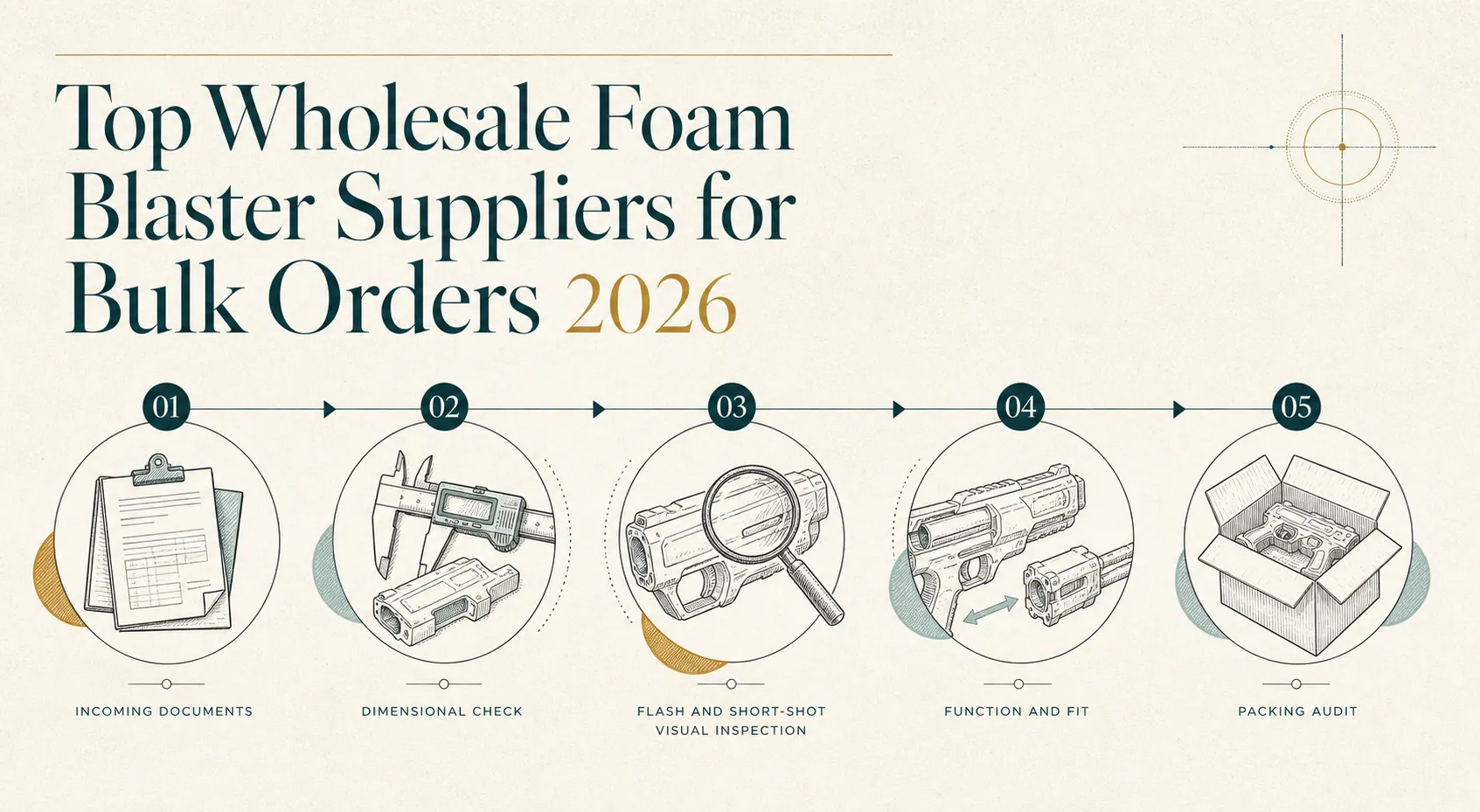
Begin with a first-article inspection. Before mass production, this verifies that the initial parts meet your drawings, material, appearance, and assembly requirements — your gate against a bad batch.
Set clear AQL levels. Use ISO 2859-1 sampling with separate limits for critical, major, and minor defects. For toys, importers commonly set critical defects at 0, major at 1.0 or 1.5, and minor at 2.5 or 4.0 — but confirm these with your supplier and inspection agency.
Demand a sealed golden sample. A physical golden sample on the QC shelf ends color and finish disputes better than dozens of emails. Make sure the supplier keeps one sealed sample for comparison on every lot.
Clarify tooling ownership and storage. If you pay for a custom mold, the contract must define who owns the tool, the storage period, and what happens if the tool sits idle. A tooling policy is a document, not a handshake.
Review document retention. Supplier records for materials, production, inspection, change control, and testing should be retained long enough to support your market and recall obligations. Ask how long they keep records and whether you can access them.
What Compliance Do Foam Blasters Need for 2026?
For the US, foam blasters must meet ASTM F963 and CPSIA requirements, including lead and phthalate limits. For the EU, EN71 applies, and the new Toy Safety Directive 2025/… is being phased in — but the exact application dates are not confirmed in official text. Check the latest status from the European Commission.
If your blaster includes AI features (e.g., smart targeting), it may also fall under Regulation 2024/1689 (the AI Act). Identify any AI function in your product file to determine if additional obligations apply.
For the UK, UKCA marking is required, and a VOC file for an electric bubble machine is different from a UKCA certificate — so map your market, lot, and which certificate covers which test. Paperwork that does not match the lot is not paperwork.
Worked Example: A 10,000-Unit Order with Two Destinations
Worked example (illustrative, not a real shipment): Imagine you order 10,000 foam blasters from a Chenghai factory, split into 6,000 units for the US and 4,000 for the EU. The US lot needs ASTM F963 and CPSIA compliance; the EU lot needs EN71. You require a first-article inspection before production, and a final AQL inspection (Level II, AQL 1.0/2.5) on each lot.
At the final inspection, the inspector finds 200 units with minor paint chips (within AQL 2.5) and 30 units with missing triggers (critical defect, above AQL 0). The critical defects exceed the limit, so the entire lot is rejected until the factory fixes the issue and re-inspects. This illustrates why you must define AQL limits before shipping, not after.
Supplier Evaluation Checklist for Foam Blaster Bulk Orders
Use this checklist when shortlisting any supplier:
1. Confirm manufacturing capability: injection molding machines, assembly lines, and in-house tooling.
2. Request a tiered price list for your expected order volumes, with MOQ clearly stated.
3. Verify compliance certificates match the exact product and destination market.
4. Ask for their QC plan: incoming material inspection, in-line checks, and final AQL inspection.
5. Request client references and export records (with permission).
6. Clarify tooling ownership, storage, and idle-tool policy in the contract.
7. Define document retention periods for materials and test records.
8. Agree on Incoterms with a named place (e.g., FOB Shantou) to avoid freight disputes.
9. Plan a first-article inspection and a pilot order before committing to a full container.
FAQ: Foam Blaster Bulk Sourcing Questions
What is the typical MOQ for custom foam blasters from Chinese factories?
For custom OEM foam blasters, MOQs often range from 3,000 to 5,000 units per SKU, depending on complexity. Stock models may start as low as 500 units. Always confirm the MOQ and per-unit price tiers in writing, as they vary by factory and product.
How do I verify a supplier’s ASTM F963 or EN71 certificates are valid?
Ask for the certificate number and the testing lab, then verify with the lab or a third-party agency. Ensure the certificate covers the exact product model and destination market. A certificate for a different product or expired is a red flag.
What AQL levels should I specify for foam blaster inspection?
Common practice is to set critical defects at 0, major at 1.0 to 1.5, and minor at 2.5 to 4.0, using General Inspection Level II (per ISO 2859-1). Confirm these with your supplier and inspection agency before production.
How can I protect my custom mold investment?
In the contract, clearly define tooling ownership, storage period, and what happens if the tool sits idle. A written tooling policy prevents disputes, as a handshake is not enough.
Is it better to use a factory-direct supplier or a distributor for bulk orders?
Factory-direct suppliers (e.g., in Chenghai) offer lower per-unit costs and full customization, ideal for large volumes. Distributors provide faster fulfillment and local inventory but at a higher cost. Choose factory-direct for OEM or high volume, distributors for small, frequent orders.
What documents should I request from a foam blaster supplier before placing an order?
Request business license, export record, compliance certificates (ASTM F963, EN71, UKCA as applicable), QC plan, and sample inspection reports. Also ask for a first-article inspection report before mass production.
Sources
Request a Quote for Bulk Foam Blasters
Ready to source foam blasters for your next bulk order? Contact us for a quote and let our team help you navigate supplier selection, compliance, and quality control. We offer a range of manual and electric foam blasters with OEM options.